5 Best Optolong L-Extreme Light Pollution Filter Options Compared (2026)
Compare five Optolong light pollution filters, including the L-Extreme, to see which one fits your telescope, camera and urban sky before you buy.
 By Audrey Hayes
Updated November 25, 2026
 By Audrey Hayes
Updated November 2026
Anyone shooting or observing from a city or suburb eventually runs into the same problem: sky glow washes out faint nebulae and galaxies. An optolong l-extreme light pollution filter is one of the more specialized answers, designed to pass the narrow emission lines of certain nebulae while blocking much of the broadband street lighting around them. This list compares five Optolong filters across the lineup, judged on the sky conditions each one is built for, the imaging or visual use it suits, the filter type and bandwidth stated by the manufacturer, and the feedback owners commonly report about fit and performance. Nothing here is based on personal testing.
Our top picks at a glance
- 1TOP CHOICEBest overallOptolong L-Ultimate 2" Dual Bandpass Light Pollution Reduction Imaging FilterView on Amazon
- 2
 TOP CHOICEBest for narrowband emission nebulaeOptolong L-Extreme 7nm Dual Narrowband Filter (H-Alpha and O-III) (2")View on Amazon
- 3
 TOP CHOICEBest for mixed visual and imaging useOptolong 2" L-Enhance Dual Narrowband Light Pollution FilterView on Amazon
- 4
 Best for heavy suburban skiesOptolong 2" L-Pro Light Pollution FilterView on Amazon
- 5
 Best for dual-band imaging on a budget-minded setupNew Optolong Filter 2-inch L-Quad Enhance Filter (L-QEF)View on Amazon
Our Top Picks
Quick Comparison
| Product | Best for | Key feature |
|---|---|---|
| Optolong L-Ultimate 2″ Dual Bandpass Light Pollution Reduction Imaging Filter | Overall imaging in suburban skies | Dual bandpass design for broad light pollution reduction |
| Optolong L-Extreme 7nm Dual Narrowband Filter (H-Alpha and O-III) (2″) | Emission nebulae from light-polluted sites | 7nm dual narrowband passband at H-alpha and O-III |
| Optolong 2″ L-Enhance Dual Narrowband Light Pollution Filter | Visual and imaging use under moderate glow | Dual narrowband H-alpha and H-beta/O-III passbands |
| Optolong 2″ L-Pro Light Pollution Filter | Heavy suburban and urban skies | Broadband light pollution suppression |
| New Optolong Filter 2-inch L-Quad Enhance Filter (L-QEF) | Multi-band emission capture | Quad-band design for targeted emission lines |
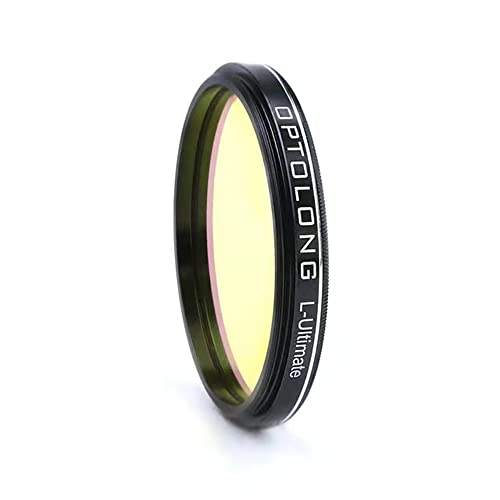
Optolong L-Ultimate 2″ Dual Bandpass Light Pollution Reduction Imaging Filter
Optolong L-Ultimate 2” Dual Bandpass Light Pollution Reduction Imaging Filter
Best for: Overall imaging in suburban skies
This is the most general-purpose filter in the group. It suits imagers who shoot a mix of targets and want one filter that handles typical suburban glow without committing to only emission nebulae. Owners often describe it as a dependable starting point when they are still learning how their sky responds to filtering.
Key specs
- Dual bandpass design, 2-inch format
- Intended for light pollution reduction in imaging
Pros
- Broad applicability across targets and sky brightness levels
- Easy to adopt as a first filter for an imaging setup
- Mounts in standard 2-inch filter cells
Cons
- Less aggressive suppression than the narrowband models in heavy glow
- Not the best fit for purely visual observers under dark skies
Bottom line: A strong pick for imagers who want one filter for mixed targets from a suburban backyard.
View on AmazonOptolong L-Extreme 7nm Dual Narrowband Filter (H-Alpha and O-III) (2″)
Optolong L-Extreme 7nm Dual Narrowband Filter (H-Alpha and O-III) (2")
Best for: Emission nebulae from light-polluted sites
The name specifies a 7nm dual narrowband design targeting H-alpha and O-III. That makes it a natural fit for imagers who chase emission nebulae such as the Rosette, Veil and Pelican-type targets, where the signal lives in a narrow slice of the spectrum that street lights do not occupy.
Key specs
- 7nm dual narrowband passband
- H-alpha and O-III emission lines
- 2-inch format
Pros
- Narrow passband rejects much of the broadband glow
- Well matched to emission-rich targets
- Clearly defined use case in the product name
Cons
- Dims galaxies and reflection nebulae, which lack strong emission lines
- Requires longer exposures than broadband filters on many targets
Bottom line: Choose this if emission nebulae are your main target and your sky is badly light polluted.
View on AmazonOptolong 2″ L-Enhance Dual Narrowband Light Pollution Filter
Optolong 2" L-Enhance Dual Narrowband Light Pollution Filter (H-Alpha and H-Beta/O-III)
Best for: Mixed visual and imaging use under moderate glow
The L-Enhance covers H-alpha and H-beta/O-III passbands, which gives it more coverage of emission lines than a single-band filter. Observers who move between visual sessions and imaging nights often prefer this kind of versatility.
Key specs
- Dual narrowband design
- H-alpha and H-beta/O-III passbands
- 2-inch format
Pros
- Broader emission-line coverage than single-band narrowband filters
- Useful for both eyepiece and camera work
- Compatible with standard 2-inch cells
Cons
- Less contrast gain than the 7nm L-Extreme on strongly emitting targets
- Not designed for dark-sky galaxy work
Bottom line: A sensible middle ground for observers who want emission-line help without committing to one narrow band.
View on AmazonOptolong 2″ L-Pro Light Pollution Filter
Optolong 2" L-Pro Light Pollution Filter
Best for: Heavy suburban and urban skies
The L-Pro is one of the older broadband-style filters in the line. It is aimed at observers and imagers dealing with heavy sky glow who need general suppression rather than narrow emission targeting, and it is often discussed as an accessible entry point.
Key specs
- Broadband light pollution suppression
- 2-inch format
Pros
- Works across a wide range of targets
- Simple to understand and use
- Good match for bright urban skies
Cons
- Lower contrast gain on emission nebulae than narrowband filters
- Can tint or shift color balance in some imaging workflows
Bottom line: Pick this if your sky is very bright and you want broad glow reduction rather than narrowband targeting.
View on AmazonNew Optolong Filter 2-inch L-Quad Enhance Filter (L-QEF)
New Optolong Filter 2-inch L-Quad Enhance Filer Professional L-Quad Enhance Filter (L-QEF)
Best for: Multi-band emission capture
The L-QEF is marketed as a quad-band design, aiming to pass several emission lines at once. It suits imagers who shoot a range of emission targets and want more coverage than a single narrowband filter provides.
Key specs
- Quad-band emission design
- 2-inch format
Pros
- Covers multiple emission lines in one filter
- Flexible across several emission target types
- Designed for camera use with standard 2-inch cells
Cons
- Wider passbands let in more glow than the 7nm L-Extreme
- Owner feedback on color balance varies, so verify with your camera
Bottom line: A good choice for imagers who want multi-line emission coverage and accept some trade-off in glow rejection.
View on AmazonBuying Guide
Passband width and filter type
Broadband filters pass a wide slice of visible light and reduce glow more gently. Narrowband filters pass only a few nanometers around specific emission lines, which cuts more sky glow but also dims everything without emission. Check the stated bandwidth before you buy. A 7nm passband is much narrower than a typical broadband filter.
Good picks for this: Optolong L-Extreme 7nm Dual Narrowband Filter (H-Alpha and O-III) (2″), Optolong L-Ultimate 2″ Dual Bandpass Light Pollution Reduction Imaging Filter
Target type
Emission nebulae respond best to narrowband filters. Galaxies, star clusters and reflection nebulae usually do better with broadband or dual-bandpass designs. If your list is mostly galaxies, a narrowband filter will work against you.
Good picks for this: Optolong L-Ultimate 2″ Dual Bandpass Light Pollution Reduction Imaging Filter, Optolong 2″ L-Enhance Dual Narrowband Light Pollution Filter
Sky brightness
Filters are not magic. In a Bortle 3 or 4 sky, a narrowband filter can be unnecessary and may hurt. In a Bortle 7 or 8 sky, the same filter becomes valuable. Use a light pollution map or Bortle scale reference to estimate your conditions before choosing.
Good picks for this: Optolong 2″ L-Pro Light Pollution Filter, Optolong 2″ L-Enhance Dual Narrowband Light Pollution Filter
Filter size and fit
The filters in this list are listed in 2-inch format. Confirm that your eyepiece, camera adapter or filter wheel uses 2-inch threads or a compatible 2-inch cell. Measure your existing accessories before ordering so you do not end up with a filter that cannot thread on.
Good picks for this: Optolong 2″ L-Pro Light Pollution Filter, New Optolong Filter 2-inch L-Quad Enhance Filter (L-QEF)
Camera compatibility and color balance
Narrowband and multi-band filters can shift color balance, especially on one-shot color cameras. Plan on white balance adjustments or calibration frames. Owners frequently mention needing custom processing steps, so check that your processing workflow can handle it.
Good picks for this: New Optolong Filter 2-inch L-Quad Enhance Filter (L-QEF), Optolong L-Extreme 7nm Dual Narrowband Filter (H-Alpha and O-III) (2″)
Build quality and coatings
Look for multi-layer coatings and a sturdy cell. Coatings determine how much light the filter transmits and how well it rejects unwanted wavelengths. Store filters in a padded case, keep the glass clean, and avoid touching the optical surface.
Good picks for this: Optolong L-Ultimate 2″ Dual Bandpass Light Pollution Reduction Imaging Filter, Optolong 2″ L-Pro Light Pollution Filter
Use case: visual versus imaging
Visual observers see different results than imagers, because the eye does not integrate light the way a camera does. A filter that looks dim at the eyepiece can still produce a usable image after long exposures. Decide which you do most before committing.
Good picks for this: Optolong 2″ L-Enhance Dual Narrowband Light Pollution Filter, Optolong 2″ L-Pro Light Pollution Filter
FAQ
What does an optolong l-extreme light pollution filter actually block?
It is a narrowband design that passes a narrow slice of light around emission lines and rejects much of the broadband glow from street lights and sky brightness outside that slice.
Is a narrowband filter good for galaxies?
Usually not. Galaxies emit mostly continuous light, so a narrowband filter removes much of their signal. Broadband or dual-bandpass filters are generally a better fit.
Do I need a filter if I live in a dark rural site?
Probably not. In very dark skies, a light pollution filter can dim targets more than it helps. Use one only when sky glow is clearly limiting your images or views.
Will these filters work with a one-shot color camera?
Many people use them that way, but color balance can shift. Expect to make white balance adjustments and possibly use calibration frames.
What is the difference between a 2-inch filter and a smaller one?
A 2-inch filter fits a 2-inch cell and is more common for eyepieces and larger camera adapters. Confirm your accessory threads before buying.
How do I know which emission lines my target has?
Emission nebulae commonly emit H-alpha, O-III and H-beta. Planetarium software and target catalogs list the emission lines for many objects.
Should a beginner start with a narrowband or broadband filter?
Beginners often do better with a broadband or dual-bandpass filter because it works across more targets. Move to narrowband once you know which emission targets you want to pursue.
Conclusion
For most suburban imagers, the Optolong L-Ultimate offers the broadest usefulness. If emission nebulae dominate your list and your sky is badly lit, the Optolong L-Extreme 7nm is the most targeted choice in this group. The L-Enhance suits observers who want a middle ground, the L-Pro fits very bright skies where broad suppression matters most, and the L-QEF is worth considering for multi-line emission imaging. Match the filter to your sky brightness and target list, and check color balance with your own camera before committing to a full session.
Sources
- Background on emission lines such as H-alpha and O-III and how they appear in nebulae (nasa.gov)
- Information on light pollution, sky brightness and how urban glow affects observing
- Resources from the American Astronomical Society on astronomical observing and imaging practice
Before you buy: helpful guides
Related reading
- Optolong L Pro Light Pollution Filter (2026): Which Should You Choose?
- Optolong Light Pollution Filter Compared: 6 Best Picks for 2026
- 7 Best Optolong CLS Light Pollution Filters Compared (2026)
- 6 Best Optolong UHC Light Pollution Filter Options Compared (2026)
About Audrey Hayes
Audrey Hayes is part of our editorial team and reviews and edits our telescopes & stargazing guides, checking product details against manufacturer specifications and owner feedback.
About the author
Audrey Hayes writes reviews and buying guides for Astronomy Site.