5 Best Nikon Binoculars for Astronomy: Picks Compared (2026)
Looking for the best Nikon binoculars for astronomy? Compare five models by magnification, aperture, stability and how well they show the night sky.
 By Audrey Hayes
Updated November 12, 2026
 By Audrey Hayes
Updated November 2026
Shopping for the best Nikon binoculars for astronomy usually comes down to one question: which model gives you the most useful view of the night sky without making your arms ache? Nikon makes everything from compact porro-prism glasses to large zoom models, and each one trades off magnification, light-gathering and weight differently. This guide compares five Nikon binoculars against the criteria that matter most for stargazing: aperture for faint deep-sky objects, magnification you can hold steady, field of view for sweeping the Milky Way, and how well each model works with a tripod. Every pick is judged on its published specifications and the patterns owners commonly describe, not on any personal testing.
Our top picks at a glance
- 1TOP CHOICEBest overallNIKON Monarch M5 Binoculars 8×42View on Amazon
- 2
 TOP CHOICEBest for wide-field sky sweepsNikon Monarch M7 10×42 BinocularsView on Amazon
- 3
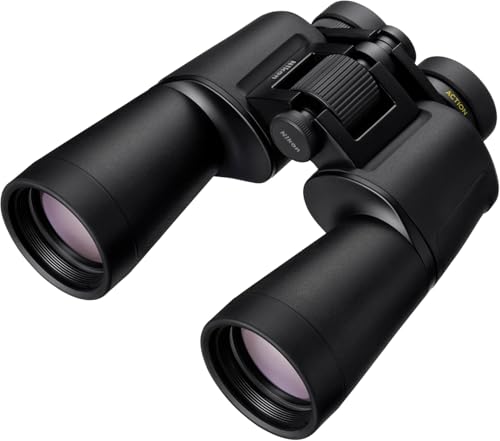 TOP CHOICEBest for tripod-mounted deep-sky viewingNikon ACTION 10×50 BinocularView on Amazon
- 4
 Best for variable magnificationNikon Action Zoom 10-22×50 BinocularView on Amazon
- 5
 Best budget pickNikon Action 7×50 BinocularView on Amazon
Our Top Picks
Quick Comparison
| Product | Best for | Key feature |
|---|---|---|
| NIKON Monarch M5 8×42 | Overall all-round use | Waterproof, fogproof ED glass optics |
| Nikon Monarch M7 10×42 | Wide-field sky sweeps | Wide field of view with locking diopter |
| Nikon ACTION 10×50 | Tripod-mounted deep-sky viewing | 50mm objectives with tripod-ready porro-prism design |
| Nikon Action Zoom 10-22×50 | Variable magnification | Zoom range from 10x to 22x |
| Nikon Action 7×50 | Budget-minded beginners | Wide 7x magnification with bright 50mm lenses |
NIKON Monarch M5 Binoculars 8×42
NIKON Monarch M5 Binoculars | Waterproof Fogproof ED Glass Optics with Dielectric Prism Coating | Bright High-Resolution Outdoor Binoculars for Birdwatching, Hiking & Wildlife, 8×42
Best for: All-round use, from the Moon and star clusters to the brighter Milky Way
This is the most versatile option on the list. It suits someone who wants one pair for stargazing, daytime birding and general outdoor use, and who does not want to carry a tripod.
Key specs
- 8x magnification
- 42mm objective lenses
- Waterproof and fogproof construction
- ED glass optics with dielectric prism coating
Pros
- Handheld stability at 8x is generally easier than at higher powers
- Weather-sealed body suits damp nights and dew
- Bright, high-contrast views across a wide field
Cons
- A 42mm aperture gathers less light than 50mm models for faint galaxies
- Limited reach for planetary detail
Bottom line: The safest first pair for someone who wants both daytime and nighttime use from one set of optics.
View on AmazonNikon Monarch M7 10×42 Binoculars
Nikon Monarch M7 10×42 Binoculars | Official Nikon USA Model | Wide field of view, locking diopter, waterproof, fogproof, ED glass, oil
Best for: Wide-field sky sweeps and looking for star clusters across the Milky Way
Owners who want to scan large regions of sky and enjoy a relaxed, immersive view will find this model appealing. The 10x power is still comfortable to hold for many people, and the wide field of view makes it easier to find targets.
Key specs
- 10x magnification
- 42mm objective lenses
- Wide field of view
- Locking diopter, waterproof and fogproof, ED glass
Pros
- Wide field helps you find and track star fields
- Locking diopter keeps focus set between sessions
- Weather-resistant body for outdoor use
Cons
- Shaky hands will show more at 10x than at 8x
- 42mm aperture is modest for very faint deep-sky objects
Bottom line: A good step up from 8x for stargazers who want more reach but still value a comfortable handheld view.
View on AmazonNikon ACTION 10×50 Binocular
Nikon ACTION10x50 Binocular | Multilayer-Coated Nikon Optics, Bright 50mm Objective Lenses, 10x Power, Turn-and-Slide Adjustable eyecups and Tripod-Ready Porro-Prism Design
Best for: Tripod-mounted deep-sky viewing of galaxies, nebulae and star clusters
This model is aimed at observers who plan to mount their binoculars and spend longer sessions on dim targets. The 50mm objectives gather more light than 42mm models, which helps faint objects stand out.
Key specs
- 10x magnification
- 50mm objective lenses
- Porro-prism design, tripod-ready
- Turn-and-slide adjustable eyecups
Pros
- Bright 50mm objectives show more faint detail
- Tripod-ready design makes steady deep-sky viewing practical
- Adjustable eyecups suit eyeglass wearers
Cons
- Heavier than compact 42mm models
- Needs a tripod to get the most from 10x
Bottom line: Pick this if you are serious about deep-sky work and will use a tripod most nights.
View on AmazonNikon Action Zoom 10-22×50 Binocular
Nikon Action Zoom 10-22×50 Binocular | High-Power Zoom Binoculars with Multilayer-Coated Nikon Optics, Large Objective Lenses and a Tripod-Ready Porro-Prism Design
Best for: Variable magnification for lunar, planetary and star-cluster viewing in one pair
Observers who want to change power on the fly will value the zoom range. It suits people comfortable with a mounted setup, since higher magnifications amplify any movement.
Key specs
- Zoom range 10x to 22x
- 50mm objective lenses
- Multilayer-coated optics
- Tripod-ready porro-prism design
Pros
- Flexible magnification for different targets
- Large objectives keep views bright at higher power
- Tripod-ready for steady high-power viewing
Cons
- Zoom mechanism adds weight and complexity
- Image steadiness at 22x requires a solid tripod
Bottom line: Best for observers who want range from wide sweeps to closer planetary looks, and who will mount the binoculars.
View on AmazonNikon Action 7×50 Binocular
Nikon Action 7×50 Binocular | Multilayer-Coated Nikon Optics, Bright 50mm Objective Lenses, 7X Power, Turn-and-Slide Adjustable eyecups and Tripod-Ready Porro-Prism Design
Best for: Budget-minded beginners who want wide, bright views of the night sky
A 7x power with 50mm lenses is one of the more forgiving combinations for handheld stargazing. The low magnification gives a wide field and a steady image, which suits first-time observers.
Key specs
- 7x magnification
- 50mm objective lenses
- Multilayer-coated Nikon optics
- Turn-and-slide adjustable eyecups
Pros
- Steady handheld image at low power
- Wide field helps with finding targets
- Bright 50mm objectives gather good light
Cons
- Limited magnification for small planetary detail
- Less reach for distant galaxies than 10x models
Bottom line: A sensible starting point for beginners who want to learn the sky without a tripod.
View on AmazonBuying Guide
Aperture and Light-Gathering
The second number in a binocular designation is the objective lens diameter in millimeters. Larger objectives collect more light, which matters most for faint targets like galaxies and nebulae. Many stargazers find 50mm models a useful balance between brightness and weight, while 42mm models are lighter and easier to carry.
Good picks for this: Nikon ACTION 10×50, Nikon Action 7×50
Magnification and Hand Steadiness
Higher magnification brings out more detail but magnifies hand movement. As a general guide, 7x to 10x is comfortable handheld for most people, while anything above that usually needs a tripod or a very steady rest.
Good picks for this: Nikon Monarch M7 10×42, Nikon Monarch M5 8×42
Field of View
A wider field lets you scan star fields and find targets more easily. Lower-power binoculars generally offer a wider apparent field, which helps when you are sweeping the Milky Way.
Good picks for this: Nikon Monarch M7 10×42, Nikon Action 7×50
Tripod Compatibility
If you plan to observe for long periods, check whether the binoculars have a tripod socket or are designed to be tripod-ready. Porro-prism designs with a standard tripod adapter are common in this category. A stable mount makes a large difference at higher magnification.
Good picks for this: Nikon ACTION 10×50, Nikon Action Zoom 10-22×50
Weather Resistance
Dew and humidity are common at night. Look for waterproof and fogproof ratings, which mean the body is sealed and purged with inert gas. Owners frequently mention this feature when they observe in damp conditions.
Good picks for this: NIKON Monarch M5 8×42, Nikon Monarch M7 10×42
Eye Relief and Eyecups
If you wear eyeglasses, adjustable or twist-up eyecups help you see the full field. Turn-and-slide eyecups let you find a comfortable eye position without losing the image edges.
Good picks for this: Nikon ACTION 10×50, Nikon Action 7×50
Weight and Portability
Heavier binoculars are harder to hold steady for long sessions. Consider how far you will carry them. A lighter pair is easier for travel, while a heavier one often pairs better with a tripod.
Good picks for this: Nikon Monarch M5 8×42, Nikon Action 7×50
FAQ
Are Nikon binoculars good for astronomy?
Yes, many Nikon models are used for stargazing. The key is choosing the right magnification and aperture for the targets you want to see, and for steady views, a tripod helps at higher powers.
What magnification is best for stargazing with binoculars?
For handheld use, 7x to 10x is a common range because it balances brightness, field of view and steadiness. Higher magnifications work well when mounted.
Do I need a tripod for astronomy binoculars?
Not always. Lower-power models can be used handheld, but at 10x and above a tripod makes a noticeable difference in image stability and comfort.
What does 50mm mean on binoculars?
It refers to the diameter of the objective lenses. Larger objectives collect more light, which helps reveal faint objects in the night sky.
Are waterproof binoculars necessary for night observing?
They are not required, but waterproof and fogproof construction helps when dew forms or humidity rises, which is common during night sessions.
Can binoculars show planets?
Binoculars can show the Moon in detail, along with the brighter planets as bright points and the largest craters and features on the Moon. Fine planetary detail usually requires a telescope.
Is 8×42 or 10×50 better for astronomy?
It depends on your goals. 8×42 is lighter and easier to hold for general sky viewing, while 10×50 gathers more light and reaches farther but needs steadier support.
Conclusion
The best Nikon binoculars for astronomy depend on how you plan to observe. For an all-round pair that works handheld, the Monarch M5 8×42 is a practical choice. If you want wider sweeps, the Monarch M7 10×42 offers more reach with a comfortable field. For deep-sky work from a tripod, the ACTION 10×50 and the Action Zoom 10-22×50 deliver more light and flexibility. The Action 7×50 is a sensible, forgiving starting point for beginners who want a steady, wide view.
Sources
- Guides to observing the night sky and the features visible with optical aids (nasa.gov)
- Resources on amateur observing and choosing optics for stargazing
- Information on dark-sky viewing and light pollution considerations (nps.gov)
Related reading
- Stabilized Binoculars for Astronomy: 5 Best Picks Compared (2026)
- 9 Best Good Pair of Binoculars for Astronomy (2026)
- 8 Best Tripods for Binoculars Astronomy Buyers Should Consider (2026)
- 7 Best High Powered Binoculars for Astronomy (2026)
- 7 Best Giant Binoculars for Astronomy (2026)
About Audrey Hayes
Audrey Hayes is part of our editorial team and reviews and edits our telescopes & stargazing guides, checking product details against manufacturer specifications and owner feedback.
About the author
Audrey Hayes writes reviews and buying guides for Astronomy Site.