Stabilized Binoculars for Astronomy: 5 Best Picks Compared (2026)
Compare 5 stabilized binoculars for astronomy by magnification, stabilization, and use case. Find the right pair for steady planets, Moon views, and deep-sky ta

 By Garrett Keller
Updated November 2026
Stabilized binoculars for astronomy solve the single biggest frustration of handheld sky viewing: image shake. At 10x or higher, even a steady pair of hands makes the Moon wobble and star clusters blur. Image stabilization uses either a gyroscope-driven optical element or a motor-assisted system to cancel small hand movements, so the view holds still long enough to see detail. This guide compares five models against four criteria: magnification and field of view, stabilization type and reported effectiveness, optical quality and waterproofing, and how well each suits real night-sky targets such as the Moon, bright planets, and open clusters.
Our top picks at a glance If you want more background, see 8 Best Image-Stabilized Binoculars for Astronomy in 2026.
- 1TOP CHOICEBest overallCanon 10×42 L is WP Image Stabilized BinocularsView on Amazon
- 2
 TOP CHOICEBest for high magnificationKite Optics APC Stabilized 16×42 BinocularsView on Amazon
- 3
 TOP CHOICEBest for marine and astronomy useFujinon Techno-Stabi TS-X 14×40 Image Stabilized BinocularsView on Amazon
- 4
 Best for wide-field sweepingCanon 18×50 IS Image Stabilized BinocularsView on Amazon
- 5
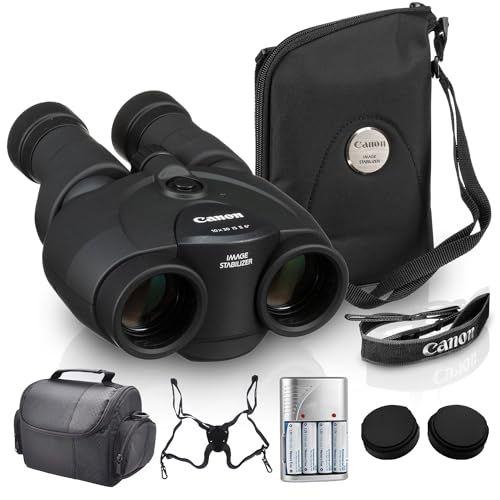 Best budget pickCanon 10×30 IS II Image Stabilized BinocularsView on Amazon
Our Top Picks
Quick Comparison
| Product | Best for | Key feature |
|---|---|---|
| Canon 10×42 L is WP Image Stabilized Binoculars | Overall balance of steadiness and brightness | Waterproof body with 10x optical stabilization |
| Kite Optics APC Stabilized 16×42 Binoculars | Higher magnification planetary and Moon views | 16x magnification with stabilization |
| Fujinon Techno-Stabi TS-X 14×40 Image Stabilized Binoculars | Marine and astronomy use in damp conditions | ±6° stabilization and reverse Porro prism design |
| Canon 18×50 IS Image Stabilized Binoculars | Wide-field viewing with high magnification | 18x magnification with a 50 mm objective |
| Canon 10×30 IS II Image Stabilized Binoculars | Compact, portable sky viewing | Lightweight body with 10x stabilization |
Canon 10×42 L is WP Image Stabilized Binoculars
Canon 10×42 L is WP Image Stabilized Binoculars
Best for: Overall balance of steadiness and brightness
This is a practical first choice for observers who want stabilization without giving up too much brightness or field width. The 10x magnification is a comfortable level for handheld use, and the 42 mm objectives gather enough light for the Moon, star clusters, and the brighter Messier objects under a dark sky.
Key specs:
- 10x magnification
- 42 mm objective diameter
- Optical image stabilization
- Waterproof body
Pros:
- Stabilization makes 10x views feel much calmer than unstabilized binoculars of the same power
- Waterproof construction suits dew-heavy nights
- Balanced weight for extended handheld sessions
Cons:
- Brightness is modest compared with larger-objective models for faint deep-sky work
- Stabilization draws battery power, so spare batteries are worth carrying
Bottom line: Pick this if you want one pair that handles the Moon, planets, and clusters without much compromise.
View on AmazonKite Optics APC Stabilized 16×42 Binoculars
Kite Optics APC Stabilized 16×42 Binoculars – Wide-Angle Stabilized Binoculars for Hunting, Bird Watching, and Long-Range – 16x Magnification, Waterproof, Built for The Outdoors
Best for: Higher magnification planetary and Moon views
Observers who want more magnification from a stabilized handheld pair will find this model appealing. At 16x, the Moon’s crater detail and the disks of Jupiter and Saturn become noticeably larger, though the higher power also magnifies residual motion, which is where stabilization earns its place.
Key specs:
- 16x magnification
- 42 mm objective diameter
- Stabilized design
- Waterproof construction
Pros:
- Higher power than most stabilized 10x models for lunar and planetary detail
- Waterproof body suits outdoor observing
- Stabilization keeps the image usable at high magnification
Cons:
- Narrower field of view makes star hopping harder for beginners
- Exit pupil is small, so dark-sky deep-sky views are dimmer
Bottom line: Best for observers who prioritize lunar and planetary detail over wide-field sweeping.
View on AmazonFujinon Techno-Stabi TS-X 14×40 Image Stabilized Binoculars
Fujinon Techno-Stabi TS-X 14×40 Image Stabilized Binoculars, ±6° Stabilization, Waterproof Marine & Astronomy Optics, Reverse Porro Prism Design (Yellow) (Bundle)
Best for: Marine and astronomy use in damp conditions
This model is designed with marine use in mind, which makes it a sensible choice for observers who spend time near water or in humid, dew-prone locations. The reverse Porro prism layout is traditionally associated with a larger, more robust body and a wide, comfortable view.
Key specs:
- 14x magnification
- 40 mm objective diameter
- ±6° stabilization range
- Reverse Porro prism design
- Waterproof marine-oriented optics
Pros:
- Stabilization range is stated as ±6°, well suited to handheld steadiness
- Marine-grade waterproofing for damp nights
- Reverse Porro design generally offers good image quality
Cons:
- The 40 mm objectives gather less light than 42 mm and larger models
- Heavier body than compact stabilized pairs
Bottom line: A strong choice for observers in humid or coastal conditions who want stabilization built for wet weather.
View on AmazonCanon 18×50 IS Image Stabilized Binoculars
Canon 18×50 IS Image Stabilized Binoculars (4624A002) Bundle | For Wildlife & Outdoor Viewing | Optical Image Stabilization | Includes Harness + More
Best for: Wide-field viewing with high magnification
The 50 mm objectives give this model more light-gathering power than the 42 mm class, which helps when scanning for faint objects. At 18x, it reaches higher magnification while stabilization keeps the view controllable.
Key specs:
- 18x magnification
- 50 mm objective diameter
- Optical image stabilization
Pros:
- Larger objectives collect more light for deep-sky targets
- High magnification with stabilization for lunar detail
- Bundle includes a harness for carrying
Cons:
- Heavier than 30 mm and 42 mm models, which tires the arms during long sessions
- Higher magnification with a 50 mm objective can narrow the usable field
Bottom line: Best for observers who want more light and magnification and are willing to accept extra weight.
View on AmazonCanon 10×30 IS II Image Stabilized Binoculars
Canon 10×30 is II Image Stabilized Binoculars (9525B002) Bundle | For Travel & Birdwatching | 10x Magnification with Optical Image Stabilization | Lightweight Design | Includes Harness + More
Best for: Compact, portable sky viewing
Smaller and lighter than the 42 mm and 50 mm models, this pair suits observers who carry gear to dark sites or want a pair that stays on hand for quick looks. The 30 mm objectives gather less light, so expectations for faint targets should be adjusted.
Key specs:
- 10x magnification
- 30 mm objective diameter
- Optical image stabilization
- Lightweight design
Pros:
- Lightweight body is easy to hold steady and to carry
- Stabilization at 10x delivers calm views of the Moon and bright clusters
- Good entry point into stabilized sky viewing
Cons:
- Smaller objectives gather noticeably less light than 42 mm models
- Exit pupil is small, which can feel dim for deep-sky work
Bottom line: A sensible starting point for beginners who value portability over maximum brightness.
View on AmazonBuying Guide
Stabilization type and effectiveness
Optical stabilization and gyroscopic systems both aim to cancel hand tremor, but manufacturers describe their effectiveness in different ways. Check the stated stabilization range and whether the system runs on batteries. Stabilization is most useful at 10x and above, where unsteady hands are magnified.
Good picks for this: Canon 10×42 L is WP Image Stabilized Binoculars, Fujinon Techno-Stabi TS-X 14×40 Image Stabilized Binoculars
Magnification and field of view
Higher magnification shows more detail on the Moon and planets but narrows the field and magnifies shake. For sweeping star fields and open clusters, 10x to 12x usually gives the best balance. Compare apparent field widths in the specifications before buying.
Good picks for this: Canon 10×30 IS II Image Stabilized Binoculars, Kite Optics APC Stabilized 16×42 Binoculars
Objective diameter and light gathering
The objective lens diameter determines how much light enters the binocular. A 42 mm or 50 mm objective gathers substantially more light than a 30 mm objective, which matters for faint galaxies and nebulae. Larger objectives add weight, so weigh brightness against comfort.
Good picks for this: Canon 18×50 IS Image Stabilized Binoculars, Canon 10×42 L is WP Image Stabilized Binoculars
Weight and handheld comfort
Stabilized binoculars are often heavier than standard models because of the stabilization hardware and batteries. Hold the pair at arm’s length for a minute and notice how it feels. If you plan long sessions, a lighter body reduces fatigue, which in turn reduces unintended movement.
Good picks for this: Canon 10×30 IS II Image Stabilized Binoculars, Canon 10×42 L is WP Image Stabilized Binoculars
Waterproofing and weather resistance
Dew forms quickly on optics during clear nights, and humidity can fog internal surfaces. Waterproof and nitrogen-purged bodies resist fogging and let you observe longer. Look for waterproof ratings stated by the manufacturer rather than assuming protection.
Good picks for this: Fujinon Techno-Stabi TS-X 14×40 Image Stabilized Binoculars, Kite Optics APC Stabilized 16×42 Binoculars
Battery life and power source
Stabilization systems draw power, so check the battery type and the manufacturer’s stated runtime. Carry spare batteries for long sessions, and keep them warm in cold weather, since cold reduces battery output.
Good picks for this: Canon 10×42 L is WP Image Stabilized Binoculars, Canon 18×50 IS Image Stabilized Binoculars
Accessories and mounting
A neck strap or harness spreads weight across the shoulders and helps you hold the binoculars steady. For high magnification, a tripod adapter can be useful even with stabilization, because a fixed mount removes the last of the hand movement.
Good picks for this: Canon 18×50 IS Image Stabilized Binoculars, Canon 10×30 IS II Image Stabilized Binoculars
FAQ
Do stabilized binoculars work for astronomy?
Yes. Stabilization reduces hand shake, which makes it easier to hold the Moon, planets, and star clusters steady in the eyepiece-like view of binoculars. They do not add light, so brightness still depends on objective size.
What magnification is best for stabilized astronomy binoculars?
Most observers find 10x to 12x the most practical for handheld sky viewing, because it offers a wide field and manageable shake. Higher powers such as 15x to 18x show more lunar and planetary detail but require more steadiness.
Are 42 mm or 50 mm objectives better for dark-sky viewing?
Larger objectives gather more light, which helps with faint deep-sky targets. A 42 mm or 50 mm objective will generally show more than a 30 mm pair. The trade-off is added weight.
Do image stabilized binoculars need batteries?
Many stabilized models do, because the stabilization system is powered. Check the battery type and runtime listed by the manufacturer, and carry spares for longer sessions.
Can I use stabilized binoculars with a tripod?
Yes. A tripod adapter removes the remaining hand movement and is especially helpful at higher magnification. Stabilization and a tripod work together, though a tripod limits movement across the sky.
Are stabilized binoculars good for beginners?
They can be. Stabilization makes it easier to find and hold objects, which helps newcomers learn the sky. A 10x model is often a practical starting point before moving to higher powers.
Conclusion
For most observers, the Canon 10×42 L is WP Image Stabilized Binoculars offer the best balance of steadiness, brightness, and weather resistance. If higher magnification for lunar and planetary detail is the priority, the Kite Optics APC Stabilized 16×42 Binoculars are worth considering. The Fujinon Techno-Stabi TS-X 14×40 suits humid or marine conditions, the Canon 18×50 IS favors light-gathering and wide-field viewing, and the Canon 10×30 IS II is the compact choice for portability. Match the pick to where and how you observe, and check each manufacturer’s specifications before buying.
Sources
- Current lunar and planetary observing guides and sky event schedules (nasa.gov)
- Resources on observing techniques and amateur astronomy practice
- Reference information on celestial objects and astronomical terminology
Related reading
- 6 Best Image Stabilized Binoculars for Astronomy (2026)
- What Size Binoculars for Astronomy? A Practical Guide
- Telescope vs Binoculars for Astronomy: Which Should You Choose?
- Orion Resolux 15×70 Waterproof Astronomy Binoculars: A Practical Guide (2026)
- Orion Mini Giant 15×63 Astronomy Binoculars: A Practical Guide (2026)
- Orion Giantview 15×70 Wp Astronomy Binoculars: A Practical Guide (2026)

About Garrett Keller
Garrett writes about telescopes & stargazing. Each guide starts with research into how products are built and what owners report after months of use, and is revised when better options appear.
About the author
Garrett Keller writes reviews and buying guides for Astronomy Site.