6 Best Deep Sky Objects Telescope Picks Compared for 2026
Find the best deep sky objects telescope for your backyard. We compare six models on aperture, mount type, and setup ease to match your viewing goals.
 By Audrey Hayes
Updated November 22, 2026
 By Audrey Hayes
Updated November 2026
Finding the best deep sky objects telescope starts with knowing what you want to see. Galaxies, star clusters, and nebulae are faint, spread out, and far more rewarding when your scope has enough light-gathering power and a mount that keeps targets centered. This guide compares six telescopes by aperture, mount type, computerized navigation, and how well each suits beginners versus observers who want to push deeper. Each pick is evaluated on specifications, brand reputation, and patterns in owner feedback. None of these picks were tested by our team.
Our top picks at a glance
- 1TOP CHOICEBest overallCelestron NexStar 8SE Computerized Telescope – Schmidt-CassegrainView on Amazon
- 2
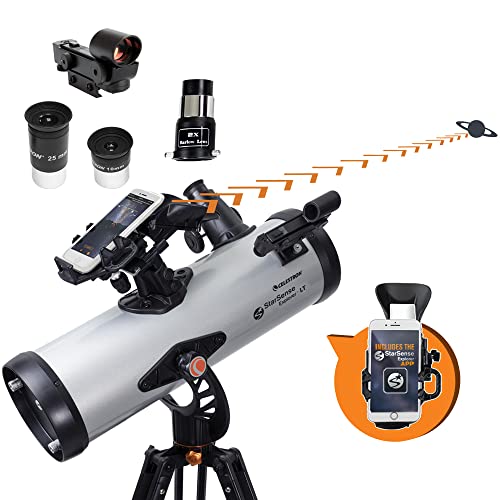 TOP CHOICEBest for beginners who want push-to simplicityCelestron StarSense Explorer LT 114AZ Newtonian Smartphone Guided TelescopeView on Amazon
- 3
 TOP CHOICEBest for a first telescope on a budgetCelestron AstroMaster 130EQ Telescope for Deep-Sky BeginnersView on Amazon
- 4
 Best for portable light bucketsSky-Watcher Heritage 150 Tabletop Dobsonian TelescopeView on Amazon
- 5
 Best for serious large-aperture deep-sky workCelestron CGEM II 11" Schmidt-Cassegrain Telescope with GoTo EQ MountView on Amazon
- 6
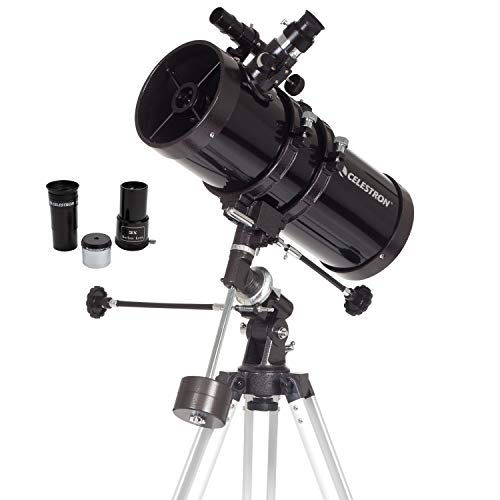 Best for simple equatorial trackingCelestron PowerSeeker 127EQ Reflector Telescope for Home AstronomyView on Amazon
Our Top Picks
Quick Comparison
| Product | Best for | Key feature |
|---|---|---|
| Celestron NexStar 8SE Computerized Telescope | Overall deep-sky performance | Automated GoTo mount with SkyAlign |
| Celestron StarSense Explorer LT 114AZ | Beginners who want guided setup | Smartphone app sky navigation |
| Celestron AstroMaster 130EQ | A first telescope on a budget | 130mm optics on a German equatorial mount |
| Sky-Watcher Heritage 150 Tabletop Dobsonian | Portable light gathering | 150mm Dobsonian with easy setup |
| Celestron CGEM II 11″ Schmidt-Cassegrain | Large-aperture deep-sky work | 11-inch aperture with precision GoTo mount |
| Celestron PowerSeeker 127EQ | Simple equatorial tracking | 127mm reflector with slow-motion controls |
Celestron NexStar 8SE Computerized Telescope – Schmidt-Cassegrain
Celestron NexStar 8SE Computerized Telescope – Schmidt-Cassegrain | Fully Automated GoTo Mount with SkyAlign, Large 8" SCT Optics, Visual & Astroimaging Ready, Deep-Sky & Planets, 40k+ Objects
Best for: Overall deep-sky performance with minimal manual star-hopping
This is a strong fit for observers who want a large-aperture scope that can find thousands of objects automatically. It suits people who plan to image as well as observe, since the optical tube and mount are commonly used with cameras.
Key specs
- 8-inch Schmidt-Cassegrain optical tube
- Fully automated GoTo mount with SkyAlign alignment
- Catalog of more than 40,000 objects
Pros
- Large aperture gathers substantially more light than small refractors
- GoTo mount locates deep-sky targets quickly once aligned
- Works well for both visual observing and astrophotography
Cons
- Heavier to transport than tabletop scopes
- Alignment and power setup take some learning
Bottom line: The best choice for a dedicated observer who wants automated access to deep-sky objects and room to grow into imaging.
View on AmazonCelestron StarSense Explorer LT 114AZ Newtonian Smartphone Guided Telescope
Celestron StarSense Explorer LT 114AZ Newtonian Smartphone Guided Telescope | Smartphone App Sky Navigation, Manual Reflector Telescope, Beginner Deep-Sky Telescope, Bright Celestial Views, Portable
Best for: Beginners who want guided setup with a phone app
Newcomers who are intimidated by star charts will appreciate the smartphone-guided alignment. It is a good match for casual backyard sessions rather than hunting faint galaxies from light-polluted suburbs.
Key specs
- 114mm Newtonian reflector optics
- Smartphone app sky navigation
- Altazimuth mount
Pros
- Phone app makes locating targets approachable
- Compact enough for quick outdoor sessions
- Good starting point for learning the sky
Cons
- Smaller aperture limits faint deep-sky detail
- Relies on a phone for its guided features
Bottom line: A friendly entry point for someone who wants to start viewing bright deep-sky targets without memorizing the sky.
View on AmazonCelestron AstroMaster 130EQ Telescope for Deep-Sky Beginners
Celestron AstroMaster 130EQ Telescope for Deep-Sky Beginners | Large 130mm Optics, Bright Moon & Deep-Sky Views, Perfect First Telescope, German Equatorial Mount with Easy Manual Controls
Best for: A first telescope on a budget
This scope suits buyers who want a larger 130mm aperture without paying for computerized features. It works well for learning equatorial mounting and manual star-hopping.
Key specs
- 130mm reflector optics
- German equatorial mount with manual slow-motion controls
Pros
- Large aperture for its class
- Equatorial mount teaches sky navigation
- Simple to set up and use
Cons
- Manual finding takes practice
- Mount can feel less stable at high magnification
Bottom line: A sensible first telescope for a patient beginner who wants to learn the sky by hand.
View on AmazonSky-Watcher Heritage 150 Tabletop Dobsonian Telescope
Sky-Watcher Heritage 150 Tabletop Dobsonian Telescope – Perfect for Beginners, Easy Setup, Portable, and Fun (S11710)
Best for: Portable light gathering
Dobsonian designs are built around light-gathering power on a simple altitude-azimuth base. This model is for observers who want a 150mm mirror that fits on a table and can travel to darker sites.
Key specs
- 150mm Newtonian Dobsonian optics
- Tabletop altitude-azimuth base
Pros
- Large aperture for the size of the tube
- Easy setup in minutes
- Portable enough for car trips to dark skies
Cons
- No tracking, so objects drift out of view
- Requires manual star-hopping
Bottom line: Ideal for observers who want maximum aperture per dollar of portability and don’t mind pushing the scope by hand. For another angle, check out Deep Sky Telescope Camera Picks: 7 Best Options Compared for 2026.
View on AmazonCelestron CGEM II 11″ Schmidt-Cassegrain Telescope with GoTo EQ Mount
Celestron CGEM II 11" Schmidt-Cassegrain Telescope with GoTo EQ Mount | Outstanding Light Gathering, Sharp Planetary & Deep-Sky Views, Precision GoTo Equatorial Mount, Visual & Astroimaging Ready
Best for: Serious large-aperture deep-sky work
An 11-inch aperture collects far more light than smaller scopes, which matters for faint galaxies and nebulae. This is intended for experienced observers with a permanent or semi-permanent setup.
Key specs
- 11-inch Schmidt-Cassegrain optical tube
- GoTo equatorial mount with precision tracking
Pros
- Excellent light gathering for faint deep-sky targets
- Equatorial tracking keeps objects centered
- Strong option for visual observing and imaging
Cons
- Heavy and bulky to move
- Requires careful setup and balancing
Bottom line: The right pick for a committed observer with a dedicated observing spot who wants the most deep-sky detail in this list.
View on AmazonCelestron PowerSeeker 127EQ Reflector Telescope for Home Astronomy
Celestron PowerSeeker 127EQ Reflector Telescope for Home Astronomy | German Equatorial Mount, Bright Views of the Moon, Planets & Deep Sky, Slow-Motion Controls, Stable Tripod, Easy to Use
Best for: Simple equatorial tracking
This reflector suits someone who wants equatorial tracking with a stable tripod and straightforward controls. It is a practical middle ground between a basic tabletop scope and a computerized model.
Key specs
- 127mm reflector optics
- German equatorial mount with slow-motion controls
Pros
- Equatorial mount tracks targets more smoothly than alt-azimuth
- Stable tripod reduces wobble
- Easy controls for beginners
Cons
- Manual finding requires star-hopping skills
- Aperture is modest for very faint galaxies
Bottom line: A good all-round choice for a home observer who wants tracking without paying for full automation.
View on AmazonBuying Guide
Aperture and light-gathering power
Aperture is the single most important factor for deep-sky viewing. Larger mirrors or lenses collect more light, which reveals fainter galaxies and nebulae. Doubling the diameter gives roughly four times the light-gathering area, so an 8-inch scope shows far more than a 4-inch one under the same sky.
Good picks for this: Celestron NexStar 8SE Computerized Telescope, Celestron CGEM II 11″ Schmidt-Cassegrain
Mount type: alt-azimuth versus equatorial
Alt-azimuth mounts move up-down and left-right, which is simple but causes objects to rotate in the eyepiece. Equatorial mounts align with Earth’s rotation axis and let you track objects with one motion. Dobsonians are a popular alt-azimuth design that trades tracking for stability and aperture.
Good picks for this: Celestron PowerSeeker 127EQ Reflector Telescope, Sky-Watcher Heritage 150 Tabletop Dobsonian Telescope
Computerized GoTo and navigation
GoTo mounts find targets automatically after alignment, which helps when there are thousands of faint objects to locate. Smartphone-guided systems offer a middle path for beginners who want help without a fully motorized mount.
Good picks for this: Celestron StarSense Explorer LT 114AZ Newtonian Smartphone Guided Telescope, Celestron NexStar 8SE Computerized Telescope
Optical design: reflector, refractor, or catadioptric
Reflectors use a curved mirror and are typically the most aperture for the money. Schmidt-Cassegrain designs fold the light path, producing a compact long-focal-length tube. Each design has trade-offs in weight, cooling time, and maintenance.
Good picks for this: Celestron AstroMaster 130EQ Telescope for Deep-Sky Beginners, Celestron CGEM II 11″ Schmidt-Cassegrain Telescope
Size and portability
A scope you can carry to a dark site gets used more often. Tabletop Dobsonians and small refractors are easy to transport, while 8-inch and larger scopes usually need a car and a stable spot to set up. Consider how far you will travel and how often.
Good picks for this: Sky-Watcher Heritage 150 Tabletop Dobsonian Telescope, Celestron StarSense Explorer LT 114AZ Newtonian Smartphone Guided Telescope
Stability and tripod quality
Vibration ruins views at high magnification. Look for a sturdy tripod, adequate spreader bars, and a mount that doesn’t flex under the weight of the optical tube. Heavier scopes generally need heavier mounts.
Good picks for this: Celestron PowerSeeker 127EQ Reflector Telescope, Celestron AstroMaster 130EQ Telescope
Care, collimation, and maintenance
Reflector telescopes need occasional collimation, which is aligning the mirrors. Schmidt-Cassegrain tubes need dew control and careful cleaning of the corrector plate. Plan for routine care so the optics keep performing well.
Good picks for this: Sky-Watcher Heritage 150 Tabletop Dobsonian Telescope, Celestron NexStar 8SE Computerized Telescope
FAQ
What aperture do I need to see deep-sky objects?
Many bright galaxies, star clusters, and the Orion Nebula are visible in small scopes, but faint galaxies and detailed nebulae benefit from 6 inches or more. Dark skies matter as much as aperture.
Is a GoTo telescope better for beginners?
GoTo can help you find objects faster, but it requires alignment and a power source. Beginners who want to learn the sky may prefer a manual scope or a smartphone-guided model first.
Do I need a tracking mount for deep-sky viewing?
Tracking is helpful at high magnification because objects drift out of view quickly. Low-power viewing with a Dobsonian works well without tracking, especially for wide star fields.
Can I use these telescopes for astrophotography?
Some models, particularly larger Schmidt-Cassegrain scopes with equatorial mounts, are commonly used for imaging. Smaller reflectors can capture the Moon and bright objects, but deep-sky imaging needs precise tracking and a camera.
Where should I observe deep-sky objects?
Dark sky sites, away from city lights, show far more faint detail. Light pollution reduces contrast, so even a large telescope will look dim in a bright suburb.
How long does setup take?
Tabletop Dobsonians can be ready in minutes. Equatorial and GoTo systems typically take longer, especially the first time you align the mount.
Conclusion
For the best deep sky objects telescope experience, match aperture and mount to your goals. The Celestron NexStar 8SE suits observers who want automated access to many targets, while the Celestron CGEM II 11″ serves experienced observers chasing faint detail. Beginners seeking a gentle start may prefer the StarSense Explorer LT or AstroMaster 130EQ. The Sky-Watcher Heritage 150 suits portable light gathering, and the PowerSeeker 127EQ offers simple tracking on a stable tripod.
Sources
- Background on deep-sky objects, galaxies, and nebulae for beginners (nasa.gov)
- Guidance on dark-sky preservation and why dark sites improve deep-sky viewing (nps.gov)
- Resources from the American Astronomical Society on telescopes and observing
Related reading
- 7 Best Telescope Eyepieces for Deep Sky Objects (2026)
- 6 Best Telescopes for Viewing Deep Sky Objects: Picks Compared
- 7 Best Telescopes for Deep Sky Viewing: Best Picks Compared for 2026
- 7 Best Telescopes for Deep Sky Viewing Compared for 2026
About Audrey Hayes
Audrey Hayes is part of our editorial team and reviews and edits our telescopes & stargazing guides, checking product details against manufacturer specifications and owner feedback.
About the author
Audrey Hayes writes reviews and buying guides for Astronomy Site.