4 Best 12×60 Binoculars for Astronomy Compared (2026)
Compare 12x60 binoculars for astronomy: four picks with key specs, pros, cons and who each one suits, so you can choose the right pair for stargazing.
 By Audrey Hayes
Updated November 11, 2026
 By Audrey Hayes
Updated November 2026
Shopping for 12×60 binoculars for astronomy comes down to a few trade-offs: magnification versus steadiness, aperture versus weight, and how much sky you need to see at once. This list compares four pairs against those criteria, with notes on what each one is likely to show you under a dark sky. Everything here is based on manufacturer specifications, brand reputation and patterns in owner feedback. None of these pairs has been tested in our hands, so treat the details as a guide and check the current listing before you buy.
Our top picks at a glance
- 1TOP CHOICEBest overallBushnell PowerView 2 12×50View on Amazon
- 2
 Best for a wide sky viewBushnell Falcon 10×50View on Amazon
- 3
 Best for deep-sky viewingCelestron SkyMaster 20×80View on Amazon
- 4
 Best budget pick for stargazing20×50 High Powered Binoculars for AdultsView on Amazon
Our Top Picks
The table below gives a fast side-by-side view. Each product is then covered in more detail.
| Product | Best for | Key feature |
|---|---|---|
| Bushnell PowerView 2 12×50 | General stargazing and a balance of magnification and handling | Multi-coated lenses and a durable aluminum alloy chassis |
| 20×50 High Powered Binoculars for Adults | Budget-minded beginners who want high magnification | Waterproof build with low-light vision claims |
| Bushnell Falcon 10×50 | Wide-field sweeping of the Milky Way and star clusters | Wide-angle optics with fold-down eyecups |
| Celestron SkyMaster 20×80 | Deep-sky objects from a fixed or tripod-mounted position | 80mm objectives for maximum light gathering |
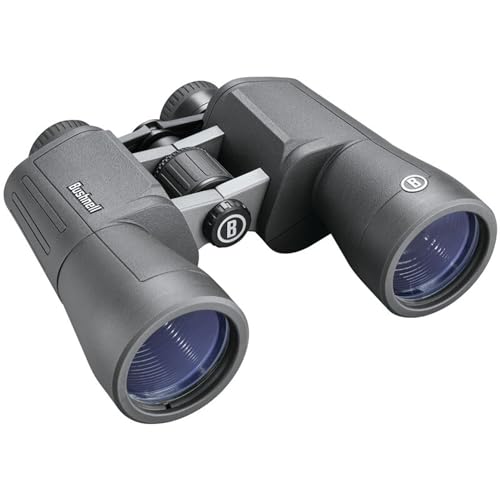
Bushnell PowerView 2 12×50
Bushnell PowerView 2 Binoculars_12x50_PWV1250 Grey | High-Definition with Multi-Coated Lenses, Durable Aluminum Alloy Chassis, Wide Field of View
Best for: General stargazing with a good balance of magnification and handling.
This is a sensible first pair for someone who wants more magnification than a standard 10x binocular but does not want to commit to a heavy, tripod-dependent instrument. The 12x power is enough to pull out star clusters and show the mottled texture of the Moon, while a 50mm objective keeps the pair reasonably light.
Key specs:
- Magnification: 12x
- Objective lens diameter: 50mm
- Multi-coated lenses
- Aluminum alloy chassis
Pros:
- Multi-coated optics help with light transmission and contrast.
- Durable aluminum chassis is well suited to outdoor use.
- Wide field of view makes it easier to find and track objects.
Cons:
- A 50mm objective gathers less light than larger models, so faint deep-sky objects will be dimmer.
- At 12x, hand-held views will show some shake, so a tripod or steady rest helps.
Bottom line: A good pick for beginners who want a versatile pair for the Moon, bright planets and open clusters without a large investment in mounting gear.
View on Amazon20×50 High Powered Binoculars for Adults
20×50 High Powered Binoculars for Adults, Waterproof Compact Binoculars with Low Light Vision for Bird Watching Hunting Camping Travel Cruise Hiking Sports Stargazing, Christmas Birthday Gifts for Men
Best for: Budget-minded beginners who want high magnification.
This pair is aimed at buyers who want a lot of magnification for the price of an entry-level binocular. Its listing emphasizes multipurpose use, including stargazing, so it fits people who plan to use it for wildlife, travel and sky viewing alike.
Key specs:
- Magnification: 20x
- Objective lens diameter: 50mm
- Waterproof construction (per listing)
Pros:
- High magnification for close-up lunar and planetary views.
- Listed as waterproof, which is useful for outdoor nights.
- Versatile enough for daytime and nighttime use.
Cons:
- At 20x with a 50mm objective, the exit pupil is small, so dim objects are harder to see and the image shakes more.
- A tripod is almost essential for steady viewing at this power.
Bottom line: Best for shoppers who want strong magnification on a budget and are willing to use a tripod for serious observing.
View on AmazonBushnell Falcon 10×50
Bushnell Falcon 10×50 Wide-Angle Binoculars | Porro Prism, InstaFocus, BK7, Fold-Down Eyecups, Non-Slip Grip
Best for: Wide-field sweeping of the Milky Way and star clusters.
This is a classic porro-prism design that trades some magnification for a wide, comfortable field. It suits people who want to scan large areas of sky, find constellations and enjoy the Milky Way rather than chase tiny detail on individual planets.
Key specs:
- Magnification: 10x
- Objective lens diameter: 50mm
- Porro prism design with BK7 glass (per listing)
- Fold-down eyecups and non-slip grip
Pros:
- Wide field of view is well suited to sweeping star fields.
- Steadier hand-held views than 12x or 20x models.
- Fold-down eyecups are convenient for eyeglass wearers.
Cons:
- 10x is less magnification than the 12x models here, so planetary detail is more limited.
- The 50mm objective gathers less light than the 80mm SkyMaster.
Bottom line: A good choice if your priority is steady, wide views of the sky over high power.
View on AmazonCelestron SkyMaster 20×80
Celestron SkyMaster 20×80 Binoculars for Deep-Sky Astronomy – 80mm Aperture | Large 80mm Objectives, Bright Deep-Sky Views, Multi-Coated BaK-4 Optics,Tripod Adaptable, Ultra-Stable Mounting
Best for: Deep-sky objects from a fixed or tripod-mounted position.
This is the heaviest and most light-gathering pair on the list. It is designed for observers who want to see faint nebulae, galaxies and dense star fields, and who are willing to set up a tripod and sit or stand at the eyepieces for long sessions.
Key specs:
- Magnification: 20x
- Objective lens diameter: 80mm
- Multi-coated BaK-4 optics (per listing)
- Tripod adaptable
Pros:
- 80mm objectives gather substantially more light than 50mm models.
- Tripod adaptability improves steadiness at high power.
- Well regarded among astronomy beginners for deep-sky viewing.
Cons:
- Considerable weight makes it impractical to hold steady by hand.
- Requires a tripod and mount, which adds to the total setup cost and effort.
Bottom line: The right choice for observers who prioritize faint deep-sky targets and will mount their binoculars on a tripod.
View on AmazonBuying Guide
Magnification versus steadiness
At 12x, a binocular magnifies the sky twelve times. That is enough to separate close double stars and bring out lunar craters, but every degree of hand movement is also magnified. As magnification climbs, a tripod or a steady rest becomes almost mandatory for comfortable viewing.
Good picks for this: Bushnell PowerView 2 12×50, 20×50 High Powered Binoculars for Adults
Objective size and light gathering
The objective diameter, the front lens size, determines how much light the binocular collects. A 50mm objective is a practical balance for hand-held use, while 80mm objectives collect considerably more light for faint deep-sky targets. More light means brighter, more contrasty views of dim objects.
Good picks for this: Celestron SkyMaster 20×80, Bushnell Falcon 10×50
Exit pupil
Divide the objective diameter by the magnification to get the exit pupil, the diameter of the light beam leaving the eyepiece. For 12×50 the exit pupil is about 4.2mm, which suits dark-adapted eyes well. For 20×50 it drops to about 2.5mm, which can make dim views harder to see. Aim for an exit pupil of roughly 3–5mm for general astronomy.
Good picks for this: Bushnell PowerView 2 12×50, Celestron SkyMaster 20×80
Field of view
A wider field lets you scan the sky and keep objects in view. Lower-power binoculars generally have wider fields, which makes them easier for finding constellations and sweeping the Milky Way. Higher-power models narrow the field, so locating targets takes more practice.
Good picks for this: Bushnell Falcon 10×50, Bushnell PowerView 2 12×50
Weight and portability
Weight matters more than most buyers expect. A heavier pair is harder to hold steady and tiring over long sessions. Consider how far you will carry the binoculars and whether you plan to use a tripod. Lighter pairs suit travel; heavier pairs suit fixed observing positions.
Good picks for this: Bushnell PowerView 2 12×50, Bushnell Falcon 10×50
Build quality and weather resistance
Look for an aluminum or reinforced body, multi-coated lenses and, if you observe outdoors in damp conditions, a waterproof or water-resistant rating. Owners often report that sturdy chassis and secure focus mechanisms hold up better over time, especially in cold weather.
Good picks for this: Bushnell PowerView 2 12×50, 20×50 High Powered Binoculars for Adults
Mounting and tripod compatibility
For 20x and above, or for large 80mm objectives, a tripod adapter is worth checking. A stable mount reduces fatigue and lets you observe faint targets for longer. Confirm that the binocular has a standard tripod socket or adapter before you buy.
Good picks for this: Celestron SkyMaster 20×80, 20×50 High Powered Binoculars for Adults
FAQ
Are 12×60 binoculars good for astronomy?
They can be useful for the Moon, bright planets, star clusters and the Milky Way. The 60mm objective gathers more light than a 50mm model, which helps with fainter objects. Steadiness at 12x is still a consideration, so a tripod improves results.
Can I see planets with 12x binoculars?
Yes, you can see Jupiter’s largest moons and Saturn as a slightly elongated shape, and the Moon’s major features are clear. Fine planetary detail, such as cloud bands, usually needs a telescope.
Do I need a tripod for 12×60 binoculars?
Not always, but a tripod makes viewing noticeably more comfortable and stable, especially for faint objects and long sessions. Many observers find hand-held viewing at 12x workable for brief sessions.
What is a good exit pupil for astronomy binoculars?
A range of about 3–5mm works well for most astronomy, because it matches the dark-adapted pupil. Calculate it by dividing the objective diameter by the magnification.
Is 12x better than 10x for stargazing?
12x shows more detail and brighter contrast on small targets, while 10x gives a wider field and steadier hand-held views. The better choice depends on whether you prioritize detail or sweeping the sky.
Should I buy a waterproof pair?
If you observe outdoors in dew, humidity or light rain, a waterproof or water-resistant body protects the optics and seals. It is a useful feature for regular night use.
Conclusion
For a balanced all-round pair, the Bushnell PowerView 2 12×50 is the most sensible starting point. Buyers who want a wide sky view should look at the Bushnell Falcon 10×50, while observers chasing faint deep-sky objects will benefit from the Celestron SkyMaster 20×80 on a tripod. The 20×50 High Powered Binoculars for Adults suit budget-minded shoppers who accept a tripod requirement in exchange for high magnification. Match the pick to how you plan to observe, not just to the magnification number.
For more background on choosing the right size, see What Size Binoculars for Astronomy? A Practical Guide and Telescope vs Binoculars for Astronomy: Which Should You Choose?. If you want wider options, 9 Best Good Pair of Binoculars for Astronomy (2026) and 7 Best Giant Binoculars for Astronomy (2026) cover additional models. For steadier hand-held viewing, see 6 Best Image Stabilized Binoculars for Astronomy (2026).
Sources
- Background on the Moon, planets and night-sky observing for beginners (nasa.gov)
- Guidance on amateur observing practice and sky-viewing resources
- Reference information on astronomical objects and their naming
About Audrey Hayes
Audrey Hayes is part of our editorial team and reviews and edits our telescopes & stargazing guides, checking product details against manufacturer specifications and owner feedback.
About the author
Audrey Hayes writes reviews and buying guides for Astronomy Site.