Computerized German Equatorial Mount (2026): Pros, Cons & Verdict
Is the Celestron Advanced VX computerized German equatorial mount right for you? See specs, pros, cons, alternatives and who should buy it before you decide.
 By Colin Foster
Updated November 23, 2026
 By Colin Foster
Updated November 2026
The Celestron Advanced VX is a computerized German equatorial mount aimed at observers who want GoTo pointing and automated tracking without stepping up to a heavier, more expensive platform. It suits beginners moving past a manual alt-azimuth mount, intermediate visual observers with a mid-sized scope, and imagers working with modest focal lengths and short-to-medium exposures. It is a weaker choice for anyone planning to carry a large refractor or heavy Newtonian, for observers who need a fully portable setup that fits in a small car trunk, or for imagers chasing long unguided exposures with big glass. Those buyers should look at heavier-duty mounts instead.
Celestron Advanced VX Computerized German Equatorial Mount – 30lb Payload | Ideal Beginner EQ Setup, Precision GoTo Tracking, NexStar+ Hand Control, Perfect for Imaging or Advanced Visual Astronomy
Product Overview
The Advanced VX is Celestron’s mid-range German equatorial mount in the company’s Advanced series. It combines a computerized hand control with GoTo slewing, an onboard object database, and an equatorial tracking drive. Its design follows the classic German equatorial layout: a polar axis aligned with the celestial pole, a declination axis that carries the optical tube, and counterweights on a shaft that balance the load on the opposite side of the mount head. This arrangement lets the mount track a target across the sky in right ascension with a single motor, which is the core requirement for long visual sessions and for photographing deep-sky objects.
The mount is marketed for a payload of roughly 30 pounds, which refers to the combined weight of the optical tube, eyepieces or camera, and accessories the manufacturer considers safe for the mount. In practice, payload ratings assume good balance and a stable setup, and many users find that a scope near the upper end of the rating is harder to keep steady in wind. The included NexStar+ hand control handles alignment routines, object selection and tracking-rate adjustments. Owners generally describe the hand control as the part of the system they interact with most, so its menu logic and button layout matter as much as the motors themselves.
The Advanced VX is sold as a complete mount head with a tripod in many configurations, so buyers should check whether their listing includes the tripod and counterweights before ordering. Setup is a multi-step process: level the tripod, install the mount head, attach the counterweight shaft, balance the optical tube, and then run a polar alignment and a star alignment inside the hand control. Each of these steps is covered in the setup guides linked later in this article.
Key Features & Specifications
The table below lists the specifications Celestron and the product listing state, along with the features that the listing name itself identifies. Where a detail is not confirmed by the listing, it is left out rather than estimated.
| Feature | Details |
|---|---|
| Mount type | Computerized German equatorial |
| Rated payload | About 30 lb (per listing) |
| Drive type | Computerized GoTo with equatorial tracking |
| Hand control | NexStar+ computerized hand control |
| Pointing | GoTo slewing to catalog objects |
| Intended use | Visual observing and imaging |
| Experience level | Beginner EQ setup; suits intermediate users |
| Polar alignment | Manual polar alignment routine supported by the hand control |
Two points deserve attention. First, the 30-pound payload is a headline figure, but the actual usable limit depends on how far the optical tube’s center of mass sits from the declination axis. A longer tube mounted far out on the dovetail adds leverage on the mount and makes balance harder to hold. Second, computerized GoTo accuracy depends heavily on a good alignment. Owners who skip or rush the polar alignment often report that objects drift out of the eyepiece over a session, which is a setup problem more than a hardware fault.
Pros & Cons
Pros
- Computerized GoTo lets a beginner find deep-sky objects without learning the sky star by star.
- Equatorial tracking keeps a target centered during long visual sessions and supports longer exposures for imaging.
- The NexStar+ hand control is a familiar interface for owners who later move to other Celestron mounts.
- The 30-pound payload rating covers a wide range of mid-sized refractors, Schmidt-Cassegrain and reflector tubes.
- Owners generally report that the mount is a meaningful step up from a basic alt-azimuth GoTo mount for imaging.
Cons
- Setup takes time, and a first-session polar alignment can feel tedious for newcomers.
- The rated payload is most comfortable well below its maximum, especially outdoors in wind.
- The mount and tripod together are heavy enough that carrying the setup any distance is a two-trip job for many users.
- Serious long-exposure astrophotography usually calls for autoguiding, which adds cost and complexity.
- Counterweight and balance adjustments must be redone when the optical tube or camera changes.
Performance Analysis
Performance on a computerized German equatorial mount has three parts: pointing accuracy, tracking stability and mechanical rigidity. Pointing accuracy comes from the alignment routine and the quality of the internal database. Tracking stability depends on the drive’s periodic error, which is the regular back-and-forth error a worm gear produces each rotation. Rigidity depends on how much the head, tripod and tube flex under load. The Advanced VX sits in the mid-range of this category, so its results track closely with how carefully it is set up and how well the load stays within its comfortable range.
Owner feedback patterns cluster around a few themes. Observers using the mount for visual work commonly report that GoTo slews land objects within the field of a moderate eyepiece once a good two- or three-star alignment is in place, and that tracking holds a target comfortably for the length of a typical session. Imagers tend to report that unguided exposures are limited by periodic error and by polar alignment quality, and that short exposures at moderate focal lengths are the realistic sweet spot without guiding. Owners frequently mention that the mount performs best when the tripod is set on firm, level ground and the scope is kept near the center of the rated payload.
Wind is the most common complaint. A mount that is rated for 30 pounds can still shake noticeably when a breeze catches a large tube, and the vibration can take several seconds to settle after focusing or a slew. Owners who want steadier results often add a heavier tripod or pier, reduce the tube size, or observe from a sheltered spot. These are reasonable workarounds rather than defects, but they do shape how the mount performs in the field.
Who Should Buy This Product?
The Advanced VX suits several kinds of observers. A beginner who has outgrown a basic GoTo alt-azimuth mount, and who wants to learn equatorial tracking, will find it a sensible step. An intermediate visual observer with a 6- to 8-inch Schmidt-Cassegrain or a mid-sized refractor gets useful GoTo and tracking without a large investment in a heavier mount. A beginning astrophotographer using a DSLR or a small dedicated camera on a short focal length can capture wide-field deep-sky targets with this mount and short exposures.
Some buyers should skip it. Observers with large apertures, long refractors or heavy Newtonians will be operating near or past the payload comfort zone and will likely want a heavier-duty mount. Imagers who plan to shoot long unguided exposures, or who need precise guiding over many minutes, should budget for a mount with better tracking performance and an autoguider. Anyone who needs to carry the entire system a long distance on foot, or who has very limited storage, may find the weight and footprint a daily frustration.
Buying Guide
Before buying any computerized German equatorial mount, check four things. First, add up the weight of your optical tube, eyepieces, camera, diagonal, finder, dew heater and counterweights, and compare that total to the rated payload with a comfortable margin. Second, confirm whether the listing includes the tripod, the counterweight shaft and the counterweights, since some configurations are sold as head-only. Third, decide whether you will observe visually or image, because imaging puts much higher demands on tracking accuracy. Fourth, check that you have a stable spot for the tripod and enough room to swing counterweights safely.
Several well-known alternatives are worth comparing. The Celestron CGEM II is a step up in payload and includes a larger feature set, which makes it a reasonable choice for observers who expect to grow into heavier tubes.
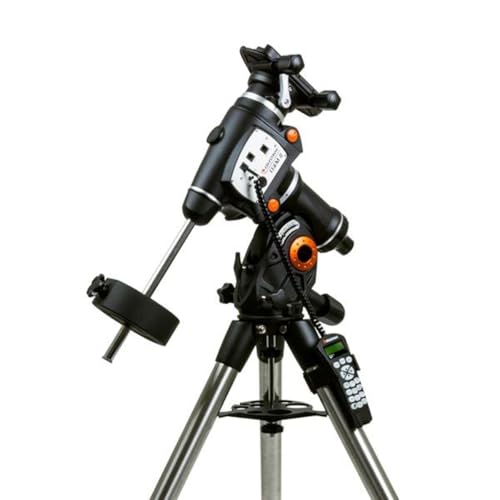
Celestron CGEM II Computerized Equatorial Mount & Tripod – 40lb Payload | Belt-Driven Gears, All-Star Polar Alignment, 40,000+ Object Database, NexStar+ Hand Control, Precision GoTo Performance
For buyers who want a long-focus imaging platform on the same family of mounts, the Celestron CGX 9.25″ EdgeHD package bundles a flat-field telescope with a computerized EQ mount. It is a different kind of purchase because the optics come with the mount, which suits observers who want a complete system rather than a mount to pair with existing gear.
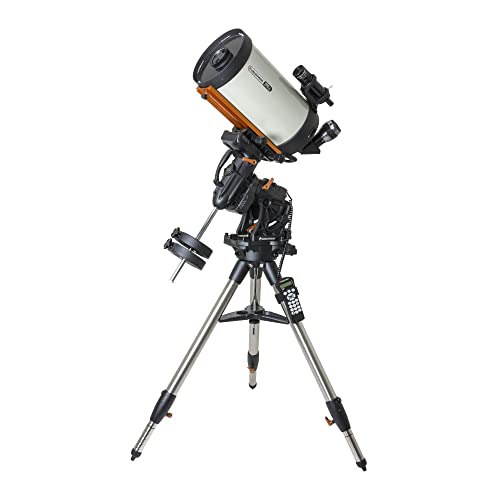
Celestron CGX 9.25" EdgeHD Flat-Field Telescope & Computerized EQ Mount | Enhanced Contrast, Flat-Field Performance, Ideal for Deep-Sky Imaging, GoTo German Equatorial Mount, Versatile Focal Ratios
If you are still deciding between mount styles, the explainer on what an equatorial mount does is a useful starting point, and the comparison of German equatorial mounts walks through the tradeoffs in more detail. What Is an Equatorial Telescope Mount? How It Works and Why It Matters Buyers focused on the Celestron line may also find the roundup of Celestron German equatorial mount picks helpful, and those looking at used gear should read the guide to used Celestron equatorial mounts before committing. Celestron German Equatorial Mount: 5 Best Picks Compared in 2026 Used Celestron Equatorial Mount: 4 Best Picks for Buyers in 2026
FAQ
Is the Advanced VX good for beginners?
It can be. Beginners who are willing to learn polar alignment and the basics of the hand control will find the GoTo and tracking features genuinely useful. Those who want a plug-and-play experience with no alignment at all may prefer a simpler alt-azimuth mount for their first telescope.
Can I use it for astrophotography?
Yes, for short to moderate exposures with a camera on a modest focal length. Long unguided exposures are limited by periodic error and polar alignment, so an autoguider is recommended for serious deep-sky imaging.
What does the 30-pound payload actually mean?
It is the manufacturer’s rated load for the mount. For the most stable results, keep your combined setup comfortably below that figure, and remember that a long tube adds leverage that makes balance harder to hold.
Do I need to polar align the mount?
Yes. Equatorial tracking depends on the polar axis pointing at the celestial pole. The hand control includes a routine to help with this, and a careful alignment makes the GoTo and tracking results noticeably more reliable.
Is it heavy to transport?
The mount head, tripod and counterweights add up to a load most people can carry in two or three trips. Owners often recommend a sturdy case or a wheeled bag for the tripod and a padded box for the head.
Can I add a heavier tube later?
Possibly, but check the weight and balance first. Going above the rated payload or mounting a much longer tube than the mount was designed for tends to reduce stability and tracking performance, and in some cases can strain the mechanics.
Does it work with a laptop or planetarium software?
Many owners pair equatorial mounts with planetarium software for targeting and session planning. Check the compatibility notes in the manufacturer’s documentation for the exact connection method before buying any accessories.
Final Verdict
The Celestron Advanced VX is a practical computerized German equatorial mount for beginners and intermediate observers who want GoTo pointing, equatorial tracking and a realistic path into short-exposure imaging. Its strengths are a familiar hand control, a meaningful payload rating for mid-sized scopes and a clear upgrade over basic alt-azimuth mounts. Its limits are the time needed for setup, sensitivity to wind and balance, and the need for autoguiding in serious long-exposure work. If your optical tube fits comfortably inside the rated payload and you are ready to learn polar alignment, it is a sound choice. If you plan to run heavy glass or serious deep-sky imaging from the start, look at a heavier mount instead.
View on AmazonNote: Specifications here are drawn from the product listing and general category knowledge. Confirm current details with the manufacturer before purchase.
Related reading
- When Was the German Equatorial Mount Invented? History and Origins
- Top 5 Goto German Equatorial Mount Picks for Every Observer
- Meade German Equatorial Mount: Setup Steps and What to Know (2026)
- German Equatorial Mount Comparison (2026): Which Should You Choose?
About Colin Foster
Colin Foster is part of our editorial team and reviews and edits our telescopes & stargazing guides, checking product details against manufacturer specifications and owner feedback.
About the author
Colin Foster writes reviews and buying guides for Astronomy Site.