6 Best City Light Pollution Filter Options Compared for Urban Stargazing
Find the best city light pollution filter for your telescope. We compare six options on fit, filter type and sky contrast so you can see deep-sky targets from u
 By Audrey Hayes
Updated November 24, 2026
 By Audrey Hayes
Updated November 2026
A city light pollution filter is one of the most practical accessories an urban observer can buy. Sodium street lamps, LED glare and skyglow wash out faint nebulae and galaxies, and a good filter blocks much of that unwanted light while passing the emission and reflection light that deep-sky objects give off. This guide compares six options on the criteria that matter most at the eyepiece: thread size and fit, how the filter handles broadband versus narrowband light, optical coating quality, and how well each one suits visual work versus astrophotography. The picks are based on specifications, brand reputation and patterns in owner feedback, not on any testing of our own.
Our Top Picks
Quick Comparison
| Product | Best for | Key feature |
|---|---|---|
| Light Pollution Filter 1.25″ for City Viewing | Visual observing from a backyard or balcony | Standard 1.25 inch thread for eyepiece-end use |
| K&F CONCEPT 58mm Clear Natural Night Filter | Small-aperture camera lenses in city skies | 28 multi-layer coatings with a neutral color balance |
| SVBONY 1.25″ UHC Filter | Budget visual setups | Ultra high contrast design in an aluminum frame |
| K&F CONCEPT 67mm Clear Natural Night Filter | Mid-size lenses and general astrophotography | Nano-X coating series aimed at reducing color cast |
| K&F CONCEPT 77mm Clear Natural Night Filter | Large telephoto lenses | 77mm thread for wide front elements |
| Walking Way 67mm Natural Night Filter | Astrophotographers wanting nano-coated glass | Nano-coated optical glass for star clarity |
Light Pollution Filter 1.25″ for City Viewing
Light Pollution Filter 1.25" for City Viewing Light Pollution | Boosts for nebula contrast, blocks artificial light, enhances deep views, standard 1.25 inch thread
Best for: Best overall for visual observers using a telescope with standard 1.25 inch eyepieces.
This filter suits someone who observes visually from a city or suburban backyard and wants a simple, screw-in accessory that fits the most common eyepiece size. Its design aims to boost contrast on nebulae and to tame artificial light scatter across the field of view.
Key specs
- Thread: 1.25 inch
- Application: visual observing with eyepieces
Pros
- Fits the standard 1.25 inch eyepiece size used by most beginner and intermediate telescopes
- Designed specifically for city viewing and nebula contrast
- Simple to swap in and out during a session
Cons
- Not suitable for camera lens use
- Will not restore a dark sky; it improves contrast rather than eliminating glow
Bottom line: A sensible first choice for a visual observer who uses a 1.25 inch eyepiece in a light-polluted yard.
View on AmazonK&F CONCEPT 58mm Clear Natural Night Filter Pollution Reduction

K&F CONCEPT 58mm Clear Natural Night Filter Pollution Reduction | 28 Multi-Layer Coatings Light Pollution Reduction Filter for Night City Sky Star Shots.No Color Cast Nano-X Series FE707
Best for: Best for small camera lenses shooting the night sky from a city.
This is a camera-lens filter for photographers shooting wide-field or landscape-style night scenes with a standard lens. The 58mm thread suits many mid-range lenses, and the clear design is intended to reduce light pollution without adding a strong color tint.
Key specs
- Thread: 58mm
- Coatings: 28 multi-layer coatings (per manufacturer)
- Series: Nano-X (per listing)
Pros
- Clear design intended to avoid a noticeable color cast
- Multi-layer coatings aimed at reducing glare and flare
- Suits common camera lens thread sizes
Cons
- Camera-only; not compatible with telescope eyepieces
- Owners with very wide lenses should confirm the thread matches their filter ring
Bottom line: A good fit for a photographer with a 58mm lens who wants a neutral night filter for city sky shots.
View on AmazonSVBONY Telescope Filter, 1.25″ UHC Filter
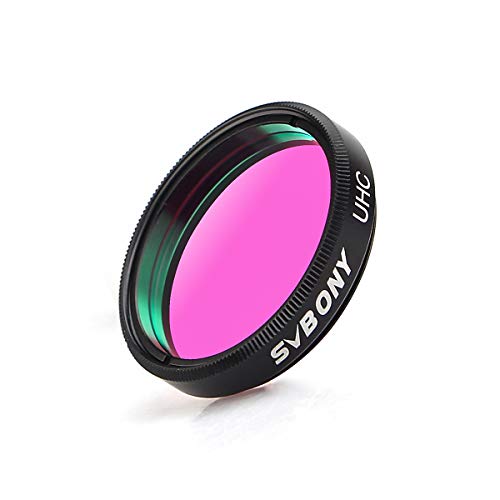
SVBONY Telescope Filter, 1.25" UHC Filter Improve Contrast for Telescope | Optical Glass Lens, Aluminum Frame, Astrophotography Filter, Light Pollution Filter Nebula Filters, Telescope Accessories
Best for: Best budget pick for visual observers who want an ultra high contrast filter.
This filter targets visual observers who want to sharpen contrast on emission nebulae from the city. It uses an aluminum frame and optical glass, which suits a beginner building out a modest accessory kit.
Key specs
- Thread: 1.25 inch
- Type: UHC (ultra high contrast) per listing
- Frame: aluminum; glass: optical
Pros
- Budget-friendly option within the visual filter category
- Aluminum frame and optical glass per listing
- Fits standard 1.25 inch eyepieces
Cons
- UHC designs favor emission nebulae and do little for galaxies
- Not intended for camera lens use
Bottom line: The practical budget pick for a visual observer who mainly wants to see nebulae better from town.
View on AmazonK&F CONCEPT 67mm Clear Natural Night Filter Pollution Reduction
K&F CONCEPT 67mm Clear Natural Night Filter Pollution Reduction | 28 Multi-Layer Coatings Light Pollution Reduction Filter for Night City Sky Star Shots.No Color Cast Nano-X Series FE707
Best for: Best for mid-size lenses and general city night photography.
A 67mm filter suits a wide range of mid-size telephoto and standard zoom lenses. This model shares the same multi-layer, clear-design approach as the 58mm version and is aimed at photographers who want consistent results across lens sizes.
Key specs
- Thread: 67mm
- Coatings: 28 multi-layer coatings (per manufacturer)
- Series: Nano-X (per listing)
Pros
- 67mm is a common thread size for many lenses
- Clear design intended to limit color cast
- Multi-layer coatings aimed at reducing flare
Cons
- Camera-only; no eyepiece use
- Filter effect depends on how bright the local light source is
Bottom line: A solid choice for a photographer whose main lens takes a 67mm thread.
View on AmazonK&F CONCEPT 77mm Clear Natural Night Filter Pollution Reduction

K&F CONCEPT 77mm Clear Natural Night Filter Pollution Reduction | 28 Multi-Layer Coatings Light Pollution Reduction Filter for Night City Sky Star Shots.No Color Cast Nano-X Series FE707
Best for: Best for large telephoto lenses used on city night skies.
The 77mm size is aimed at larger telephoto and professional-style lenses. Photographers with big front elements often need this size to avoid vignetting and to keep the filter coverage even across the frame.
Key specs
- Thread: 77mm
- Coatings: 28 multi-layer coatings (per manufacturer)
- Series: Nano-X (per listing)
Pros
- Suits large front elements on telephoto lenses
- Same clear, multi-layer design as the smaller K&F sizes
- Helps keep coverage even across the frame
Cons
- Only useful if your lens actually takes a 77mm thread
- Larger filters are heavier and can be pricier to replace if damaged
Bottom line: The right pick for a telephoto owner with a 77mm lens, not a general-purpose choice.
View on AmazonWalking Way 67mm Natural Night Filter for Light Pollution Reduction

Walking Way 67mm Natural Night Filter for Light Pollution Reduction Nano-Coated Optical Glass for Night Sky/Astrophotography/Star Clarity Anti-Light Pollution Filter
Best for: Best for astrophotographers who want nano-coated optical glass.
This 67mm filter emphasizes nano-coated optical glass and is marketed for star clarity and night sky work. It suits a photographer already committed to a 67mm lens who wants a filter focused on keeping stars sharp.
Key specs
- Thread: 67mm
- Glass: nano-coated optical glass (per listing)
Pros
- Nano-coated optical glass per listing
- Marketed for star clarity and night sky use
- 67mm suits many mid-size lenses
Cons
- Camera-only; not for eyepieces
- Owner comparisons with other brands vary, so compare coatings in person if possible
Bottom line: A reasonable alternative for a 67mm lens owner who prioritizes star sharpness and nano-coated glass.
View on AmazonBuying Guide
Visual Versus Camera Use
Decide first whether you will use the filter on an eyepiece or on a camera lens. A 1.25 inch eyepiece filter will not thread onto a camera, and a camera filter will not fit a telescope eyepiece. Visual filters are generally designed to work with the eye’s response, while camera filters are designed around sensor response and long exposures.
Good picks for this: Light Pollution Filter 1.25″ for City Viewing; K&F CONCEPT 67mm Clear Natural Night Filter
Thread Size and Fit
Measure the thread on your lens or check your eyepiece barrel before ordering. Common camera sizes include 58mm, 67mm and 77mm. Visual filters usually use 1.25 inch or 2 inch barrels. A filter that does not thread or seat properly will introduce vignetting or fall out during use.
Good picks for this: K&F CONCEPT 58mm Clear Natural Night Filter; K&F CONCEPT 77mm Clear Natural Night Filter
Filter Type: Broadband Versus Narrowband
Broadband light pollution filters pass a wide range of visible light while cutting some of the sodium and mercury glow common in cities. Narrowband or UHC designs focus on specific emission lines, which can boost nebulae but dim many other objects. Know which type you want before you buy.
Good picks for this: SVBONY 1.25″ UHC Filter; Light Pollution Filter 1.25″ for City Viewing
Coating Quality
Multi-layer coatings help reduce reflections and flare, which matter when stars are bright or when a streetlight sits near the frame. Owners frequently mention coating quality as the biggest difference between filters of similar size, so check whether the listing names its coating count or series.
Good picks for this: K&F CONCEPT 67mm Clear Natural Night Filter; Walking Way 67mm Natural Night Filter
Color Neutrality
A filter that adds a strong tint can make star colors look unnatural or cause white balance problems in photographs. Clear or neutral designs are generally preferred for astrophotography, while UHC designs tint the view by design.
Good picks for this: K&F CONCEPT 58mm Clear Natural Night Filter; Walking Way 67mm Natural Night Filter
Optical Glass and Frame
Look for optical glass rather than plain glass, and a metal frame that holds the glass securely. Aluminum frames are common on eyepiece filters. A loose or poorly seated frame can shift during focusing and degrade the image.
Good picks for this: SVBONY 1.25″ UHC Filter; Light Pollution Filter 1.25″ for City Viewing
Care and Handling
Keep the glass clean with a soft microfiber cloth and a blower. Store filters in a padded case. Avoid touching the coated surfaces, since oil and fingerprints affect contrast and can be hard to remove from some coatings.
Good picks for this: K&F CONCEPT 77mm Clear Natural Night Filter; K&F CONCEPT 58mm Clear Natural Night Filter
FAQ
Will a city light pollution filter make my sky completely dark?
No. A filter reduces some of the artificial light and improves contrast, especially on emission nebulae. It cannot remove all skyglow, and a truly dark site will always show more faint detail.
Can I use a light pollution filter with a telescope and a camera?
Some owners use separate filters for each setup. Eyepiece filters and camera filters thread differently, so you will usually need one of each.
Do light pollution filters work on galaxies?
Broadband filters can help somewhat with galaxies, but UHC and narrowband designs are most effective on emission nebulae. Galaxies typically benefit more from darker skies.
Will the filter tint the view?
Clear or neutral designs add little tint. UHC filters will shift color by design, so expect a visible change in the view.
How do I know what thread size I need?
Check the front filter thread on your lens or the barrel diameter of your eyepiece. Measure before ordering, since a size mismatch is one of the most common returns.
Do I need a filter if I already have a dark site nearby?
If you can reach a dark site regularly, a filter is less essential. For frequent city observing, a filter is often the most cost-effective upgrade to your view.
Conclusion
For visual observers using 1.25 inch eyepieces, the Light Pollution Filter 1.25″ for City Viewing and the SVBONY 1.25″ UHC Filter are the most direct options. Camera users should match the thread to their lens: the K&F CONCEPT 58mm, 67mm and 77mm filters cover common sizes, and the Walking Way 67mm suits a photographer focused on nano-coated glass. Confirm your thread size first, then choose between broadband and UHC based on the objects you most want to see.
Sources
- background on how light pollution affects astronomical observing and skyglow (nasa.gov)
- information on light pollution, skyglow and lighting standards
- guidance on outdoor lighting and reducing artificial light glare (energy.gov)
Before you buy: helpful guides
Related reading
- Polarizer Filter Light Pollution vs Narrowband: Which Should You Choose?
- Optolong L Pro Light Pollution Filter (2026): Which Should You Choose?
- Light Pollution Filter Comparison (2026): Which Should You Choose?
About Audrey Hayes
Audrey Hayes is part of our editorial team and reviews and edits our telescopes & stargazing guides, checking product details against manufacturer specifications and owner feedback.
About the author
Audrey Hayes writes reviews and buying guides for Astronomy Site.