6 Best Refractor Telescopes for Deep Space Picks Compared (2026)
Find the best refractor telescope for deep space with our six compared picks, covering aperture, focal ratio, focusers and who each telescope suits.
 By Claire Whitaker
Updated November 9, 2026
 By Claire Whitaker
Updated November 2026
Choosing the best refractor telescope for deep space comes down to a few measurable things: aperture, focal ratio, optical quality, focuser stability and how easily the tube mounts and balances. Deep-sky targets such as galaxies, nebulae and star clusters are faint and spread out, so light-gathering power and a dark, well-corrected view matter more than raw magnification. This guide compares six refractors using manufacturer specifications, brand reputation and common owner feedback patterns. We have not tested these instruments ourselves, so treat the notes below as a research-based shortlist rather than hands-on verdicts.
Our top picks at a glance
- 1TOP CHOICEBest overallSVBONY SV550 Triplet APO TelescopeView on Amazon
- 2
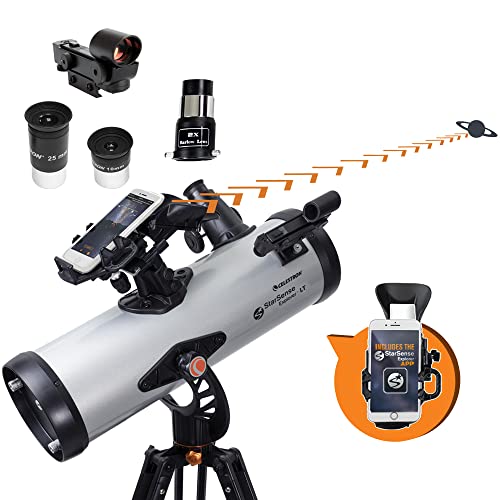 TOP CHOICEBest for beginnersCelestron StarSense Explorer LT 114AZView on Amazon
- 3
 TOP CHOICEBest for fast deep-sky imagingSVBONY SV48P Telescope for Adults High PoweredView on Amazon
- 4
 Best budget pickBushnell Refractor 600x50mm TelescopeView on Amazon
- 5
 Best for a steady mount setupGskyer Telescope 600x90mm AZ Astronomical RefractorView on Amazon
- 6
 Best for planets and deep skySVBONY SV503 Telescope for Adults High PoweredView on Amazon
Our Top Picks
Quick Comparison
| Product | Best for | Key feature |
|---|---|---|
| SVBONY SV550 Triplet APO Telescope | Serious deep-sky visual observers | 122mm triplet APO optics, 2.5″ dual-speed focuser |
| Celestron StarSense Explorer LT 114AZ | Beginners who want guided navigation | Smartphone app sky navigation |
| SVBONY SV48P Telescope for Adults | Wide-field deep-sky views | 102mm aperture at a short F6.5 focal ratio |
| Bushnell Refractor 600x50mm Telescope | Casual first-time observers | Simple setup with a 50mm aperture |
| Gskyer Telescope 600x90mm AZ | Users who want a stable altazimuth mount | 90mm aperture with an AZ mount |
| SVBONY SV503 Telescope for Adults High Powered | Planets and deep sky on one scope | 102mm ED glass with a dual-speed focuser |
SVBONY SV550 Triplet APO Telescope
SVBONY SV550 Triplet APO Telescope, 122mm F7 ED Glass Telescope for Adults | 2.5" Dual-Speed Focuser, 87mm Focus Travel Distance, Refractor Telescope High Power, for Deep Space Astrophotography Visual
Best for: Serious deep-sky visual observers who want the highest contrast and color correction in this list
This is the most capable instrument here for observers who already know their way around the sky and want sharp, color-neutral views of galaxies and nebulae. It suits someone willing to invest in a sturdy mount and accessories to match the optics.
Key specs
- 122mm aperture, F7 focal ratio (per the listing name)
- ED glass triplet apochromatic optics
- 2.5-inch dual-speed focuser
- 87mm focus travel distance
Pros
- Apochromatic correction reduces color fringing on bright stars and planets
- Large aperture gathers more light for faint targets
- Dual-speed focuser helps with precise focusing at high power
Cons
- Heavier tube requires a solid mount to avoid vibration
- Higher price tier than entry-level refractors (budget-sensitive buyers may prefer another option)
Bottom line: Pick this if you want the strongest optical performance here and already plan to use a stable mount.
View on AmazonCelestron StarSense Explorer LT 114AZ
Celestron StarSense Explorer LT 114AZ Newtonian Smartphone Guided Telescope | Smartphone App Sky Navigation, Manual Reflector Telescope, Beginner Deep-Sky Telescope, Bright Celestial Views, Portable
Best for: Beginners who want guided navigation to deep-sky targets
This Newtonian reflector is included because many beginners searching for a deep-sky scope want help finding objects. Its smartphone app handles sky navigation, which reduces the time spent hunting for faint targets. It is a reflector rather than a true refractor, so it is listed here as a beginner alternative.
Key specs
- 114mm aperture
- Smartphone app-based sky navigation
- Altazimuth mount
Pros
- App-guided navigation shortens the learning curve
- Larger aperture than many entry refractors
- Portable and simple to set up
Cons
- Reflector optics need occasional collimation
- Smartphone dependence means you need a charged device at the eyepiece
Bottom line: A good choice for a beginner who wants guided help more than optical purity.
View on AmazonSVBONY SV48P Telescope for Adults High Powered
SVBONY SV48P Telescope for Adults High Powered, 102mm Large Aperture F6.5 | Short Focal Ratio, Achromatic Refractor OTA, for Beginner Astronomer, Astronomical Telescope for Observation of Deep Space
Best for: Wide-field deep-sky views from a compact, fast refractor
The short focal ratio of this 102mm achromatic refractor gives a wide field of view, which suits large nebulae and star fields. It works well for observers who want to sweep the sky rather than zoom in on small targets.
Key specs
- 102mm aperture
- F6.5 focal ratio (per the listing name)
- Achromatic refractor optical tube assembly
Pros
- Short focal ratio delivers a wide, bright field
- Good light-gathering from a 102mm aperture
- Compact tube for easier transport
Cons
- Achromatic optics show more color fringing than apochromatic designs
- Fast optics are less forgiving with eyepiece choice
Bottom line: Suited to observers who favor wide-field deep-sky sweeping over maximum color correction.
View on AmazonBushnell Refractor 600x50mm Telescope
Bushnell Refractor 600x50mm Telescope, Deep Space Viewing Telescope 181561
Best for: Casual first-time observers with a limited budget
This is an entry-level refractor for people who want to try deep-sky viewing without much commitment. Its 50mm aperture limits faint detail, so expectations should stay modest.
Key specs
- 50mm aperture
- 600mm focal length (per the listing name)
Pros
- Simple, quick setup for a first look at the Moon and bright deep-sky objects
- Lightweight and easy to store
- Accessible entry point for families
Cons
- Small aperture limits faint galaxies and nebulae
- Lower-end mounts can wobble at higher magnification
Bottom line: A budget pick for a first look at the sky, not a serious deep-sky instrument.
View on AmazonGskyer Telescope 600x90mm AZ Astronomical Refractor
Gskyer Telescope 600x90mm AZ Astronomical Refractor Telescope for Adults | High-power 90mm AZ Telescope For Adults Astronomy, Telescope for Beginners, German Technology Scope
Best for: Users who want a stable altazimuth mount with a mid-size aperture
The 90mm aperture is a step up from the smallest refractors, and the AZ mount keeps setup simple for casual observing sessions. It suits a backyard observer who wants moderate deep-sky views without a complicated mount.
Key specs
- 90mm aperture
- 600mm focal length (per the listing name)
- Altazimuth (AZ) mount
Pros
- Larger aperture than entry 50mm scopes
- Intuitive up-down and left-right movement
- Straightforward for beginners
Cons
- Altazimuth mounts make tracking objects across the sky more manual
- Achromatic optics may show some color fringing
Bottom line: A practical middle ground for a beginner who wants more aperture than a starter scope offers.
View on AmazonSVBONY SV503 Telescope for Adults High Powered
SVBONY SV503 Telescope for Adults High Powered, 102mm Large Diameter F7 ED | Extra Low Dispersion Achromatic OTA, Dual-Speed Focuser, Refractor Telescope for Planets Deep Sky Astrophotography Visual
Best for: Observers who want planets and deep-sky objects from one refractor
This 102mm extra-low-dispersion refractor balances high-contrast planetary views with deep-sky use. Its dual-speed focuser helps with fine focusing when you switch between targets.
Key specs
- 102mm aperture, F7 focal ratio (per the listing name)
- Extra-low-dispersion (ED) glass
- Dual-speed focuser
Pros
- ED glass reduces color fringing compared with standard achromats
- Dual-speed focuser aids precise focusing
- Versatile for planets and deep sky
Cons
- Mount quality should be matched to the tube’s weight
- Less light-gathering than the 122mm SV550 for the faintest targets
Bottom line: A versatile choice for observers who split time between planets and deep-sky objects.
View on AmazonBuying Guide
Aperture and light-gathering
Aperture is the single most important number for deep-sky work because it determines how much light reaches your eye. Larger apertures reveal fainter galaxies and more detail in nebulae. A 50mm refractor will show bright objects, while 100mm and above open up a wider range of targets.
Good picks for this: SVBONY SV550 Triplet APO Telescope, SVBONY SV503 Telescope for Adults High Powered
Focal ratio and field of view
Focal ratio (focal length divided by aperture) affects how wide your view is. Shorter focal ratios, such as F6.5, give wider fields suited to large nebulae. Longer ratios give higher magnification with a narrower field.
Good picks for this: SVBONY SV48P Telescope for Adults High Powered, SVBONY SV550 Triplet APO Telescope
Optical correction: achromatic versus apochromatic
Achromatic refractors use two lens elements and can show color fringing around bright objects. Apochromatic and ED designs use special glass to reduce this. Manufacturers generally position APO and ED optics for higher-contrast views, though they cost more to produce.
Good picks for this: SVBONY SV550 Triplet APO Telescope, SVBONY SV503 Telescope for Adults High Powered
Focuser quality
A smooth, stable focuser matters when you use heavier eyepieces or add a camera. Dual-speed focusers allow fine adjustment, which helps when the image is sharpest only for a fraction of a turn. Check focuser diameter, typically 1.25 or 2 inches, and make sure it fits your accessories.
Good picks for this: SVBONY SV550 Triplet APO Telescope, SVBONY SV503 Telescope for Adults High Powered
Mount type and stability
An altazimuth mount is simple to use but requires manual tracking for objects that drift across the sky. An equatorial mount tracks more smoothly but takes longer to learn. Whatever you choose, the mount should hold the tube steady; a wobbling tube blurs deep-sky detail.
Good picks for this: Gskyer Telescope 600x90mm AZ, Celestron StarSense Explorer LT 114AZ
Portability and setup
Consider how often you will set up and where you observe. A compact tube is easier to carry to a dark-sky site, while a heavier tube needs a more robust mount and a car or cart for transport. Manufacturers usually list tube weight and dimensions, which helps you judge the trade-off.
Good picks for this: SVBONY SV48P Telescope for Adults High Powered, Bushnell Refractor 600x50mm Telescope
Light pollution and observing site
Even the best refractor shows limited deep-sky detail under bright skies. Observing from a darker site makes a larger difference than a modest upgrade in aperture. Light-pollution maps and the Bortle scale can help you plan where to observe.
Good picks for this: SVBONY SV550 Triplet APO Telescope, SVBONY SV503 Telescope for Adults High Powered
FAQ
What aperture do I need for deep-sky objects?
Many observers find that 100mm or more shows a good range of galaxies and nebulae, while smaller refractors are best for brighter targets. Aperture is only one factor, and dark skies matter just as much.
Is an apochromatic refractor better for deep space?
APO and ED refractors generally offer higher contrast and less color fringing, which many deep-sky observers prefer. Achromatic scopes can still be useful, especially for beginners on a budget.
Do I need a motorized mount for deep-sky viewing?
Not necessarily for short sessions, but a motorized or tracking mount makes it much easier to keep faint objects centered. Altazimuth mounts work well for casual observing.
Can a refractor be used for astrophotography?
Yes, refractors are popular for imaging because they have no central obstruction and good contrast. Astrophotography generally requires a stable tracking mount and a suitable camera, so plan accessories accordingly.
What eyepiece should I start with?
A low-power eyepiece gives a wide field and bright view, which is ideal for finding deep-sky objects. Higher-power eyepieces are useful once the target is centered, but image brightness drops as magnification rises.
Are refractors better than reflectors for deep space?
Refractors offer sealed tubes, sharp optics and low maintenance. Reflectors typically provide more aperture for the same price, which can benefit deep-sky work. The right choice depends on your priorities.
Conclusion
For the best refractor telescope for deep space, the SVBONY SV550 Triplet APO Telescope offers the strongest optics for serious observers who have a solid mount. The SVBONY SV48P suits wide-field sweeping, and the SVBONY SV503 covers both planets and deep sky. Beginners who want help finding targets may prefer the Celestron StarSense Explorer LT 114AZ, while the Gskyer and Bushnell models fit casual, entry-level use. Match the aperture, optics and mount to the targets you most want to see, and observe from the darkest site you can reach.
Sources
- Background on telescope optics, light gathering and how astronomers observe deep-sky objects (nasa.gov)
- Beginner resources on telescope types, observing techniques and night-sky planning
- Guidance on light pollution and why dark sites improve deep-sky viewing
Related reading
- Top 7 Refractor Telescope Solar Filters Compared for Safe Sun Viewing
- Top 6 APO Refractor Telescopes for Astrophotography Compared (2026)
- Tasco 800x60mm Novice Refractor Telescope: 4 Best Picks Compared (2026)
- Meade Infinity 102mm Refractor Telescope: 4 Best Picks Compared (2026)
- Barska 300 Power Starwatcher Refractor Telescope: 6 Best Picks Compared (2026)
About Claire Whitaker
Claire Whitaker is part of our editorial team and reviews and edits our telescopes & stargazing guides, checking product details against manufacturer specifications and owner feedback.
About the author
Claire Whitaker writes reviews and buying guides for Astronomy Site.