5 Best Manual Alt Azimuth Mounts for Visual Observing (2026)
Compare the best manual alt azimuth mount options for visual observing, with specs, pros, cons and buying tips to match your telescope and night-sky goals.
 By Colin Foster
Updated November 12, 2026
 By Colin Foster
Updated November 2026
A manual alt azimuth mount is the simplest way to point a telescope at the sky: you move the tube up and down (altitude) and side to side (azimuth) by hand, and the scope follows what you aim at. For a beginner or a casual observer, that simplicity is the appeal. This guide compares five manual alt azimuth mounts on the criteria that matter most in practice: how stable the mount feels at high magnification, how smooth the slow-motion controls are, how much payload the head is rated to carry, how easily it fits a tripod setup you can actually carry outside, and how well it suits the telescope types it is marketed for. The list is based on published specifications, brand reputation and common owner feedback patterns, not on hands-on testing.
Our top picks at a glance
- 1TOP CHOICEBest overallCelestron AstroMaster 102AZ Wide-Field Refractor TelescopeView on Amazon
- 2
 TOP CHOICEBest for heavy opticsCelestron Heavy-Duty Alt-Azimuth TripodView on Amazon
- 3
 TOP CHOICEBest for a bundled starter setupCelestron AstroMaster 70AZ Refractor TelescopeView on Amazon
- 4
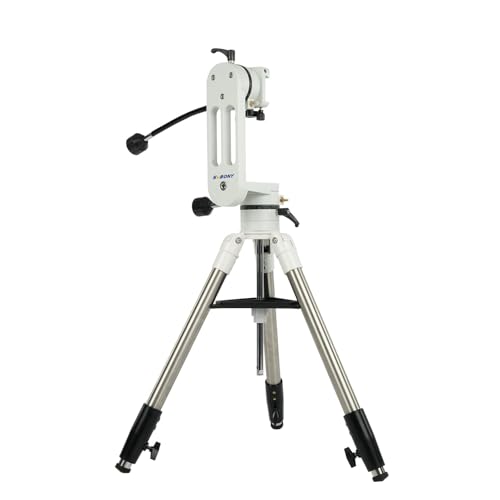 Best for a compact, adjustable mountSVBONY SV225 Alt-Azimuth Mount BundleView on Amazon
- 5
 Best for small refractors and NewtoniansExplore Scientific Twilight I Alt-Azimuth Telescope MountView on Amazon
Our Top Picks
Quick Comparison
| Product | Best for | Key feature |
|---|---|---|
| Celestron AstroMaster 102AZ Wide-Field Refractor Telescope | Beginners wanting a complete scope on a manual mount | Short-tube 102 mm refractor on an easy alt-azimuth mount |
| Celestron Heavy-Duty Alt-Azimuth Tripod | Owners of larger or heavier optics | Heavy-duty head with slow-motion controls on both axes |
| Celestron AstroMaster 70AZ Refractor Telescope | First-time buyers focused on Moon and planets | Fully coated glass optics on a manual alt-azimuth mount |
| SVBONY SV225 Alt-Azimuth Mount Bundle | Observers who want an adjustable, compact mount | CNC hollow structure with quick-shift handle |
| Explore Scientific Twilight I Alt-Azimuth Telescope Mount | Owners of small refractors and Newtonians | 18 lb rated capacity with slow-motion cables |
Celestron AstroMaster 102AZ Wide-Field Refractor Telescope
Celestron AstroMaster 102AZ Wide-Field Refractor Telescope | Perfect First Telescope for Beginners, Short Tube Refractor, Bright Moon & Planetary Views, Easy Manual Alt-Azimuth Mount
Best for: Best overall
This is a complete, ready-to-observe package aimed at people who want a telescope and a manual mount in one purchase. It suits a beginner who plans to spend most evenings looking at the Moon, bright planets and open clusters rather than faint galaxies.
Key specs
- Short-tube 102 mm refractor optics
- Manual alt-azimuth mount
- Designed for wide-field, low-power viewing
Pros
- Easy to set up and point without a learning curve
- Short tube makes it more compact to store and transport
- Wide field helps you find objects before moving to higher power
Cons
- Manual mounts can drift as objects move across the sky at high magnification
- Limited payload compared with heavier-duty mounts for large apertures
Bottom line: A strong pick for a first-time observer who wants a complete system and does not plan to chase faint deep-sky objects at high power.
View on AmazonCelestron Heavy-Duty Alt-Azimuth Tripod
Celestron Heavy-Duty Alt-Azimuth Tripod for Spotting Scopes & Telescopes | Heavy-Duty Mount, Precision Slow-Motion Controls in Altitude and Azimuth, Built for Large Optics, Smooth Tracking
Best for: Best for heavy optics
This is a mount rather than a telescope, aimed at owners who already have a spotting scope or telescope and need a sturdier base with fine control. It fits observers whose current setup wobbles or who are upgrading to larger optics.
Key specs
- Heavy-duty alt-azimuth head
- Precision slow-motion controls in altitude and azimuth
- Built for large optics
Pros
- Slow-motion controls on both axes help with fine tracking
- Heavy-duty build is intended to resist vibration
- Works for both spotting scopes and telescopes
Cons
- Heavier and bulkier to carry to a dark-sky site
- Requires you to supply or match a compatible optical tube
Bottom line: The right choice for someone who wants stability and fine control more than portability.
View on AmazonCelestron AstroMaster 70AZ Refractor Telescope
Celestron AstroMaster 70AZ Refractor Telescope for Moon & Planet Viewing | Fully Coated Glass Optics, Crisp Moon & Planetary Views, Alt-Azimuth Mount with Easy Manual Controls, Beginner Friendly
Best for: Best for a bundled starter setup
This is a small refractor on a manual alt-azimuth mount, sized for someone who wants a light, inexpensive-to-transport introduction to visual astronomy. It works best for lunar and planetary viewing.
Key specs
- 70 mm fully coated glass refractor
- Alt-azimuth mount with manual controls
- Geared for beginner use
Pros
- Lightweight and easy to set up quickly
- Fully coated glass optics support bright, contrasty Moon views
- Simple controls make it approachable for kids and new observers
Cons
- Small aperture limits faint deep-sky viewing
- Included eyepieces are typically modest, so upgrades are often recommended
Bottom line: Best for first-time buyers who want to start with the Moon and planets and keep the setup light.
View on AmazonSVBONY SV225 Alt-Azimuth Mount Bundle
SVBONY SV225 Alt-Azimuth Mount Adjustable Angle Alt-Azimuth Mount Bundle with SV225T Astronomical Telescope Tripod, CNC Hollow Structure, Quick Shift Handle Telescope Altazimuth for Astronomical Obser
Best for: Best for a compact, adjustable mount
This is a mount-and-tripod bundle aimed at observers who want an adjustable angle head and a compact footprint. It suits people who already own a scope and want a manual mount with more adjustability than a basic head.
Key specs
- Alt-azimuth mount with adjustable angle
- CNC hollow structure for reduced weight
- Quick-shift handle for fast repositioning
Pros
- Adjustable angle head adds flexibility for different scope sizes
- Lighter than many traditional heavy-duty heads
- Quick-shift handle speeds up re-aiming
Cons
- Owner feedback patterns suggest lighter builds can feel less rigid at high magnification
- Bundle contents should be checked carefully against your existing gear
Bottom line: A good match for an owner who values adjustability and portability over maximum rigidity.
View on AmazonExplore Scientific Twilight I Alt-Azimuth Telescope Mount
Explore Scientific Twilight I Alt-Azimuth Telescope Mount, 18 lb Capacity | Adjustable Angle Head, Slow-Motion Cables, Stainless Steel Tripod, Refractors and Small Newtonians
Best for: Best for small refractors and Newtonians
This is a dedicated mount head rated for a defined payload, suited to owners who already have a small refractor or Newtonian and want a steady alt-azimuth base with fine adjustment.
Key specs
- 18 lb rated capacity
- Adjustable angle head
- Slow-motion cables on both axes
Pros
- Stated payload gives a clear limit to check against your optics
- Slow-motion cables allow fine, controlled movement
- Stainless steel tripod is typically favored for stability
Cons
- Requires separate optics, so total cost and setup are higher
- Heavier than compact bundles when packed for travel
Bottom line: The right choice for an owner who already has a compatible scope and wants a durable manual mount.
View on AmazonBuying Guide
Payload capacity and optics weight
Check the rated capacity against the combined weight of your telescope, eyepieces, finder and any camera. A mount near its limit tends to vibrate and drift more, which is frustrating at high power. Leave margin rather than buying to the exact number.
Good picks for this: Explore Scientific Twilight I Alt-Azimuth Telescope Mount, Celestron Heavy-Duty Alt-Azimuth Tripod
Slow-motion controls
Manual mounts are much easier to use when both axes have slow-motion controls. Without them, tiny adjustments require nudging the tube, which can overshoot your target. Look for fine-control knobs or cables on altitude and azimuth.
Good picks for this: Celestron Heavy-Duty Alt-Azimuth Tripod, Explore Scientific Twilight I Alt-Azimuth Telescope Mount
Tripod stability and height
Stability matters more than most beginners expect. A tripod that flexes will shake the view every time you touch the focuser. Check the leg diameter, leg-locking style and whether the tripod reaches a comfortable eyepiece height while seated or standing.
Good picks for this: Explore Scientific Twilight I Alt-Azimuth Telescope Mount, Celestron Heavy-Duty Alt-Azimuth Tripod
Portability and setup time
If you observe at a dark-sky site an hour’s drive away, weight and packed size count. Compact mounts and short-tube scopes are easier to carry, while heavy-duty heads reward you with steadiness at home or in a permanent observing spot.
Good picks for this: SVBONY SV225 Alt-Azimuth Mount Bundle, Celestron AstroMaster 70AZ Refractor Telescope
Compatibility with your telescope type
Refractors, short-tube refractors and small Newtonians generally pair well with alt-azimuth heads, but larger Newtonians and heavy reflectors can strain a light mount. Confirm the mount’s stated compatibility and, if possible, the dovetail or saddle style.
Good picks for this: Celestron AstroMaster 102AZ Wide-Field Refractor Telescope, Explore Scientific Twilight I Alt-Azimuth Telescope Mount
Build quality and materials
Steel tripods and machined metal heads are commonly reported to hold position better than thin plastic components. Lightweight alloy or hollow CNC structures can save weight, but owners often note they should be paired with modest payloads.
Good picks for this: Explore Scientific Twilight I Alt-Azimuth Telescope Mount, SVBONY SV225 Alt-Azimuth Mount Bundle
Care and maintenance
Keep the slow-motion cables and gears clean and lightly lubricated as the manufacturer recommends, and avoid over-tightening locking knobs. Store the mount dry, since moisture after dew-soaked nights can corrode metal fittings over time.
Good picks for this: Celestron Heavy-Duty Alt-Azimuth Tripod, Celestron AstroMaster 70AZ Refractor Telescope
FAQ
What is a manual alt azimuth mount?
It is a mount that moves a telescope up and down (altitude) and left and right (azimuth) by hand, usually with optional slow-motion controls. It is the simplest type of telescope mount.
Is an alt azimuth mount good for beginners?
Yes. Its motions are intuitive, and there is no need to set the mount’s polar axis to the celestial pole, which keeps the learning curve short.
Can I track objects with a manual alt azimuth mount?
You can, by making small adjustments by hand. Because the sky rotates in two directions relative to an alt-azimuth mount, tracking at high magnification requires frequent corrections, which is why slow-motion controls help.
What payload should I look for?
Choose a mount whose rated capacity comfortably exceeds the combined weight of your optics and accessories. Leaving margin reduces vibration and drift.
Is a manual alt azimuth mount good for astrophotography?
Generally, no. Long exposures need precise tracking, and manual alt-azimuth mounts are better suited to visual observing. For photography, a motorized or equatorial system is usually recommended.
Do I need slow-motion controls?
They are not strictly required, but they make fine aiming and tracking much easier, especially above about 100x magnification.
How do I keep my mount steady?
Use a sturdy, fully extended and locked tripod on firm ground, avoid touching the focuser during observing, and let the scope cool and settle before you start.
Conclusion
For a complete beginner package, the Celestron AstroMaster 102AZ is a practical starting point. If you already own heavier optics and value stability, the Celestron Heavy-Duty Alt-Azimuth Tripod or the Explore Scientific Twilight I suits that need best. The AstroMaster 70AZ fits first-time buyers who want to start with the Moon and planets, and the SVBONY SV225 bundle works for observers who want adjustability and a lighter setup. Match the payload rating, the slow-motion controls and the tripod stability to the telescope you already have or plan to buy.
Sources
- Background on how telescopes gather and resolve light, and why steady aiming matters for visual observing (nasa.gov)
- Resources from the Astronomical League on beginner observing, equipment and observing programs
- Information from the American Astronomical Society on amateur astronomy and public observing
Related reading
- Top 5 Alt Azimuth GoTo Mount Picks for Every Observer
- Svbony SV225 Alt-Azimuth Mount Review: Pros and Cons
- Celestron Alt Azimuth Mount Review: Features and Performance
About Colin Foster
Colin Foster is part of our editorial team and reviews and edits our telescopes & stargazing guides, checking product details against manufacturer specifications and owner feedback.
About the author
Colin Foster writes reviews and buying guides for Astronomy Site.