4 Best Phone Camera Lens for Astrophotography Compared (2026)
Compare 4 phone camera lenses for astrophotography. See which clip-on lens suits night sky shots, telephoto zoom and wide fields, plus a buying guide.
 By Colin Foster
Updated November 10, 2026
 By Colin Foster
Updated November 2026
Shooting the night sky with a phone camera lens for astrophotography is less about the lens alone and more about matching optics to what you want to capture. A clip-on lens can extend reach toward the Moon and bright planets, widen the field for the Milky Way, or add a fisheye perspective, but the wrong glass can add softness, vignetting and color fringing to already noisy night frames. This guide compares four clip-on options, judged on focal range, optical design, mounting stability, compatibility with common phone models and how well each suits night-sky use. The list is based on published specifications, brand reputation and common owner feedback patterns, not on our own testing.
Our top picks at a glance
- 1TOP CHOICEBest overallMIAO LAB 28X HD Telephoto Lens for iPhone/Samsung/AndroidView on Amazon
- 2
 Best for wide Milky Way fieldsAilun Phone Lens, 3 in 1 Clip on Fish Eye Lens+Wide Angle+Macro LensView on Amazon
- 3
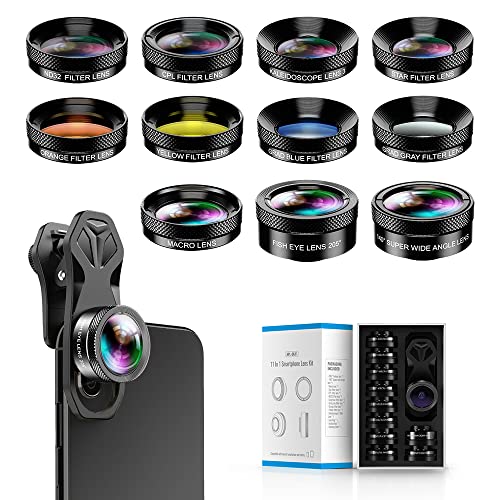 Best budget pick for experimentingMIAO LAB 11 in 1 Phone Camera Lens Kit for iPhone Samsung Sony and Most of SmartphoneView on Amazon
- 4
 Best for Moon and planet detailAPEXEL 10X Tele-Macro Pro Dual Lens 2-in-1 for iPhoneView on Amazon
Our Top Picks
Quick Comparison
| Product | Best for | Key feature |
|---|---|---|
| MIAO LAB 28X HD Telephoto Lens | Moon and bright planets | High-magnification telephoto zoom |
| Ailun 3 in 1 Clip On Lens Kit | Wide Milky Way framing | 180-degree fisheye and 0.65X wide angle |
| MIAO LAB 11 in 1 Phone Camera Lens Kit | Budget experimenting | Eleven accessories including ND32, CPL and star filter |
| APEXEL 10X Tele-Macro Pro Dual Lens | Moon and planet reach with a macro option | 10X telephoto zoom with a dual-lens design |
MIAO LAB 28X HD Telephoto Lens for iPhone/Samsung/Android
MIAO LAB 28X HD Telephoto Lens for iPhone/Samsung/Android | HD Telephoto Camera Lens, Universal Smartphone Compatibility
Best for: Moon and bright planet close-ups from a phone
This is the option for people whose main goal is reaching toward the Moon, Jupiter or Saturn. A telephoto clip-on turns a phone’s wide lens into something closer to a small spotting scope, which is where most casual planetary attempts succeed or fail. Expect strong magnification but also a narrow field, so a steady mount matters more than with any other lens on this list.
Key specs
- Telephoto zoom rated at 28X in the listing name
- Universal clip designed for iPhone, Samsung and other Android phones
- Clip-on attachment that sits over the phone’s main camera
Pros
- Large magnification suits Moon craters and planetary disks
- Universal clip fits a wide range of phone models
- Simple attach-and-shoot setup for quick lunar sessions
Cons
- Narrow field makes alignment and tracking harder
- Phone’s own sensor limits detail at high magnification
Bottom line: The best fit for anyone whose main target is the Moon or bright planets. Pair it with a tripod or mount and expect to crop heavily.
View on AmazonAilun Phone Lens, 3 in 1 Clip on Fish Eye Lens+Wide Angle+Macro Lens
Ailun Phone Lens, 3 in 1 Clip on Fish Eye Lens+Wide Angle+Macro Lens | 180 Degree Fish Eye Lens, 0.65X Wide Angle, 10X Macro Lens, Universal HD Camera Lens kit, For Mobile Phone & Smartphone
Best for: Wide Milky Way framing and night landscapes with sky
Wide-field astrophotography is where a phone’s native lens is already strong, but a wide-angle clip can push the frame further. This kit is aimed at people who want the sky overhead and a foreground in the same shot, or who want a fisheye look for the galactic core. Owners generally report that the wide attachments work best with the lens centered and the phone held steady.
Key specs
- 180-degree fisheye lens
- 0.65X wide-angle lens
- 10X macro lens (for close subjects rather than sky)
Pros
- Three optics in one kit cover wide, fisheye and macro uses
- Good fit for Milky Way composition with foreground
- Universal clip works across many phone models
Cons
- Fisheye distortion and edge softness are common complaints
- Macro lens is of limited use for astrophotography
Bottom line: Choose this if your priority is a wide sky-and-landscape frame rather than magnified detail.
View on AmazonMIAO LAB 11 in 1 Phone Camera Lens Kit for iPhone Samsung Sony and Most of Smartphone
MIAO LAB 11 in 1 Phone Camera Lens Kit – Wide Angle Lens & Macro Lens+Fisheye Lens+ND32//CPL/Color Lens/Star+Kaleidoscope Lens for iPhone Samsung Sony and Most of Smartphone
Best for: Budget experimenting with several optical effects
This kit suits people who want to try different looks before committing to a single specialized lens. The listing includes a neutral density filter (ND32), a polarizer (CPL) and a star filter, which are relevant to night work, alongside wide, fisheye and kaleidoscope optics that are more creative than scientific. Expect variable optical quality across the accessories.
Key specs
- Eleven-piece kit as stated in the listing name
- Includes ND32, CPL and star filter accessories
- Wide-angle, macro and fisheye optics among the set
Pros
- Broad variety of accessories for the price tier
- Star filter can add diffraction spikes to bright stars
- Good starting point for learning how clip-on optics behave
Cons
- Optical quality across the kit varies, with softness at the edges
- Creative filters can mask detail rather than reveal it
Bottom line: A sensible choice for a beginner who wants to test several effects before buying specialized glass.
View on AmazonAPEXEL 10X Tele-Macro Pro Dual Lens 2-in-1 for iPhone
APEXEL 10X Tele-Macro Pro Dual Lens 2-in-1 for iPhone | Clip-On Telephoto & Macro Lens for Samsung/Android | 10x Zoom for Concerts, Travel, and Outdoor Exploration | Pro Photography
Best for: Moon and planet reach with a telephoto-plus-macro design
This dual-lens clip-on combines a 10X telephoto with a macro option, positioned for people who want magnified views of the Moon and planets and occasional close-up work. Owners often describe the telephoto side as the more useful one for sky targets, and the dual design as a convenience rather than a central feature.
Key specs
- 10X telephoto zoom as stated in the listing name
- Two-in-one design combining telephoto and macro optics
- Clip-on compatibility listed for iPhone and Samsung/Android phones
Pros
- Telephoto reach suits lunar and planetary framing
- Two optics in one clip add flexibility
- Compatible with both iPhone and Android in the listing
Cons
- Magnification is lower than a 28X-class telephoto
- Alignment with the phone lens can be fiddly
Bottom line: A good middle ground for someone who wants Moon and planet reach plus close-up versatility.
View on AmazonBuying Guide
Focal range and magnification
Telephoto clip-ons help with the Moon, planets and double stars, while wide-angle and fisheye clip-ons suit Milky Way and sky-plus-landscape frames. Decide your main target first. Higher magnification also magnifies shake and atmospheric turbulence, so more zoom is not always better on a phone.
Good picks for this: MIAO LAB 28X HD Telephoto Lens, APEXEL 10X Tele-Macro Pro Dual Lens
Optical quality and edge sharpness
Clip-on optics are typically sharpest in the center. Fisheye and wide designs often show soft corners and distortion. Check owner feedback for comments on edge sharpness, because that is where budget clip-ons most often disappoint at night.
Good picks for this: Ailun 3 in 1 Clip On Lens Kit, MIAO LAB 11 in 1 Phone Camera Lens Kit
Phone compatibility and clip fit
Most clip-ons use a universal spring clip, but the lens must line up with the phone’s main camera. Thick cases can block the clip or cause vignetting. Remove the case before attaching, and check the listed phone models against yours.
Good picks for this: MIAO LAB 28X HD Telephoto Lens, Ailun 3 in 1 Clip On Lens Kit
Useful night-sky accessories
A star filter, neutral density filter and polarizer can each change night results. A star filter adds diffraction spikes, an ND filter lengthens usable exposure in twilight, and a polarizer can reduce some glare. Use them deliberately rather than as default additions.
Good picks for this: MIAO LAB 11 in 1 Phone Camera Lens Kit
Stability and mounting
Telephoto work magnifies every vibration. A tripod, a phone holder with a fixed clamp and a 2-second timer or remote shutter help. Clip-ons add weight to the phone’s front, so a sturdy mount matters more with any added glass.
Good picks for this: APEXEL 10X Tele-Macro Pro Dual Lens, MIAO LAB 28X HD Telephoto Lens
Build quality and care
Clip-on lenses are small and exposed, so housings, clip springs and glass coatings take wear. Keep lens caps on when not shooting, wipe glass with a microfiber cloth and avoid storing them in pockets with keys. Replace the lens if the clip loses grip, since slippage can damage the phone camera.
Good picks for this: Ailun 3 in 1 Clip On Lens Kit, APEXEL 10X Tele-Macro Pro Dual Lens
Your shooting environment
Light pollution, humidity and wind all affect results more than the lens does. A dark-sky site and steady air will help any of these lenses more than a higher-priced option under a city sky. Plan sessions around Moon phase and seeing conditions.
Good picks for this: MIAO LAB 11 in 1 Phone Camera Lens Kit, MIAO LAB 28X HD Telephoto Lens
FAQ
Can a clip-on lens really improve phone astrophotography?
Yes, for specific targets. A telephoto clip-on can magnify the Moon and bright planets, and a wide clip-on can widen Milky Way frames. It will not help with faint deep-sky objects, which need long exposures and a dedicated camera.
Do I need a tripod with a clip-on lens?
For most night-sky work, yes. Longer exposures and magnified views both amplify motion, so a tripod or fixed holder with a self-timer or remote shutter gives noticeably steadier results.
Will a fisheye lens distort the stars?
A fisheye lens curves straight lines and can stretch stars toward the edges of the frame. Centered subjects, such as the galactic core, are usually less affected than the corners.
Is a telephoto lens better than the phone’s zoom for the Moon?
A dedicated telephoto clip-on usually provides more optical reach than digital zoom, which only crops the sensor and reduces detail. Digital zoom beyond the native lens generally looks softer.
Do clip-on lenses work with cases?
Thin cases often work, but thick or rugged cases can block the clip or cause vignetting. Removing the case gives the most reliable alignment.
What is a star filter and do I need one?
A star filter adds diffraction spikes to bright points of light. It can be fun for artistic night shots, but it does not reveal more detail and can obscure faint stars, so most astrophotographers use it only occasionally.
How should I clean a clip-on lens?
Use a microfiber cloth and, if needed, a lens-safe cleaning solution. Avoid paper towels and household cleaners, which can scratch coatings.
Conclusion
For Moon and planet reach, the MIAO LAB 28X HD Telephoto Lens is the strongest focus of this group, and the APEXEL 10X Tele-Macro Pro Dual Lens is a sensible alternative if you want a telephoto with a macro option. For wide Milky Way framing with foreground, the Ailun 3 in 1 Clip On Lens Kit offers the most useful range. The MIAO LAB 11 in 1 Phone Camera Lens Kit suits someone who wants to experiment with filters and effects before committing to specialized glass. Match the lens to your main target, and remember that a steady mount and a dark site will matter more than any single clip-on.
Sources
- Current Moon phases, planetary visibility and observing guidance for night-sky targets (nasa.gov)
- Introductory resources on astrophotography techniques and night-sky observing
- Information on dark-sky sites and light pollution, useful for choosing where to shoot (nps.gov)
Related reading
- What Is the Best Nikon Camera Lens for Astrophotography? Top Picks
- 6 Best Camera Lens for Astrophotography: Our Picks Compared (2026)
- iPhone Camera Settings for Astrophotography: A Step-by-Step Guide
About Colin Foster
Colin Foster is part of our editorial team and reviews and edits our telescopes & stargazing guides, checking product details against manufacturer specifications and owner feedback.
About the author
Colin Foster writes reviews and buying guides for Astronomy Site.