5 Best Heavy Duty German Equatorial Mounts of 2026
Compare the best heavy duty German equatorial mounts for 2026. See payload, tracking, GoTo features and who each mount suits before you buy.
 By Colin Foster
Updated November 22, 2026
 By Colin Foster
Updated November 2026
A heavy duty German equatorial mount is the foundation of serious visual and imaging work. The mount has to carry the weight of a long-focus telescope or a heavy camera setup, track the sky smoothly for minutes or hours, and stay put when the wind picks up. This list focuses on five mounts from the Celestron and Sky-Watcher lines, judged on rated payload capacity, drive type, GoTo capability, polar alignment support and the kind of observing or imaging each one suits. The picks are ordered by how well they match the needs of readers who plan to carry heavier optics.
Our top picks at a glance
- 1
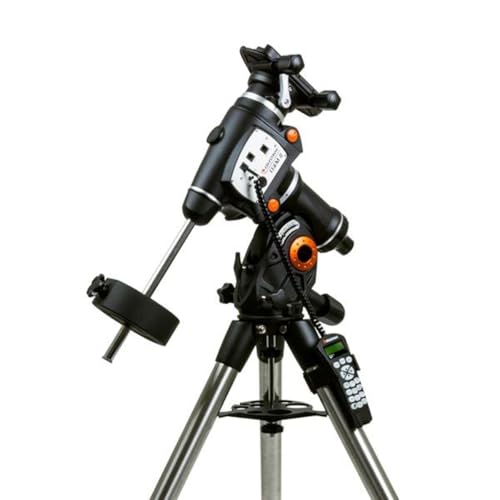 TOP CHOICEBest overallCelestron CGEM II Computerized Equatorial Mount & TripodView on Amazon
- 2
 TOP CHOICEBest for visual manual observingCelestron CG-4 Manual German Equatorial Mount with Steel TripodView on Amazon
- 3
 TOP CHOICEBest for versatile EQ and alt-az useSky-Watcher AZ-EQ6 Multi-Purpose GoTo SynScan Dual OTA MountView on Amazon
- 4Best for observatory-class imagingCelestron CGX-L 14" EdgeHD Observatory-Class Astrophotography EQView on Amazon
- 5
 Best for computerized astrophotography on a budget-minded setupSky-Watcher HEQ5 Fully Computerized GoTo German Equatorial Telescope MountView on Amazon
Our Top Picks
| Product | Best for | Key feature |
|---|---|---|
| Celestron CGX-L 14″ EdgeHD | Observatory-class imaging with long focal lengths | 75 lb payload with GoTo tracking |
| Celestron CGEM II | Most owners who want GoTo with a heavy payload | 40 lb payload, belt-driven gears, All-Star polar alignment |
| Sky-Watcher AZ-EQ6 | Switching between equatorial and alt-az modes | 44 lb payload, SynScan GoTo, dual mode |
| Sky-Watcher HEQ5 | Computerized astrophotography on a moderate budget | 42,000-object database with GoTo |
| Celestron CG-4 | Manual visual observing with steel tripod | Smooth manual tracking, motor-drive ready |
Celestron CGX-L 14″ EdgeHD Observatory-Class Astrophotography EQ
Celestron CGX-L 14" EdgeHD Observatory-Class Astrophotography EQ | 14" Flat-Field EdgeHD Optics, GoTo German Equatorial Mount, Excellent Visual & Astrophotography Performance, 75 lb Payload
Best for: Observatory-class imaging with long focal lengths
This mount suits imagers and visual observers who run large, heavy optics and want a permanent or semi-permanent setup. It is built around the 14-inch EdgeHD optical tube, so it targets owners who already expect heavy loads and long exposures.
Key specs:
- 75 lb rated payload capacity
- GoTo German equatorial design
- Designed for the 14″ flat-field EdgeHD optics
Pros
- Payload headroom suits large optics and heavier cameras
- GoTo tracking supports long unattended sessions
- Stable platform for high-magnification planetary and deep-sky work
Cons
- Weight and footprint make it hard to move between sites
- Overkill for small refractors or beginner setups
Bottom line: Choose this if you run a large optical tube, plan a fixed observing location and want the most payload margin in this list.
View on AmazonCelestron CGEM II Computerized Equatorial Mount & Tripod
Celestron CGEM II Computerized Equatorial Mount & Tripod – 40lb Payload | Belt-Driven Gears, All-Star Polar Alignment, 40,000+ Object Database, NexStar+ Hand Control, Precision GoTo Performance
Best for: GoTo tracking with a 40 lb payload for most heavy setups
This mount fits observers who want computerized pointing and tracking without moving to the largest class of mounts. It suits 8- to 11-inch Schmidt-Cassegrain or similar optics, and imagers with a mid-sized camera and guide setup.
Key specs:
- 40 lb payload capacity
- Belt-driven gears
- All-Star polar alignment and NexStar+ hand control
- Database of more than 40,000 objects
Pros
- Belt-driven gears are described by owners as quiet and smooth
- All-Star polar alignment speeds up setup
- Large object database makes finding targets straightforward
Cons
- Payload limit rules out the heaviest optics
- Power and hand control take some learning for new users
Bottom line: A strong choice for most owners who need GoTo and a balance of payload and portability.
View on AmazonSky-Watcher AZ-EQ6 Multi-Purpose GoTo SynScan Dual OTA Mount
Sky Watcher Sky-Watcher AZ-EQ6 Mount – Multi-Purpose GoTo SynScan Dual OTA Mount – EQ and Dual AZ Modes – 44 Pound Payload Capacity (S30330)
Best for: Switching between equatorial and alt-az modes
This mount suits observers who want one mount that works in equatorial mode for astrophotography and in alt-azimuth mode for casual viewing. It also accepts two optical tubes, which helps owners who carry more than one telescope.
Key specs:
- 44 lb payload capacity
- EQ and dual alt-az modes
- SynScan GoTo control
Pros
- Dual mode flexibility covers both imaging and visual use
- Payload is higher than many mid-range mounts
- SynScan control is a familiar system for many owners
Cons
- Setup in each mode takes more steps than a dedicated mount
- Heavier than simpler manual mounts when transported
Bottom line: Best for owners who want versatility across visual and imaging work with one mount.
View on AmazonSky-Watcher HEQ5 Fully Computerized GoTo German Equatorial Telescope Mount
Sky-Watcher HEQ5 – Fully Computerized GoTo German Equatorial Telescope Mount – Motorized Astrophotography Mount with 42,000 Object Database,White
Best for: Computerized astrophotography on a moderate budget
This mount suits imagers and visual users who want GoTo tracking and a large object catalog in a German equatorial design. It is a common choice for mid-sized refractors and reflectors used for deep-sky photography.
Key specs:
- 42,000-object database
- Fully computerized GoTo
- German equatorial design for astrophotography
Pros
- Large object database supports fast target selection
- Suitable for guided long-exposure imaging
- Widely discussed among owners for value within its class
Cons
- Payload margin is smaller than the top two picks
- Counterweight and balance take care to set correctly
Bottom line: A good match for imagers using mid-sized optics who want GoTo without moving to the largest mounts.
View on AmazonCelestron CG-4 Manual German Equatorial Mount with Steel Tripod
Celestron CG-4 Manual German Equatorial Mount with Steel Tripod | Smooth Manual Tracking, Precision Slow-Motion Controls, Heavy-Duty Steel Tripod, Adjustable Latitude, Accepts Motor Drive
Best for: Manual visual observing with a steel tripod
This mount suits visual observers who prefer hands-on control and do not need computerized tracking. It works well for a telescope they plan to upgrade with a motor drive later.
Key specs:
- Smooth manual tracking with precision slow-motion controls
- Heavy-duty steel tripod
- Adjustable latitude
- Accepts a motor drive
Pros
- Manual slow-motion controls give precise framing
- Steel tripod adds rigidity for heavier tubes
- Motor-drive compatibility allows a later upgrade
Cons
- No GoTo, so star hopping is required for finding objects
- Manual tracking is tiring for long sessions without a motor
Bottom line: Suited to visual observers who want a sturdy manual German mount and plan to add motor drive over time.
View on AmazonBuying Guide
Payload Capacity and Safety Margin
Manufacturers specify a rated payload, but experienced observers often recommend keeping the actual load well under that figure. A mount running near its limit tends to show more periodic error and vibration, and heavier loads make balancing harder. Add the weight of your telescope, camera, guide scope, eyepieces and accessories before choosing.
Good picks for this: Celestron CGX-L 14″ EdgeHD, Celestron CGEM II
Drive Type and Gear Design
Belt-driven and worm-gear systems behave differently under load. Owners often describe belt-driven gears as quieter and smoother, while worm-gear designs are common in heavy-duty mounts and are valued for stiffness. Check which system the mount uses and how it is serviced.
Good picks for this: Celestron CGEM II, Celestron CG-4
GoTo and Object Database
GoTo mounts point the telescope automatically at catalogued objects. Look at the size of the object database and the control system. A large database helps with deep-sky targets, while a familiar hand control makes the learning curve shorter.
Good picks for this: Sky-Watcher HEQ5, Sky-Watcher AZ-EQ6
Polar Alignment Support
Accurate polar alignment is essential for long exposures and reliable tracking. Some mounts include built-in alignment routines. Check whether the mount offers a polar scope, an electronic alignment method or a guided alignment procedure, and how much setup time each one requires.
Good picks for this: Celestron CGEM II, Celestron CGX-L 14″ EdgeHD
Use Case: Visual or Imaging
Visual observing needs smooth slow-motion control and stable tracking. Astrophotography adds requirements for guiding, long-duration tracking and a mount that holds its position for minutes at a time. Decide which use dominates before comparing specs.
Good picks for this: Sky-Watcher HEQ5, Celestron CG-4
Tripod and Build Quality
A heavy-duty tripod matters as much as the head. Steel legs generally add rigidity compared with lighter alternatives, and a solid tripod reduces the vibration that can ruin a long exposure. Check the leg diameter, the spreader design and the weight of the complete package for your transport plans.
Good picks for this: Celestron CG-4, Celestron CGX-L 14″ EdgeHD
Care and Maintenance
Keep the gears clean and lightly lubricated as the manufacturer directs. Store the mount covered to limit dust and moisture, and recheck the balance and locking clamps after transport. Regular inspection helps a heavy mount stay accurate for years.
Good picks for this: Celestron CGEM II, Sky-Watcher AZ-EQ6
FAQ
What does “German equatorial” mean?
A German equatorial mount has a polar axis aligned with the celestial pole and a counterweight shaft on one side of the head. It tracks the sky by rotating the right ascension axis, which keeps objects in view as Earth turns.
How much payload do I need?
Add up the weight of your full optical and camera setup, then choose a mount with a rated payload comfortably above that figure. Owners often recommend leaving a noticeable margin rather than running close to the limit.
Is GoTo necessary?
GoTo is convenient for finding deep-sky objects quickly, but manual mounts work well for visual observing if you are comfortable star hopping. For long-exposure imaging, reliable tracking matters more than GoTo itself.
What is polar alignment and why does it matter?
Polar alignment points the mount’s polar axis at the celestial pole. Good alignment reduces drift during tracking, which is critical for long exposures. Most mounts provide a method for doing this, and the time required varies by model.
Can a German equatorial mount be used for visual observing only?
Yes. Many visual observers use these mounts for smooth tracking and precise framing, especially with heavier telescopes where an alt-azimuth mount would be less stable at high magnification.
Should I buy a heavier mount than I currently need?
Many owners choose a mount with extra payload capacity so they can upgrade optics or add a camera later. Weigh that against transport needs, since heavier mounts are harder to move between observing sites.
Conclusion
For the widest payload headroom, the Celestron CGX-L 14″ EdgeHD suits large optics on a fixed setup. The Celestron CGEM II is a balanced choice for GoTo tracking with a 40 lb payload. The Sky-Watcher AZ-EQ6 suits owners who want both equatorial and alt-az modes, while the Sky-Watcher HEQ5 fits computerized imaging with mid-sized optics. The Celestron CG-4 is the pick for manual visual observing with room to add a motor drive later. Match the payload, drive system and control method to your own optics and observing plans before buying.
Sources
- Background on how Earth's rotation and the celestial sphere affect sky tracking (nasa.gov)
- Resources from the American Astronomical Society on telescopes and observing practice
- Introductory information on telescope mounts and observing techniques
Related reading
- When Was the German Equatorial Mount Invented? History and Origins
- German Equatorial Mount Comparison (2026): Which Should You Choose?
- 3 Best German Equatorial Mount Telescope Picks for 2026
About Colin Foster
Colin Foster is part of our editorial team and reviews and edits our telescopes & stargazing guides, checking product details against manufacturer specifications and owner feedback.
About the author
Colin Foster writes reviews and buying guides for Astronomy Site.