6 Best Deep Sky Astrophotography Telescope Picks for 2026
Compare six telescopes for deep sky astrophotography, from smart GoTo models to refractors and reflectors, and see what each one shows you in the night sky.
 By Audrey Hayes
Updated November 20, 2026
 By Audrey Hayes
Updated November 2026
A deep sky astrophotography telescope needs to gather enough light to pull faint nebulae and galaxies out of the dark, track the sky steadily over long exposures, and fit a camera without fuss. In this list we weighed aperture, mount type, focal ratio, tracking and setup effort, and how well each product suits beginners versus more experienced imagers. This is a research-based roundup built from manufacturer specifications and owner feedback patterns, not from our own testing.
Our top picks at a glance
- 1TOP CHOICEBest overallZWO Seestar S30 Pro Smart TelescopeView on Amazon
- 2
 TOP CHOICEBest for learning the processSmart Telescope Astrophotography: Capturing Deep-Sky Images from YourView on Amazon
- 3
 TOP CHOICEBest for wide, bright refractor viewsSVBONY SV503 Telescope for Adults High Powered, 102mm Large Diameter F7 EDView on Amazon
- 4
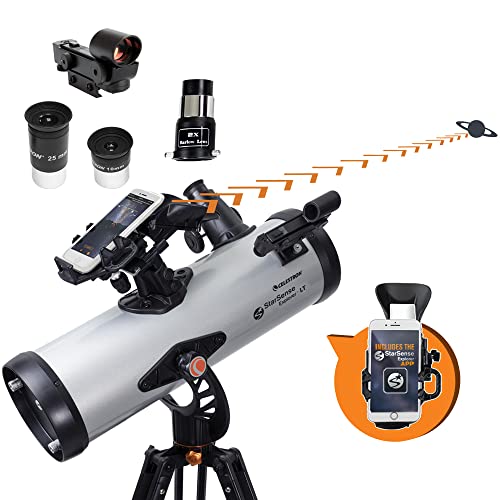 Best for smartphone-guided navigationCelestron StarSense Explorer LT 114AZ Newtonian Smartphone Guided TelescopeView on Amazon
- 5
 Best for a German equatorial mount on a budgetCelestron AstroMaster 130EQ Telescope for Deep-Sky BeginnersView on Amazon
- 6
 Best for compact fast imagingSVBONY SV48P Telescope, 90mm Aperture F5.5 Refractor OTAView on Amazon
Our Top Picks
Quick Comparison
| Product | Best for | Key feature |
|---|---|---|
| ZWO Seestar S30 Pro Smart Telescope | Hands-off deep-sky capture | Auto tracking and GoTo |
| Smart Telescope Astrophotography collection | Learning the workflow | Step-by-step imaging guidance |
| SVBONY SV503 Refractor | Bright wide-field views | 102mm ED optics |
| Celestron StarSense Explorer LT 114AZ | Smartphone-guided navigation | App-based sky alignment |
| Celestron AstroMaster 130EQ | Budget equatorial imaging | 130mm German equatorial mount |
| SVBONY SV48P Refractor | Compact fast imaging | 90mm F5.5 optics |
ZWO Seestar S30 Pro Smart Telescope
ZWO Seestar S30 Pro Smart Telescope, App-Controlled Astrophotography | 4K Dual Camera, Auto Tracking & GoTo, One-Tap Capture & Processing, Milky Way & Star Trail, Deep Sky & Wide-Field Imaging
Best for: Hands-off deep-sky capture
This suits people who want the telescope to find, track and stack targets from a phone with minimal manual work, including light-polluted backyards.
Pros:
- Auto tracking and GoTo reduce setup steps
- One-tap capture and processing in the app
Cons:
- Less control for users who want to tune every exposure
Smart Telescope Astrophotography: Capturing Deep-Sky Images from Your Backyard Using AI-Assisted Telescopes
Smart Telescope Astrophotography: Capturing Deep-Sky Images from Your Backyard Using AI-Assisted Telescopes (Smart Telescopoe Astrophotography Collection)
Best for: Learning the imaging workflow
This is a good fit for readers who want a structured introduction to AI-assisted deep-sky imaging before committing to a hardware setup.
Pros:
- Explains target selection and exposure planning
- Useful background for any smart telescope owner
Cons:
- It is a guide, so it does not replace owning a telescope
SVBONY SV503 Telescope for Adults High Powered, 102mm Large Diameter F7 ED
SVBONY SV503 Telescope for Adults High Powered, 102mm Large Diameter F7 ED | Extra Low Dispersion Achromatic OTA, Dual-Speed Focuser, Refractor Telescope for Planets Deep Sky Astrophotography Visual
Best for: Bright wide-field refractor views
Aimed at adults who want a sharp, color-corrected refractor for planets and brighter deep-sky objects, with a dual-speed focuser for finer control.
Pros:
- 102mm extra-low-dispersion optics for reduced color fringing
- Dual-speed focuser helps with precise focusing
Cons:
- Needs a sturdy mount for long-exposure imaging
Celestron StarSense Explorer LT 114AZ Newtonian Smartphone Guided Telescope
Celestron StarSense Explorer LT 114AZ Newtonian Smartphone Guided Telescope | Smartphone App Sky Navigation, Manual Reflector Telescope, Beginner Deep-Sky Telescope, Bright Celestial Views, Portable
Best for: Smartphone-guided navigation
A practical choice for beginners who want the phone app to point them at objects, though long deep-sky exposures still require a tracking mount.
Pros:
- App-based sky alignment makes finding targets easier
- Compact and portable for backyard sessions
Cons:
- Altazimuth mount limits long-exposure imaging
Celestron AstroMaster 130EQ Telescope for Deep-Sky Beginners
Celestron AstroMaster 130EQ Telescope for Deep-Sky Beginners | Large 130mm Optics, Bright Moon & Deep-Sky Views, Perfect First Telescope, German Equatorial Mount with Easy Manual Controls
Best for: Budget equatorial imaging
Suited to beginners who want a 130mm reflector on a German equatorial mount, which can follow the sky more smoothly than a simple altazimuth base.
Pros:
- Large 130mm optics gather good light for deep-sky targets
- Equatorial mount supports slow tracking
Cons:
- Manual controls require more setup time
SVBONY SV48P Telescope, 90mm Aperture F5.5 Refractor OTA
SVBONY SV48P Telescope, 90mm Aperture F5.5 Refractor OTA | Telescope for Adults & Beginner Astronomers, Telescopes for Deep Sky Astrophotography and Visual Astronomy
Best for: Compact fast imaging
A short-tube refractor with a fast focal ratio, suited to imagers who want wide fields and short exposure times while keeping the rig portable.
Pros:
- F5.5 ratio suits wide-field deep-sky targets
- Compact tube is easy to carry
Cons:
- Smaller aperture gathers less light than the 130mm reflector
Buying Guide
Aperture and Light Gathering
Aperture is the most important factor for deep sky work because it determines how much faint light the telescope collects. Larger apertures reveal fainter galaxies and nebulae, though bigger scopes also cost more and are heavier to move around.
Mount Type and Tracking
Deep sky imaging depends on the telescope following the sky smoothly during long exposures. Motorized GoTo or tracking mounts make this far easier than manual alt-azimuth mounts, which often require more setup skill and patience.
Equatorial mounts track well once polar aligned, but they take more time to learn. Smart all-in-one systems handle alignment and tracking automatically, which suits people who want quick results.
Focal Ratio and Field of View
A lower focal ratio gives a wider field of view and shorter exposure times, which helps with large objects like the Milky Way and bright nebulae. Higher focal ratios suit smaller targets such as planetary details but can make deep sky framing more demanding.
Ease of Setup and Learning Curve
Consider how much time you want to spend before taking your first image. Smartphone-guided and app-controlled systems reduce the learning curve considerably, while traditional scopes reward users willing to build skills over time.
Portability and Storage
If you plan to observe from different locations or have limited space, weight and footprint matter. Compact and portable designs are easier to transport and set up under dark skies, though they may trade some aperture or stability for convenience.
FAQ
Can a beginner really take deep sky photos with a telescope?
Yes, especially with smart or app-controlled telescopes that handle alignment, tracking, and stacking for you. Many beginners get recognizable images of nebulae and galaxies within their first few sessions. Patience and a dark sky site will improve results a lot.
Do I need a light-polluted area to do deep sky astrophotography?
Dark skies make a big difference because light pollution washes out faint objects. Some smart telescopes can still capture useful images from suburban areas by targeting brighter deep sky objects. Using light pollution filters can also help in moderately bright locations.
Is a larger aperture always better for deep sky imaging?
Larger apertures collect more light and resolve fainter detail, which is valuable for deep sky targets. However, a bigger telescope needs a sturdier mount and more setup effort. The best choice balances aperture with your mount, budget, and how much you plan to move the scope.
What is the difference between visual and astrophotography use?
Visual observing relies on your eye seeing faint objects through the eyepiece, while astrophotography uses a camera that accumulates light over long exposures. Some telescopes work well for both, but astrophotography generally needs reliable tracking and a suitable camera connection.
How important is polar alignment for equatorial mounts?
Polar alignment is essential for long exposures on equatorial mounts because it keeps the telescope tracking the sky accurately. Poor alignment can cause star trails and blurred images. Most users learn it with practice, and some mounts include tools to simplify the process.
Conclusion
For beginners who want the easiest path to deep sky images, smart and app-controlled telescopes offer automated tracking, alignment, and capture that minimize the learning curve. Smartphone-guided and beginner reflector options suit those who want to explore the sky visually first and grow into imaging over time.
For users ready to invest in more aperture and manual control, the larger refractor and equatorial mount options provide greater light gathering and room to build skills. Choose based on your budget, observing site, and how much setup effort you are willing to put in.
Related reading
- CCD Camera Telescope Astrophotography: A Beginner's Guide to Deep-Sky Images
- 6 Best Telescopes for Deep-Sky Astrophotography: Picks Compared (2026)
- 7 Best Telescopes for Deep Sky Viewing: Best Picks Compared for 2026
About Audrey Hayes
Audrey Hayes is part of our editorial team and reviews and edits our telescopes & stargazing guides, checking product details against manufacturer specifications and owner feedback.
About the author
Audrey Hayes writes reviews and buying guides for Astronomy Site.