3 Best Web Cameras for Astrophotography Picks Compared (2026)
Compare three web camera for astrophotography options by sensor, frame rate and lens, with clear pros, cons and who each one suits best.
 By Colin Foster
Updated November 8, 2026
 By Colin Foster
Updated November 2026
Choosing a web camera for astrophotography is less about megapixels and more about sensitivity, frame rate and how well the lens suits planetary or lunar work. A webcam is a small, low-cost sensor paired with a fixed lens, which makes it a practical entry point for capturing the Moon, the planets and bright double stars through a telescope. This guide compares three real Amazon listings using a research-based method: we looked at published sensor types, frame-rate and resolution specifications, lens and microphone details, and the patterns owners tend to describe in their feedback. We did not test these cameras ourselves. The selection criteria were sensor type (monochrome versus color), maximum frame rate, lens quality, and how easily each unit connects to a laptop or single-board computer.
Our top picks at a glance
- 1TOP CHOICEBest overallArducam 100fps Mono Global Shutter USB Camera, 720P OV9281 UVC Webcam ModuleView on Amazon
- 2
 Best for general-purpose useAmazon Basics Webcam with Microphone, Full HD 1080p, Computer CameraView on Amazon
- 3
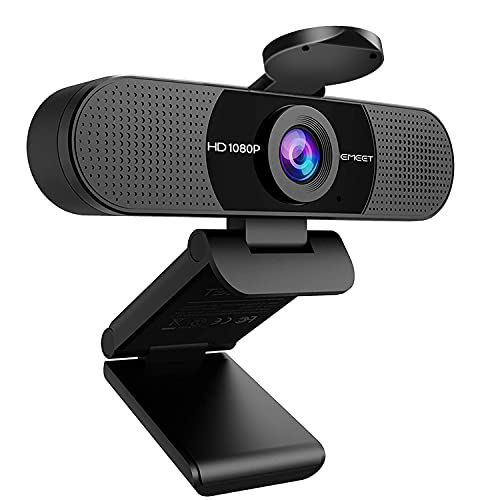 Best budget pickEMEET 1080P Webcam with Microphone, C960 Web Camera 2 Mics Streaming WebcamView on Amazon
Our Top Picks
| Product | Best for | Key feature |
|---|---|---|
| Arducam 100fps Mono Global Shutter USB Camera | Planetary and lunar imaging | Monochrome global shutter sensor with 100 fps listed |
| Amazon Basics Webcam with Microphone | General-purpose and casual sky viewing | Full HD 1080p with auto light correction |
| EMEET 1080P Webcam with Microphone, C960 | Budget-minded beginners | 1080p with a 90° field of view and dual microphones |
Arducam 100fps Mono Global Shutter USB Camera, 720P OV9281 UVC Webcam Module
Arducam 100fps Mono Global Shutter USB Camera, 720P OV9281 UVC Webcam Module with Low Distortion M12 Lens Without Microphones, for Computer, Laptop, Android and Raspberry Pi
Best for: Planetary and lunar imaging
This module suits astrophotographers who want to stack many short video frames of the Moon or planets. Its monochrome global shutter design is the feature that matters most here, because it avoids the motion distortion of rolling-shutter sensors and records every pixel at the same moment.
Key specs
- Sensor: OV9281 monochrome global shutter (as named in the listing)
- Resolution: 720P (as named in the listing)
- Frame rate: up to 100 fps (as named in the listing)
- Lens: M12 low-distortion lens (as named in the listing)
- Interface: UVC USB, compatible with computers, Android and Raspberry Pi
Pros
- Monochrome sensors generally give better signal-to-noise for planetary work than color sensors of similar size.
- Global shutter avoids skew when imaging fast-moving subjects.
- Works with common capture software that accepts UVC devices.
Cons
- The 720P resolution is modest, so fine detail on planets will depend heavily on focal length and seeing conditions.
- Requires some setup comfort with exposure control and stacking software.
Bottom line: The best fit for someone serious about planetary video and willing to learn stacking workflows.
View on AmazonAmazon Basics Webcam with Microphone, Full HD 1080p, Computer Camera
Amazon Basics Webcam with Microphone, Full HD 1080p, Auto Light Correction, Computer Camera for Streaming and Meetings, Black
Best for: General-purpose and casual sky viewing
This is a conventional 1080p webcam aimed at video calls and streaming. It can serve as a simple way to point a camera at the Moon or bright objects through a telescope, but it is not designed for long-exposure or high-sensitivity work, so expect it to suit casual snapshots rather than detailed astrophotography.
Key specs
- Resolution: Full HD 1080p (as named in the listing)
- Feature: auto light correction (as named in the listing)
- Built-in microphone (as named in the listing)
- Color, black finish (as named in the listing)
Pros
- Full HD output is easy to view and share on a laptop screen.
- Auto light correction helps with the mixed lighting of indoor setups.
- Plug-and-play operation with common video software.
Cons
- Automatic exposure and compression limit how well it handles faint deep-sky targets.
- Built-in microphone and conferencing features add nothing to astrophotography.
Bottom line: A reasonable choice for someone who wants to try webcam imaging of the Moon without committing to a specialized camera.
View on AmazonEMEET 1080P Webcam with Microphone, C960 Web Camera 2 Mics Streaming Webcam
EMEET 1080P Webcam with Microphone, C960 Web Camera 2 Mics Streaming Webcam | 90°FOV Computer Camera, Plug and Play USB Web Cam for Online Calling/Conferencing, Zoom/Teams/Facetime/YouTube, Laptop/PC
Best for: Budget-minded beginners
This webcam is aimed at streaming and calls, with a wide 90° field of view. For astrophotography, the wide view is useful for framing the Moon or a bright star field through a short-focal-length setup, though it will not resolve planetary detail the way a dedicated planetary camera can. It fits beginners who want to learn the workflow first.
Key specs
- Resolution: 1080P (as named in the listing)
- Field of view: 90° (as named in the listing)
- Dual microphones (as named in the listing)
- Plug and play USB (as named in the listing)
Pros
- Wide field of view makes framing easier for beginners.
- Plug-and-play setup with laptops and PCs.
- Full HD output gives a crisp preview.
Cons
- Rolling-shutter, consumer-grade sensor limits performance on fast planetary targets.
- Microphones and streaming features are unnecessary for sky imaging.
Bottom line: A sensible starting point for learning the basics before investing in a dedicated planetary camera.
View on AmazonBuying Guide
Sensor type: monochrome versus color
Monochrome sensors have no color filter array, so every pixel collects more light. That generally gives better sensitivity and cleaner stacked results for planets and the Moon. Color sensors are simpler to use because they show color directly, but they trade some sensitivity for it.
Good picks for this: Arducam 100fps Mono Global Shutter USB Camera, Amazon Basics Webcam with Microphone
Frame rate and shutter type
Planetary imaging relies on capturing hundreds or thousands of short frames and stacking the sharpest ones. A high frame rate helps, and a global shutter avoids the skew that appears when a rolling shutter scans across fast-moving subjects. Check the listed frame rate and shutter type before buying.
Good picks for this: Arducam 100fps Mono Global Shutter USB Camera, EMEET 1080P Webcam with Microphone, C960
Resolution and pixel size
Higher resolution is not always better. Pixel size relative to your telescope’s focal length determines how well the sensor samples fine detail. Many planetary imagers aim for small, well-matched pixels rather than the largest pixel count available.
Good picks for this: Arducam 100fps Mono Global Shutter USB Camera, Amazon Basics Webcam with Microphone
Lens and field of view
Webcam lenses are usually fixed and designed for close-range subjects. Field of view matters for framing: a wide view makes it easier to find targets, while a narrower view magnifies fine detail. Check whether the lens can be swapped or removed, since many astrophotographers use the camera body with the telescope rather than the stock lens.
Good picks for this: EMEET 1080P Webcam with Microphone, C960, Arducam 100fps Mono Global Shutter USB Camera
Connectivity and compatibility
USB UVC compatibility means the camera can be recognized by common capture software without special drivers. Confirm that your laptop, desktop or single-board computer supports the interface and that the cable length suits your setup, since long USB runs can drop signal.
Good picks for this: Arducam 100fps Mono Global Shutter USB Camera, Amazon Basics Webcam with Microphone
Built-in features you may not need
Microphones, privacy shutters and auto-focus features are designed for video calls. For sky imaging they add weight, power draw and sometimes electronic noise, and auto-exposure can fight your manual settings. Removing or ignoring these features is often part of getting clean results.
Good picks for this: Arducam 100fps Mono Global Shutter USB Camera, EMEET 1080P Webcam with Microphone, C960
Durability and mounting
Your camera will sit at a telescope eyepiece or focuser for long sessions, often in cold and damp conditions. Look for a sturdy body, a standard thread or mount point, and a cable that stays put. Owners often report that loose cables are a frequent source of frustration during long sessions.
Good picks for this: Arducam 100fps Mono Global Shutter USB Camera, Amazon Basics Webcam with Microphone
FAQ
Can a regular webcam be used for astrophotography?
Yes, for bright targets such as the Moon, the planets and bright double stars, a webcam can produce useful images when used at the telescope’s focal plane. Faint deep-sky objects are generally beyond what consumer webcams can capture.
Why is a monochrome camera preferred for planetary work?
Monochrome sensors have no color filters, so each pixel receives more light. This generally improves sensitivity and signal-to-noise, which helps when stacking short frames of a planet.
What frame rate do I need?
Higher frame rates let you capture more frames per second, which increases the number available for stacking. Many planetary imagers aim for enough frames to stack hundreds or thousands of the sharpest images, so a higher frame rate is helpful but not the only factor.
Do I need special software?
You will need capture software that can record video from a UVC camera and stacking software to combine the sharpest frames. Many free and paid options exist, and the choice depends on your operating system and workflow.
Is a global shutter important?
A global shutter exposes every pixel at once, which avoids the skew that rolling-shutter sensors create when imaging moving subjects. For planetary and lunar video, this is generally considered an advantage.
Can I use a webcam with a telescope directly?
Many astrophotographers mount the camera body at the telescope’s focuser or eyepiece position after removing the stock lens. Adapters and threads vary by model, so check the camera’s mounting options and your telescope’s focuser size before buying.
Should a beginner start with a webcam?
A webcam can be a low-commitment way to learn the basics of planetary imaging, focusing, capture and stacking. Once you understand the workflow, you can decide whether a dedicated astronomy camera is worth the investment.
Conclusion
For planetary and lunar work, the Arducam 100fps Mono Global Shutter USB Camera is the most purpose-built option of the three, thanks to its monochrome global shutter sensor and high listed frame rate. The Amazon Basics Webcam with Microphone suits someone who wants a simple, general-purpose camera for casual sky viewing. The EMEET 1080P Webcam with Microphone, C960 is a sensible budget starting point for learning the workflow, with the understanding that its performance on fast-moving targets will be limited.
Sources
- Background on planetary observation, the Moon and telescope imaging basics (nasa.gov)
- Resources from the American Astronomical Society on amateur observing and astronomy education
- Practical guidance on telescope accessories and astrophotography techniques
Related reading
- iPhone Camera Settings for Astrophotography: A Step-by-Step Guide
- iPhone Camera App for Astrophotography: Settings, Steps and Setup Tips
- iPhone 13 Camera Astrophotography: Step-by-Step Guide to Night Sky Shots
- What Is the Best Nikon Camera Lens for Astrophotography? Top Picks
About Colin Foster
Colin Foster is part of our editorial team and reviews and edits our telescopes & stargazing guides, checking product details against manufacturer specifications and owner feedback.
About the author
Colin Foster writes reviews and buying guides for Astronomy Site.