Celestron Astromaster Refractor Telescope (2026): Pros, Cons & Verdict
Celestron AstroMaster refractor telescope review: 90mm optics, alt-azimuth mount, who it suits, who should skip it, and how it compares to a StarSense alternati
 By Claire Whitaker
Updated November 11, 2026
 By Claire Whitaker
Updated November 2026
The Celestron AstroMaster 90AZ is a 90mm refractor on an alt-azimuth mount, sold as a first telescope for families, students and casual observers who want bright views of the Moon, planets and bright star clusters without a steep learning curve. It is a good fit if you want glass optics, a simple setup and a telescope that works in a backyard or on a balcony with a clear view of the sky. It is a poor fit if your main goal is faint deep-sky objects like distant galaxies and nebulae, if you want computerized object finding, or if you plan to do astrophotography. Buyers who want go-to pointing should look at a different category entirely.
Celestron – AstroMaster 90AZ Telescope – Refractor Telescope – Fully-Coated Glass Optics – Adjustable-Height Tripod – Bonus Astronomy Software Package
Product Overview
The AstroMaster 90AZ belongs to Celestron’s AstroMaster line, a set of entry-level telescopes built around straightforward optics and manual mounts. The listing identifies it as a refractor telescope with fully coated glass optics, an adjustable-height tripod and a bonus astronomy software package. In practical terms, that means the telescope uses lenses rather than mirrors to gather light, the lens surfaces carry anti-reflection coatings to improve light transmission, and you aim it by hand using an alt-azimuth mount that moves up-and-down and side-to-side.
Refractors have a long history in amateur astronomy because they need little maintenance. There is no mirror to collimate, and the tube is sealed, so dust is less of a concern than with some reflector designs. The tradeoff is cost per inch of aperture: a 90mm lens is more expensive to make than a comparable mirror, which is one reason refractors in this size class tend to be smaller than reflectors at the same price tier.
The AstroMaster 90AZ is aimed squarely at beginners. Owners generally describe it as easy to assemble and easy to point, with the main learning curve being the eyepiece and the sky itself rather than the mechanics. Because the mount is manual, there are no motors or electronics to troubleshoot, which many first-time buyers consider a plus.
Key Features & Specifications
The table below lists the features named in the product listing and the characteristics that are standard for a 90mm refractor on an alt-azimuth mount. Where a specific figure is not confirmed by the listing, it is left out rather than estimated.
| Feature | What it means for you |
|---|---|
| 90mm aperture refractor (lens-based optics) | Gathers more light than a 60mm or 70mm refractor, so bright objects look sharper and fainter ones become visible. |
| Fully coated glass optics | Anti-reflection coatings on the glass improve image brightness and contrast compared with uncoated lenses. |
| Alt-azimuth mount | Moves up-and-down and side-to-side. Intuitive for beginners, but tracking objects requires manual nudging. |
| Adjustable-height tripod | Lets you raise or lower the eyepiece for comfortable viewing while seated or standing. |
| Manual operation (no motors or computer) | No batteries or electronics to manage; you find objects by sight and star-hopping. |
| Bonus astronomy software package | Included star charts and sky-guide software to help you plan observing sessions. |
| Eyepiece-based magnification | Magnification depends on the eyepiece you use; the telescope itself has no fixed power. |
Manufacturers typically specify focal length and focal ratio for this class of telescope. Check the packaging or the full manufacturer spec sheet before buying if you need those numbers for planning eyepiece choices, since the listing summary does not state them.
Pros & Cons
Pros
- A 90mm aperture gives a clear step up in light-gathering over smaller starter refractors.
- Glass optics with coated lenses produce sharp, high-contrast views of the Moon and planets.
- Manual alt-azimuth mount is simple to understand and needs no batteries.
- Adjustable-height tripod helps reduce neck strain during longer sessions.
- The sealed refractor tube requires essentially no collimation.
- Included software gives beginners a starting point for learning the sky.
Cons
- Manual mount means you must nudge the scope to follow objects, which can be tiring at high magnification.
- No computerized object finding; new observers need time to learn star-hopping.
- Faint deep-sky objects will look dim compared with what larger reflectors show.
- Not designed for astrophotography without additional accessories and a mount upgrade.
- Owners sometimes mention that the included eyepieces are basic, so an upgrade may be worthwhile.
Performance Analysis
Aperture is the single most important number for what a telescope shows you, because it determines how much light the objective collects. A 90mm lens collects roughly twice the light of a 60mm lens (the light-gathering scales with the area of the opening, not its diameter). That difference shows up most on dimmer targets. On the Moon, the extra detail along the terminator (the line between light and shadow) is easy to appreciate. On Jupiter, you can typically pick out the cloud bands and the four Galilean moons, and Saturn’s rings should be clearly visible when the planet is well placed in the sky.
Owner feedback for telescopes in this category commonly centers on three themes. First, the views of the Moon and bright planets are consistently described as satisfying. Second, the mount is regarded as stable enough at low and moderate magnification, but it can shake or drift at high power, especially if the tripod is lightweight or placed on soft ground. Third, many new owners report that the hardest part is locating objects, not seeing them once found. A printed star chart, a red-light flashlight and a few evenings practicing star-hopping usually make a big difference.
Deep-sky performance is where expectations need to be set carefully. Bright open clusters such as the Pleiades and the Double Cluster in Perseus are rewarding targets. The Orion Nebula is visible as a glowing patch from reasonably dark skies. Fainter galaxies and nebulae will appear as subtle gray smudges rather than the detailed images seen in long-exposure photographs. Light pollution has a large effect: from a suburban backyard, expect the Moon, planets, double stars and brighter clusters to be the highlights.
Refractors have a reputation for excellent contrast and color-neutral views, and the coated glass optics help here. You may notice faint color fringing around very bright objects like the Moon or Venus at high power; this is normal for achromatic refractors and is reduced by stopping down or using a filter.
Who Should Buy This Product?
The AstroMaster 90AZ suits several types of buyers. Families looking for a shared first telescope will appreciate the simple setup and the immediate rewards of lunar and planetary viewing. Students doing a school astronomy project can use it for hands-on observation and sketching. Adults who have never looked through a telescope and want a no-electronics introduction will find the manual approach educational rather than frustrating, provided they are willing to learn the sky.
It is less suitable for people who want a telescope that finds objects for them, who plan to photograph the sky, or who live in heavily light-polluted cities and want to see faint galaxies. Those buyers should consider a computerized or go-to model, or a larger reflector for deep-sky work.
Buying Guide
When deciding whether this telescope fits your needs, start with your observing goals and your sky. If you mostly want to see the Moon, planets and bright clusters, a 90mm refractor on a manual mount is a sensible choice. If you want to see many galaxies from a dark site, a larger aperture reflector will serve you better. Our guide to Celestron Astromaster 90az Refractor Telescope: A Practical Guide (2026) walks through the same aperture-versus-mount tradeoffs for this model in more detail.
Next, think about the mount. Alt-azimuth mounts are the most intuitive and the most affordable way to get aperture, but they make tracking objects harder than equatorial mounts. If you expect to spend long sessions on a single target, a sturdier tripod or a motorized accessory may help. Smaller refractors are easier to carry; if portability matters more than aperture, look at the options covered in Celestron 70mm Portable Refractor Telescope Travel Scope: 5 Best Picks for 2026.
Eyepieces matter as much as the telescope. Start with a low-power eyepiece for wide, bright views and add higher-power options as you gain experience. Solar viewing requires a proper full-aperture solar filter on the front of the telescope, never an eyepiece filter; guidance is available in Top 7 Refractor Telescope Solar Filters Compared for Safe Sun Viewing.
Two well-known alternatives are worth considering:
- Celestron StarSense Explorer LT 114AZ Newtonian – a reflector with a smartphone app that helps you find objects. It offers a larger aperture and a guided approach that suits buyers who find star-hopping frustrating. See also 4 Best Celestron Starsense Explorer Lt 80 Refractor Telescopes (2026): Our Picks for related StarSense options.
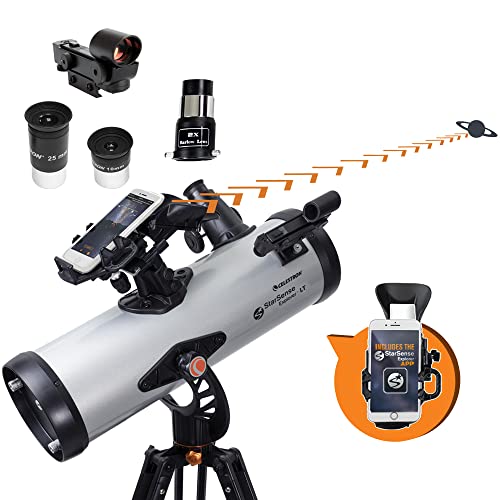
Celestron StarSense Explorer LT 114AZ Newtonian Smartphone Guided Telescope | Smartphone App Sky Navigation, Manual Reflector Telescope, Beginner Deep-Sky Telescope, Bright Celestial Views, Portable
- Celestron Omni XLT 102mm AZ – a larger refractor for buyers who want more light and are comfortable with a manual mount. Compare options in Celestron Omni XLT 102mm AZ Refractor Telescope: 3 Best Picks Compared (2026).
- Tasco Galaxsee – a budget-oriented refractor that suits very casual observing. See Tasco Galaxsee Refractor Telescope: 4 Best Picks Compared (2026).
FAQ
Is the Celestron AstroMaster 90AZ good for beginners?
Yes, for most beginners who want a simple, no-electronics telescope. Expect a learning period to find objects, but the views of the Moon and planets are rewarding from the first session.
What can I see with a 90mm refractor?
The Moon’s craters and terminator, the phases of Venus, Jupiter’s cloud bands and moons, Saturn’s rings, bright star clusters like the Pleiades, and some brighter nebulae from dark skies.
Does the telescope come with a computer or go-to system?
No. The mount is manual, and you locate objects by sight, star charts and star-hopping. The included software is a planning aid rather than a motorized controller.
Can I use this telescope for astrophotography?
Basic photography, such as imaging the Moon through a smartphone adapter, is possible. Serious astrophotography typically requires a tracking mount, a camera adapter and more advanced accessories than this package includes.
Do I need to collimate the optics?
No. Refractors have lens-based optics with a sealed tube, so collimation is not normally required, unlike with many reflector telescopes.
Will it show color in planets?
Jupiter and Saturn show subtle color in their bands and rings. Some faint color fringing around very bright objects is typical for achromatic refractors and is usually minor.
Is it safe to look at the Sun with this telescope?
Only with a proper full-aperture solar filter fitted to the front of the telescope. Never point the telescope at the Sun without one, and never use eyepiece-mounted solar filters, which can crack from the heat. If you are unsure, consult an experienced astronomy club or a qualified instructor before observing the Sun.
Final Verdict
The Celestron AstroMaster 90AZ is a sensible first telescope for buyers who want a 90mm refractor with coated glass optics and a simple manual mount. It delivers satisfying views of the Moon, planets and bright star clusters, and it asks for no batteries, no collimation and no computer. It is not the right choice for faint deep-sky work, astrophotography or computerized object finding. If those matter to you, compare the alternatives above before deciding.
View on AmazonAbout Claire Whitaker
Claire Whitaker is part of our editorial team and reviews and edits our telescopes & stargazing guides, checking product details against manufacturer specifications and owner feedback.
About the author
Claire Whitaker writes reviews and buying guides for Astronomy Site.