3 Best Barlow Lens for Celestron 130: Picks Compared for Planets and Deep Sky
Looking for the best Barlow lens for Celestron 130? We compare three 1.25" options on magnification, optics, and fit to help you choose the right one.
 By Colin Foster
Updated November 10, 2026
 By Colin Foster
Updated November 2026
Finding the best Barlow lens for Celestron 130 comes down to a few practical questions: does it thread onto your eyepieces without rattling, does it deliver a clean image at higher power, and does it suit how you actually observe? A Barlow sits between the telescope’s focuser and the eyepiece and multiplies the magnification of whatever eyepiece you already own. That sounds simple, but the quality of the lens, the barrel fit, and the amount of magnification you choose all shape what you see of planets, the Moon, and double stars. This guide compares three 1.25-inch options using specification clarity, optical coating, build quality, and owner feedback patterns, so you can match a pick to your observing goals.
Our top picks at a glance
- 1TOP CHOICEBest overallCelestron X-Cel LX 2X Barlow Lens for Telescope Eyepieces – 1.25"View on Amazon
- 2
 Best for budget-minded beginnersCelestron Omni 1.25" 2X Barlow Lens for Telescope Eyepieces Threaded BarrelView on Amazon
- 3
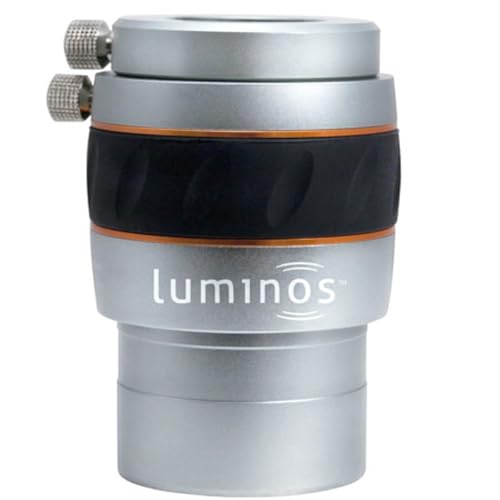 Best for higher power and planetary detailCelestron Luminos 2.5X Barlow Lens for 1.25" & 2" Telescope EyepiecesView on Amazon
How we selected these: This is a research-based comparison. We reviewed manufacturer specifications, brand reputation for optics, and common owner feedback about threading, collimation-friendly design, and image contrast. We did not run side-by-side tests of these lenses.
Our Top Picks
Quick Comparison
| Product | Best for | Key feature |
|---|---|---|
| Celestron X-Cel LX 2X Barlow Lens | Overall use across planets and deep sky | Brass compression ring and removable optical cell |
| Celestron Omni 1.25″ 2X Barlow Lens | Budget-minded beginners | Fully multi-coated optics with a straightforward 2X design |
| Celestron Luminos 2.5X Barlow Lens | Higher power and planetary detail | 2.5X magnification that fits both 1.25″ and 2″ eyepieces |
Celestron X-Cel LX 2X Barlow Lens for Telescope Eyepieces – 1.25″
Celestron X-Cel LX 2X Barlow Lens for Telescope Eyepieces – 1.25" | Doubles Eyepiece Magnification, Fully Multi-Coated Optics, Brass Compression Ring, Removable Optical Cell, Durable Housing
Best for: Overall use across planets and deep sky
This is the pick for observers who want one Barlow that works well across a range of targets and eyepieces. It suits people who plan to keep a Barlow in their kit for years and value a serviceable design.
Key specs
- Magnification factor: 2X
- Barrel size: 1.25-inch
- Fully multi-coated optics
- Brass compression ring and removable optical cell
Pros
- Removable optical cell makes cleaning simpler than sealed designs
- Brass compression ring helps hold eyepieces securely
- Multi-coated optics support good contrast at moderate powers
Cons
- Doubling magnification may be more than wide-field eyepieces need for some targets
- Heavier than minimalist Barlows, which can add stress to the focuser with long eyepiece setups
Bottom line: A strong default choice if you want a durable, versatile Barlow for general observing with a Celestron 130 setup.
View on AmazonCelestron Omni 1.25″ 2X Barlow Lens for Telescope Eyepieces Threaded Barrel
Celestron Omni 1.25" 2X Barlow Lens for Telescope Eyepieces Threaded Barrel | Doubles Eyepiece Magnification, Fully Multi-Coated Optics, Precision Machined Housing, Blackened Edges, High-Contrast View
Best for: Budget-minded beginners
This is a practical starting point for newer observers who want to see what extra magnification does to lunar craters and planetary disks without committing to a premium accessory.
Key specs
- Magnification factor: 2X
- Barrel size: 1.25-inch with threaded eyepiece connection
- Fully multi-coated optics
- Blackened edges to reduce stray light
Pros
- Straightforward 2X design is easy to understand and use
- Threaded barrel gives a secure connection to compatible eyepieces
- Blackened edges help limit internal reflections
Cons
- Fewer build-related features than the X-Cel LX line
- Owners often recommend checking eyepiece eye relief, since a Barlow shifts the focus point
Bottom line: Choose this if you are new to Barlows and want a simple, sensible 2X lens for your Celestron 130.
View on AmazonCelestron Luminos 2.5X Barlow Lens for 1.25″ & 2″ Telescope Eyepieces
Celestron Luminos 2.5X Barlow Lens for 1.25" & 2" Telescope Eyepieces | Increases Eyepiece Magnification 2.5X, Fully Multi-Coated Optics, Fits 1.25" & 2" Eyepieces, Premium Optical Performance
Best for: Higher power and planetary detail
This lens is aimed at observers who already own good eyepieces and want more magnification for planets, Jupiter’s bands, or lunar detail on steady nights. It also suits people who use 2-inch eyepieces.
Key specs
- Magnification factor: 2.5X
- Fits 1.25-inch and 2-inch eyepieces
- Fully multi-coated optics
Pros
- 2.5X power pushes planetary views further than a 2X Barlow
- Compatibility with 2-inch eyepieces adds flexibility
- Premium optical design aimed at good performance at higher power
Cons
- Higher magnification can make dim deep-sky objects harder to see
- Seeing conditions limit the benefit; owners often report softer images on turbulent nights
Bottom line: Pick this if your priority is planetary observing and you understand that more power needs steady air to pay off.
View on AmazonBuying Guide
Magnification factor
A Barlow’s number, such as 2X or 2.5X, multiplies the power of the eyepiece you insert into it. To estimate the result, multiply the eyepiece’s focal length ratio by the Barlow factor. A 10mm eyepiece in a 2X Barlow behaves like a 5mm eyepiece. Higher powers reveal finer planetary detail but reduce brightness and field of view, so start moderate and step up as conditions allow.
Good picks for this: Celestron Omni 1.25″ 2X Barlow Lens, Celestron X-Cel LX 2X Barlow Lens
Barrel size and eyepiece compatibility
Most eyepieces for the Celestron 130 use 1.25-inch barrels, so confirm that first. Some Barlows also accept 2-inch eyepieces. Check your focuser and the eyepiece barrel before buying, since mismatched sizes will not seat properly.
Good picks for this: Celestron Luminos 2.5X Barlow Lens, Celestron Omni 1.25″ 2X Barlow Lens
Optical coatings
Multi-coated optics reduce reflections and help maintain contrast, especially on the Moon and planets. Manufacturers typically specify fully multi-coated designs for better light transmission. Coatings matter more at higher magnification, where any loss of contrast becomes visible.
Good picks for this: Celestron X-Cel LX 2X Barlow Lens, Celestron Luminos 2.5X Barlow Lens
Build quality and threading
Look for a precision-machined housing, threaded connections, and features such as a compression ring that holds the eyepiece firmly. A loose fit can cause focus shifts and image wobble. Metal construction generally feels more secure than lightweight plastic.
Good picks for this: Celestron X-Cel LX 2X Barlow Lens, Celestron Omni 1.25″ 2X Barlow Lens
Balance on your focuser
Heavier Barlows combined with heavy eyepieces and cameras can droop or shift focus on lightweight focusers. Keep the total assembly as light as practical, and consider how you will support any attached camera. Owners often note that a short, light setup feels steadier.
Good picks for this: Celestron Omni 1.25″ 2X Barlow Lens, Celestron Luminos 2.5X Barlow Lens
Use case: planets versus deep sky
For planets, Barlows add useful magnification. For deep-sky objects such as galaxies and nebulae, a Barlow often dims the view too much, so many observers use it sparingly. Match the factor to your target list and your typical sky conditions.
Good picks for this: Celestron X-Cel LX 2X Barlow Lens, Celestron Luminos 2.5X Barlow Lens
Care and cleaning
Keep caps on when not in use and avoid touching the glass. Use a blower and a soft brush first, and only clean lens surfaces with optical-grade solution and tissue if needed. Removable optical cells, where available, make cleaning easier. Store the lens in a padded case.
Good picks for this: Celestron X-Cel LX 2X Barlow Lens, Celestron Omni 1.25″ 2X Barlow Lens
FAQ
Will a Barlow lens work with my Celestron 130 telescope?
Most Barlows with a 1.25-inch barrel will work with a Celestron 130 that uses a standard 1.25-inch focuser. Confirm your focuser size in the telescope’s documentation before purchase.
Is a 2X or 2.5X Barlow better for planets?
A 2X Barlow is more versatile and keeps images brighter. A 2.5X lens offers more detail on planets when seeing is steady. Many observers start with 2X and move up as they gain experience.
Does a Barlow lens reduce image brightness?
Yes. Increasing magnification spreads the same light over a larger image, so objects appear dimmer. Good coatings help limit the loss, but the effect is unavoidable.
Can I use a Barlow with any eyepiece?
Most eyepieces work, but eye relief and focus can change. Some eyepieces may need slight refocusing, and very long eyepiece assemblies can strain the focuser. Test your combination on a bright target first.
Why does my image look soft with a Barlow?
Atmospheric turbulence, poor collimation, or a dirty optical surface are common causes. Check collimation of your telescope and clean the lens gently before assuming the Barlow is at fault.
Do I need a Barlow for deep-sky observing?
Not always. Low-power, wide-field eyepieces are often better for galaxies and star clusters. A Barlow is more useful for planets, the Moon, and tight double stars.
For a broader look at Barlow options, see Is a Barlow Lens Worth It? 6 Picks Compared for Every Telescope and 5 Best Barlow Lens for Telescope Picks Compared (2026). If you are weighing a 3x option, Celestron Barlow Lens 3x Review: Is It Worth It? covers that trade-off, and Top 5 2x or 3x Barlow Lens for Planetary Viewing Compared is useful for planet-focused choices.
Conclusion
For most Celestron 130 owners, the Celestron X-Cel LX 2X Barlow Lens offers the best balance of build, versatility, and cleaning convenience. The Celestron Omni 1.25″ 2X Barlow Lens suits beginners who want a simple, sensible 2X accessory. The Celestron Luminos 2.5X Barlow Lens is the choice for planetary observers who have steady skies and good eyepieces. Match the magnification to your targets and your conditions, and the right Barlow will add real value to your observing.
Sources
- Background on planetary observing targets and how viewing conditions affect planetary detail (nasa.gov)
- Resources from the American Astronomical Society on amateur telescope use and observing practice
- Beginner guidance on telescope accessories and eyepiece magnification
Related reading
About Colin Foster
Colin Foster is part of our editorial team and reviews and edits our telescopes & stargazing guides, checking product details against manufacturer specifications and owner feedback.
About the author
Colin Foster writes reviews and buying guides for Astronomy Site.