4 Best Barlow Lens for Celestron 8SE: Picks Compared for Planets and Deep Sky
Looking for the best Barlow lens for Celestron 8SE? Compare four picks on fit, magnification, and optical quality to choose the right one for planets and deep s
 By Colin Foster
Updated November 10, 2026
 By Colin Foster
Updated November 2026
Finding the best Barlow lens for Celestron 8SE comes down to matching the accessory to how you observe. The 8SE is a Schmidt-Cassegrain with a focal length of roughly 2032mm at f/10, so a Barlow multiplies an eyepiece’s power without you buying more eyepieces. This guide compares four Celestron-branded Barlows on the criteria that matter most for this scope: barrel size, magnification factor, optical coating, build quality, and how well each one suits planetary work versus wide-field deep-sky viewing.
Our top picks at a glance
- 1TOP CHOICEBest overallCelestron X-Cel LX 2X Barlow Lens for Telescope Eyepieces – 1.25"View on Amazon
- 2
 Best for planetary detailCelestron Omni 1.25" 2X Barlow Lens for Telescope Eyepieces Threaded BarrelView on Amazon
- 3
 Best for variable powerCelestron 8-24mm Zoom Telescope Eyepiece with Fully Multi-Coated OpticsView on Amazon
- 4
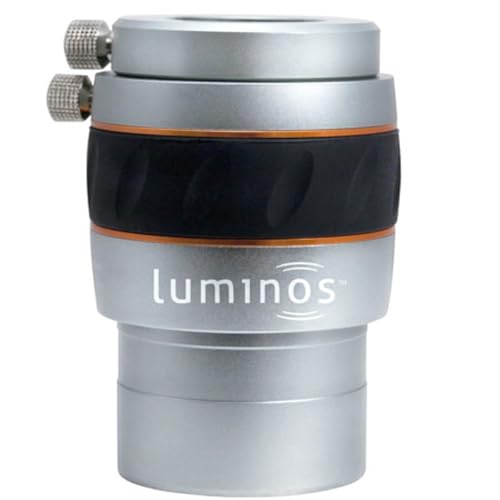 Best for dual-barrel flexibilityCelestron Luminos 2.5X Barlow Lens for 1.25" & 2" Telescope EyepiecesView on Amazon
How we selected these picks: This is a research-based comparison built from published specifications, brand reputation, and patterns in owner feedback. We did not bench-test these lenses. Where a detail is not confirmed by the listing or the manufacturer, we left it out.
Our Top Picks
Quick Comparison
| Product | Best for | Key feature |
|---|---|---|
| Celestron X-Cel LX 2X Barlow Lens – 1.25″ | Overall use on the 8SE | Fully multi-coated optics with a removable optical cell |
| Celestron Omni 1.25″ 2X Barlow Lens | Planetary observing | Precision machined housing with blackened edges for contrast |
| Celestron 8-24mm Zoom Eyepiece | Variable magnification | One eyepiece covers a range of focal lengths |
| Celestron Luminos 2.5X Barlow Lens | Mixed 1.25″ and 2″ eyepiece setups | Fits both 1.25″ and 2″ eyepieces at 2.5X |
Celestron X-Cel LX 2X Barlow Lens for Telescope Eyepieces – 1.25″
Celestron X-Cel LX 2X Barlow Lens for Telescope Eyepieces – 1.25" | Doubles Eyepiece Magnification, Fully Multi-Coated Optics, Brass Compression Ring, Removable Optical Cell, Durable Housing If you want more background, see Celestron Binoculars for Astronomy: 4 Best Picks Compared (2026).
Best for: Overall use on the 8SE with a standard 1.25″ eyepiece collection.
This is the most straightforward choice for an 8SE owner who already has a few 1.25″ eyepieces and wants to double their magnification range. It suits observers who plan to use the scope for both lunar and planetary work and occasional deep-sky targets.
Key specs
- Magnification factor: 2X
- Barrel size: 1.25″
- Optics: fully multi-coated
- Brass compression ring for eyepiece retention
- Removable optical cell
Pros
- Doubles the power of each eyepiece you pair with it
- Multi-coated glass helps maintain light transmission
- Removable cell makes cleaning simpler
Cons
- A 2X factor can soften the image in less steady conditions
- Only accepts 1.25″ eyepieces without an adapter
Bottom line: A dependable first Barlow for most 8SE owners. Pick it if you want a safe, general-purpose 2X.
View on AmazonCelestron Omni 1.25″ 2X Barlow Lens for Telescope Eyepieces Threaded Barrel
Celestron Omni 1.25" 2X Barlow Lens for Telescope Eyepieces Threaded Barrel | Doubles Eyepiece Magnification, Fully Multi-Coated Optics, Precision Machined Housing, Blackened Edges, High-Contrast View
Best for: Planetary observing where contrast and sharpness matter most.
Observers who spend most of their time on Jupiter, Saturn, and Mars often look for a Barlow that keeps the image crisp at high power. This model suits people who value a clean, high-contrast view over wide-field coverage.
Key specs
- Magnification factor: 2X
- Barrel size: 1.25″ threaded barrel
- Optics: fully multi-coated
- Precision machined housing with blackened edges
Pros
- Blackened internal edges help suppress stray light
- Threaded barrel gives a secure connection to eyepieces
- Well suited to planetary detail at high power
Cons
- Fixed 2X factor offers no adjustment
- Owners sometimes note it is less convenient to swap than a quick-release design
Bottom line: The planetary specialist of this group. Choose it if your observing targets are mainly bright planets and the Moon.
View on AmazonCelestron 8-24mm Zoom Telescope Eyepiece with Fully Multi-Coated Optics
Celestron 8-24mm Zoom Telescope Eyepiece with Fully Multi-Coated Optics | Variable 8-24mm Magnification, One Eyepiece Replaces Multiple Focal Lengths, Smooth Twist-Zoom Operation, 1.25" Barrel
Best for: Variable magnification without carrying a full eyepiece set.
This is an eyepiece rather than a Barlow, but it is included because many 8SE owners use a zoom to cover the magnification range a Barlow would otherwise provide. It suits observers who want to dial in power on the fly.
Key specs
- Focal length range: 8mm to 24mm
- Barrel size: 1.25″
- Optics: fully multi-coated
- Twist-zoom operation
Pros
- One eyepiece replaces several fixed focal lengths
- Convenient for quickly testing different powers on a target
- Multi-coated optics for good light transmission
Cons
- Zoom designs generally trade some sharpness and field flatness compared with fixed eyepieces
- Does not multiply power the way a Barlow does, so it works alongside a Barlow rather than replacing one
Bottom line: A good companion for someone building a compact eyepiece kit. Pick it if you value flexibility over the last bit of optical refinement.
View on AmazonCelestron Luminos 2.5X Barlow Lens for 1.25″ & 2″ Telescope Eyepieces
Celestron Luminos 2.5X Barlow Lens for 1.25" & 2" Telescope Eyepieces | Increases Eyepiece Magnification 2.5X, Fully Multi-Coated Optics, Fits 1.25" & 2" Eyepieces, Premium Optical Performance
Best for: Mixed eyepiece setups that include both 1.25″ and 2″ barrels.
If you own wide-field 2″ eyepieces for low-power deep-sky viewing and also use 1.25″ eyepieces for higher power, this 2.5X model covers both. It suits observers who want one Barlow for their whole collection.
Key specs
- Magnification factor: 2.5X
- Compatible with 1.25″ and 2″ eyepieces
- Optics: fully multi-coated
Pros
- Works with both common eyepiece barrel sizes
- 2.5X factor gives more power multiplication than a standard 2X
- Useful for pushing magnification on small, bright targets
Cons
- Higher magnification can reduce brightness and field of view
- Seeing conditions often limit how much 2.5X is usable on a given night
Bottom line: The most versatile option for mixed barrel sizes. Pick it if you use both 1.25″ and 2″ eyepieces on the same scope.
View on AmazonBuying Guide
Barrel size and compatibility
Check whether your eyepieces are 1.25″ or 2″. Most Celestron eyepieces for the 8SE use the 1.25″ standard, but many wide-field designs use 2″. A 1.25″ Barlow will not accept a 2″ eyepiece, and a 2″ Barlow adds bulk you may not need.
Good picks for this: Celestron X-Cel LX 2X Barlow Lens, Celestron Luminos 2.5X Barlow Lens
Magnification factor
A 2X Barlow doubles your eyepiece’s power, while a 2.5X model multiplies it further. Higher factors push the 8SE’s focal length harder, which is useful on sharp planetary nights but less helpful when seeing is poor. Start with 2X as a general baseline.
Good picks for this: Celestron Omni 1.25″ 2X Barlow Lens, Celestron Luminos 2.5X Barlow Lens
Optical coatings
Look for fully multi-coated optics. Multi-coatings reduce reflection at each glass surface, which helps keep images bright and contrasty. This matters more with Barlows because the extra glass elements add surfaces that can scatter light.
Good picks for this: Celestron X-Cel LX 2X Barlow Lens, Celestron Omni 1.25″ 2X Barlow Lens
Build quality and internal finish
Blackened internal edges and a precision-machined housing help suppress stray light, which can wash out faint detail. A secure compression ring or threaded barrel also keeps the eyepiece from loosening under the weight of a heavier accessory.
Good picks for this: Celestron Omni 1.25″ 2X Barlow Lens, Celestron X-Cel LX 2X Barlow Lens
Use case: planets, Moon, or deep sky
Planetary and lunar observing benefits most from Barlows, because high power reveals surface detail. Deep-sky work usually calls for lower power and wider fields, so a Barlow is less often needed there. Match the accessory to the targets you observe most.
Good picks for this: Celestron Omni 1.25″ 2X Barlow Lens, Celestron 8-24mm Zoom Telescope Eyepiece
Eyepiece kit and flexibility
If you own a range of eyepieces, a Barlow multiplies the usefulness of each one. If you prefer simplicity, a zoom eyepiece can cover a similar range with a single unit, though it does not replace a Barlow’s power multiplication.
Good picks for this: Celestron Luminos 2.5X Barlow Lens, Celestron 8-24mm Zoom Telescope Eyepiece
Care and handling
Keep the optical surfaces clean with a blower and a soft brush. Avoid touching glass with bare fingers. Models with a removable optical cell can be cleaned more thoroughly, but only remove the cell if the manufacturer’s instructions allow it.
Good picks for this: Celestron X-Cel LX 2X Barlow Lens
FAQ
Do I need a Barlow lens for the Celestron 8SE?
Not strictly, but it is one of the most cost-effective ways to extend your magnification range. The 8SE’s long focal length already supports high power, so a Barlow lets you reach those powers with eyepieces you may already own.
What magnification factor should I choose?
A 2X Barlow is the most common starting point. A 2.5X model gives more power but can dim the image and is only useful when seeing conditions are steady.
Can I use a Barlow with a zoom eyepiece?
Yes, though the combined magnification range can be large. Many observers use a Barlow with a fixed eyepiece rather than a zoom, because fixed designs usually give sharper results at high power.
Does a Barlow reduce image brightness?
Some light is lost through the extra glass surfaces, and higher factors spread light over a smaller area, so the image appears dimmer. Multi-coated optics help limit this loss.
Will a Barlow work with 2-inch eyepieces?
Only if the Barlow is designed for 2″ barrels or has a 2″ input. The Celestron Luminos 2.5X listed above is compatible with both 1.25″ and 2″ eyepieces.
How do I know if seeing conditions suit a Barlow?
Steady air is the key factor. On nights when stars twinkle heavily, higher magnification will look blurry no matter which Barlow you use. Plan high-power sessions for nights with calm air.
Should I consult anyone before buying optical accessories?
For most purchases, the manufacturer’s specifications and your local astronomy club are reliable guides. If you are unsure about compatibility with your specific 8SE configuration, ask experienced members at a club meeting.
Conclusion
For most Celestron 8SE owners, the Celestron X-Cel LX 2X is a sound all-around choice, with the Celestron Omni 2X favored for planetary contrast. Observers with mixed eyepiece barrels should look at the Luminos 2.5X, while those who prefer changing power quickly may find the 8-24mm zoom useful alongside a Barlow. Match the pick to your eyepieces and your main targets, and your 8SE will show more of what it can do.
Sources
- Planetary observing basics and how magnification relates to target visibility (nasa.gov)
- Guidance on telescope accessories and observing practice from astronomy education resources
- Background on optics and how lens coatings affect light transmission (si.edu)
Related reading
- Top 7 Barlow Lens for Astrophotography Compared for Planets and Deep Sky
- Top 5 2x or 3x Barlow Lens for Planetary Viewing Compared
- Celestron Omni 2X Barlow Lens Review: Is It Worth It?
- Celestron Barlow Lens 3x Review: Is It Worth It?
- 5 Best Barlow Lens for Telescope Picks Compared (2026)
- 5 Best Barlow Lens for Planetary Imaging: Picks Compared (2026)
About Colin Foster
Colin Foster is part of our editorial team and reviews and edits our telescopes & stargazing guides, checking product details against manufacturer specifications and owner feedback.
About the author
Colin Foster writes reviews and buying guides for Astronomy Site.