Tasco Galaxsee Refractor Telescope: 4 Best Picks Compared (2026)
Comparing four Tasco refractor telescopes for beginners, with specs, pros, cons and what each one shows you under a dark sky. Find the right fit.
 By Claire Whitaker
Updated November 9, 2026
 By Claire Whitaker
Updated November 2026
Shoppers searching for a tasco galaxsee refractor telescope usually want one thing: a simple, sturdy refractor that shows the Moon’s craters, Saturn’s rings and the brighter deep-sky objects without a steep learning curve. This comparison looks at four Tasco refractor models that fit that need. Our selection criteria were aperture and light-gathering, mount type, focal length and eyepiece compatibility, finder quality, portability, and the patterns owners tend to report about setup and optical performance. Nothing here is based on our own bench testing.
Our top picks at a glance
- 1TOP CHOICEBest overallTasco Spacestation 600 x 50mm Refractor Telescope, Astronomy TelescopeView on Amazon
- 2
 Best for a sturdy AZ mountTASCO Spacestation 70x800mm Refractor AZ with Variable LED Red Dot FinView on Amazon
- 3
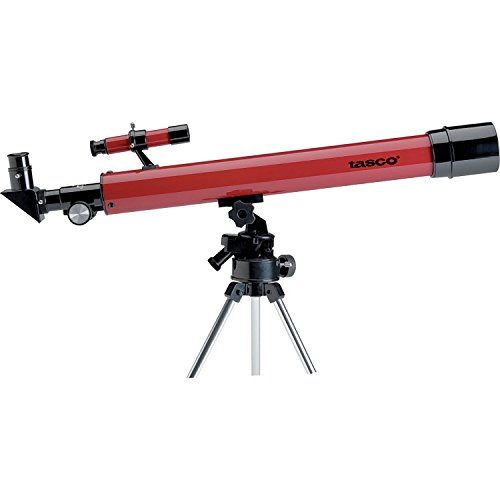 Best budget pickTasco Refractor Telescope (Novice)View on Amazon
- 4
 Best for smartphone-guided learningCelestron StarSense Explorer LT 80AZ Smartphone Guided Refractor TelescopeView on Amazon
Our Top Picks
Quick Comparison
| Product | Best for | Key feature |
|---|---|---|
| Tasco Spacestation 600 x 50mm Refractor Telescope | General beginner use | Compact 50mm refractor with wide-ranging magnification |
| TASCO Spacestation 70x800mm Refractor AZ | Stable viewing at higher magnification | 70mm objective, 800mm focal length, red dot finder |
| Tasco Refractor Telescope (Novice) | Simple first-time setup | Straightforward, low-complexity design |
| Celestron StarSense Explorer LT 80AZ | Learning the sky with a phone | Smartphone app sky navigation |
Tasco Spacestation 600 x 50mm Refractor Telescope, Astronomy Telescope for Adults and Beginners, Black
Tasco Spacestation 600 x 50mm Refractor Telescope, Astronomy Telescope for Adults and Beginners, Black
Best for: General beginner use with a compact, easy-to-carry refractor. Reflector or Refractor Telescope for Beginner: Which Should You Choose? goes further into this.
This is a good match for a first-time buyer who wants a small telescope to move between rooms, a backyard and the occasional trip. Its 50mm aperture is modest, so it favors bright targets such as the Moon, the planets and the brightest star clusters over faint galaxies.
Key specs
- Refractor optical design
- 50mm objective aperture
- Listed focal length of 600mm
- Designed for adults and beginners
Pros
- Lightweight and easy to store
- Quick to set up for casual sessions
- Good entry point for lunar observing
Cons
- Small aperture limits faint deep-sky viewing
- Stock eyepieces are basic, and many owners upgrade them
Bottom line: A sensible pick for someone who wants a light, uncomplicated first scope and expects to focus on the Moon and planets.
View on AmazonTASCO Spacestation 70x800mm Refractor AZ with Variable LED Red Dot Finderscope Telescope, Black
TASCO Spacestation 70x800mm Refractor AZ with Variable LED Red Dot Finderscope Telescope, Black, one Size (49070800)
Best for: Stable viewing at higher magnification with an altazimuth mount.
This model suits a buyer who wants a larger 70mm aperture and a longer focal length than the 50mm option, along with a red dot finder that makes pointing easier. The altazimuth mount moves up-down and left-right, which is intuitive for beginners.
Key specs
- 70mm objective aperture
- 800mm focal length
- AZ (altazimuth) mount
- Variable LED red dot finderscope
Pros
- Larger aperture collects more light than a 50mm refractor
- Red dot finder helps with locating targets
- Altazimuth mount is simple to learn
Cons
- Altazimuth mounts can be harder to track objects with at high power
- Higher magnifications will show more shake on lightweight tripods
Bottom line: A good choice for a beginner who wants more light and a finder that helps, and who is willing to nudge the mount by hand.
View on AmazonTasco Refractor Telescope (Novice)
Tasco Refractor Telescope (Novice)
Best for: Simple first-time setup on a limited budget.
This is the most straightforward option in this group, aimed at a household where a young or first-time observer wants to look through a telescope without sorting through many accessories or settings.
Key specs
- Refractor optical design
- Novice-level build intended for entry use
Pros
- Minimal setup and learning curve
- Budget-friendly category within the Tasco line
- Easy to hand to a child or family member
Cons
- Fewer specification details are published than for the other models
- Limited capability for demanding deep-sky work
Bottom line: Suited to a casual beginner who values ease over specifications and will mostly observe the Moon and bright planets.
View on AmazonCelestron StarSense Explorer LT 80AZ Smartphone Guided Refractor Telescope
Celestron StarSense Explorer LT 80AZ Smartphone Guided Refractor Telescope | Smartphone App Sky Navigation, Lightweight Manual Refractor Telescope, Perfect First Telescope, Great for Kids & Families
Best for: Learning the sky with smartphone app guidance.
This model is designed for someone who wants help identifying what is overhead. The smartphone app handles sky navigation, which can shorten the time it takes a new observer to find objects. It is a different kind of product from the Tasco models, but it is a natural comparison for buyers searching this category.
Key specs
- 80mm refractor optical design
- AZ mount
- Smartphone app sky navigation
Pros
- App guidance speeds up finding objects
- 80mm aperture gathers more light than the 50mm and 70mm Tasco models
- Lightweight, suited to families and children
Cons
- Relies on a smartphone and app for the guided features
- Higher-priced than the basic Tasco options in this comparison
Bottom line: The best fit for a buyer who wants a telescope that teaches as they go and is comfortable using a phone at the eyepiece.
View on AmazonBuying Guide
Aperture and light-gathering
Aperture is the diameter of the objective lens, and it sets how much light the telescope collects. A 50mm lens gathers less light than a 70mm or 80mm lens, which means fainter objects appear dimmer. For the Moon and planets, the difference matters less; for galaxies and nebulae, it matters more.
Good picks for this: Tasco Spacestation 600 x 50mm; Celestron StarSense Explorer LT 80AZ
Focal length and magnification
Magnification equals the telescope’s focal length divided by the eyepiece’s focal length. A longer focal length gives you more magnification range, but high power on a small telescope often shows less detail because of atmospheric steadiness. Start with low to medium power.
Good picks for this: TASCO Spacestation 70x800mm Refractor AZ; Tasco Spacestation 600 x 50mm
Mount type
Altazimuth mounts move up-down and left-right, which is intuitive. Equatorial mounts track the sky more smoothly but take longer to learn. Most Tasco models in this comparison use simple altazimuth designs, which suits beginners.
Good picks for this: TASCO Spacestation 70x800mm Refractor AZ; Tasco Refractor Telescope (Novice)
Finder scope and pointing aids
A finder scope or red dot finder helps you locate targets before you look through the main tube. A red dot finder is usually easier for beginners because you see the target as a dot in a wide field, not a small crosshair.
Good picks for this: TASCO Spacestation 70x800mm Refractor AZ; Celestron StarSense Explorer LT 80AZ
Portability and setup
Check the weight and tripod height before you buy. A lightweight refractor is easier to carry out to a dark site, but it can wobble at high magnification on a flimsy tripod. Look for a sturdy base if you plan to observe at higher power.
Good picks for this: Tasco Spacestation 600 x 50mm; Celestron StarSense Explorer LT 80AZ
Eyepieces and accessories
Stock eyepieces are often the weakest part of a beginner kit. Many owners add a better low-power eyepiece for wide views and a higher-power one for planets. Check whether the telescope accepts standard 1.25-inch eyepieces before buying extras.
Good picks for this: TASCO Spacestation 70x800mm Refractor AZ; Tasco Refractor Telescope (Novice)
Sky conditions and where you observe
Light pollution affects what any telescope can show. From a bright suburb, the Moon, planets and double stars look best. A dark rural site helps faint galaxies and nebulae, regardless of model.
Good picks for this: Celestron StarSense Explorer LT 80AZ; Tasco Spacestation 600 x 50mm
FAQ
Is a Tasco refractor good for beginners?
Yes, for many beginners. Refractors need little maintenance, give sharp views of the Moon and planets, and are easy to set up. Expect bright, high-contrast images rather than deep-sky spectacle.
What can I see with a 50mm refractor?
You can see the Moon’s craters and maria, the phases of Venus, the moons of Jupiter as points of light, and bright star clusters. Faint galaxies and nebulae will be hard to see from a city.
Does a bigger aperture always mean a better telescope?
Not always. A larger aperture gathers more light, but mount stability, optical quality and eyepieces matter too. A steady 70mm scope can outperform a wobbly larger one.
Do I need a red dot finder?
It is not required, but many beginners find it easier than a traditional finder scope because it shows the target as a dot in a wide field.
What magnification should I start with?
Start with low to medium power, around 25x to 50x, to find targets and frame them comfortably. Increase magnification only when the image stays steady and sharp.
Can I use a smartphone with the Celestron StarSense Explorer LT 80AZ?
Yes. The model uses a smartphone app for sky navigation, so you will need a compatible phone and the app installed.
Can these telescopes photograph the sky?
Basic smartphone holding and simple lunar photos are possible, but dedicated astrophotography usually requires a tracking mount and a camera adapter that these beginner models do not include.
Conclusion
For a balanced first scope, the Tasco Spacestation 600 x 50mm Refractor Telescope is a good overall fit, especially if you want something compact. If you want more light and a red dot finder, the TASCO Spacestation 70x800mm Refractor AZ is the better step up. The Tasco Refractor Telescope (Novice) suits the simplest possible start, while the Celestron StarSense Explorer LT 80AZ is the choice for someone who wants app-guided help finding objects. Match the model to what you most want to see and how much help you want while learning.
Sources
- Background on the Moon, planets and observing targets for beginners (nasa.gov)
- Guidance on choosing and using a first telescope
- Information on dark-sky conditions and light pollution at national park sites (nps.gov)
Related reading
- Tasco 800x60mm Novice Refractor Telescope: 4 Best Picks Compared (2026)
- iTek Refractor Telescope Review: Specs, Strengths and Who It Suits
- Wide Field Refractor Telescope Picks Compared for 2026
- Top 7 Refractor Telescope Solar Filters Compared for Safe Sun Viewing
- Top 6 APO Refractor Telescopes for Astrophotography Compared (2026)
- Sears Discoverer Equatorial Refractor Telescope: 3 Best Picks Compared (2026)
About Claire Whitaker
Claire Whitaker is part of our editorial team and reviews and edits our telescopes & stargazing guides, checking product details against manufacturer specifications and owner feedback.
About the author
Claire Whitaker writes reviews and buying guides for Astronomy Site.