Explore Scientific Dobsonian 10 Truss Tube Telescope Review (2026): Pros, Cons & Verdict
Explore Scientific dobsonian 10 truss tube telescope review: specs, pros and cons, performance, and who should buy this 10-inch f/5 Dobsonian or skip it.
 By Claire Whitaker
Updated November 24, 2026
 By Claire Whitaker
Updated November 2026
The explore scientific dobsonian 10 truss tube telescope is a 10-inch f/5 Newtonian reflector built on a collapsible truss tube and a Dobsonian alt-azimuth base. It is aimed at observers who want maximum light-gathering for deep-sky objects such as galaxies, nebulae and globular clusters, without paying for a computerized mount. It suits backyard observers with a dark-sky site, a bit of patience for setup, and room to store a bulky but break-down-able tube. It is a weaker choice for people who mainly want planetary detail at high power, who need to move the scope often across rough terrain, or who want automatic tracking for astrophotography.
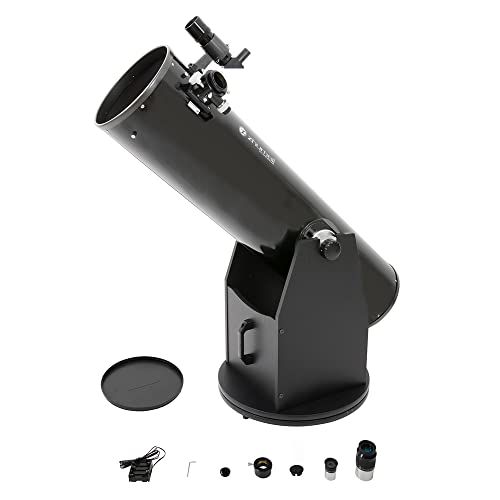
Explore Scientific 10 Inch f/5 Hybrid Truss Tube Dobsonian Telescope | 254mm Newtonian Reflector, Two Plossl Eyepieces, Red Dot Finder, Collimation Tool, Breaks Down Without Tools
Product Overview
This model is listed by Explore Scientific as a 10-inch (254mm) f/5 hybrid truss tube Dobsonian. The name on the Amazon listing describes a Newtonian reflector, which means light is collected by a concave primary mirror at the bottom of the tube and reflected to a diagonal secondary mirror near the front. The result is a bright, wide-field instrument that is well matched to deep-sky observing. The listing also includes two Plössl eyepieces, a red dot finder, and a collimation tool, so the box covers the basics of getting observing right away.
The truss design is the feature that defines this product. Instead of a solid tube, the optical assembly hangs between open lattice struts. This keeps weight and bulk down compared with a solid-tube 10-inch, and it lets air move through the optics so the mirror cools faster after you set up outdoors. The listing states that the scope breaks down without tools, which matters for transport and storage. Manufacturers generally specify that truss tubes are easier to carry in pieces than solid designs, although the total footprint still makes this a two-person lift when assembled and a vehicle-transport item for most owners.
The f/5 focal ratio is short for a Dobsonian of this aperture. A shorter focal ratio gives a wider true field and a brighter image at low power, which is useful for large, faint objects. The trade-off is that f/5 mirrors are more sensitive to collimation, meaning the mirrors must be aligned precisely to deliver sharp images. Owners who skip collimation often report softer stars and less contrast, so the included tool is not optional in practice.
Key Features & Specifications
The table below lists the specifications named in the product listing or commonly published for this design. Where a detail is not clearly stated, it has been left out rather than estimated.
| Feature | What it means for observing |
|---|---|
| Aperture: 10 inches (254mm) | Large light grasp for faint deep-sky targets; resolves more detail on bright planets at high power than smaller scopes |
| Focal ratio: f/5 | Short tube for its aperture; wide, bright low-power views; demands careful collimation |
| Design: Newtonian reflector, truss tube | Open lattice tube that is lighter and less bulky than solid tubes; faster air exchange |
| Mount: Dobsonian alt-azimuth base | Simple up-down and side-to-side motion; no motors or electronics; manual tracking only |
| Eyepieces: two Plössl eyepieces (included) | Usable starting magnification; higher-power eyepieces are a common later upgrade |
| Finder: red dot finder (included) | Helps locate targets before using the eyepiece; no magnification |
| Collimation tool (included) | Used to align the mirrors, which is necessary for sharp views |
| Assembly: breaks down without tools | Simplifies transport and storage; still a multi-step assembly |
For readers new to Dobsonians, the base is the piece that decides how comfortable the scope feels night to night. Manufacturers typically describe the Dobsonian base as a low-cost, rigid alt-azimuth mount that favors deep-sky viewing. It is not designed for tracking; you nudge the scope by hand as objects drift. If you want to understand this trade-off in more depth, Dobsonian Telescope Pros and Cons: What to Know Before You Buy walks through the same mechanics in plain language.
Pros & Cons
Pros
- 10-inch aperture gathers substantially more light than 6- or 8-inch Dobsonians, which helps with faint galaxies and nebulae.
- f/5 focal ratio gives wide, bright low-power views that are well suited to scanning the Milky Way and large star clusters.
- Truss tube design reduces weight and bulk compared with a solid-tube 10-inch and lets air cool the mirror more quickly.
- Breaks down without tools, which makes transport and storage more manageable than many one-piece scopes.
- Includes two eyepieces, a red dot finder and a collimation tool, so you have what you need to begin observing.
- No electronics or batteries to fail; the Dobsonian base is mechanically simple.
Cons
- f/5 optics are demanding; collimation must be checked regularly, and misalignment shows up as soft stars.
- Manual tracking only. Objects drift out of the eyepiece quickly at high power, and the scope is not suited to astrophotography without an add-on tracking system.
- Large footprint once assembled; carrying it outdoors is a two-person task for most adults.
- Included eyepieces are a starting point, and owners commonly report wanting better or higher-power eyepieces for planetary work.
- Not a good match for portable, travel-first observing or for users who need goto pointing.
Performance Analysis
Performance on this telescope follows from its specifications. Aperture is the first factor. A 10-inch mirror collects roughly twice the light of an 8-inch in terms of area, which shows up as more visible faint galaxies, more stars resolved in globular clusters, and more structure in bright nebulae. Under dark skies, owners tend to describe the Milky Way as striking through this scope, with dust lanes and star-cloud texture visible in wide fields.
Planetary observing is a different story. Resolution depends on aperture, and a 10-inch can show cloud belts on Jupiter and the Cassini Division in Saturn’s rings when seeing is steady. Those views are limited by the atmosphere and by the power you use. Many observers find that the included eyepieces give adequate starting magnification, but planetary detail generally improves with shorter focal-length eyepieces. Expect planets to look smaller and less crisp than deep-sky targets look bright.
Collimation is the variable most often linked to disappointing results. An f/5 Newtonian with a slightly misaligned mirror can produce coma (comet-shaped stars toward the edge of the field) and reduced contrast. Owners who learn to collimate with the included tool, usually checking before each session, report noticeably sharper stars. Those who skip this step often blame the optics when the fix is a few minutes of adjustment.
Setup and handling affect the observing session as much as the optics do. A truss tube cools faster than a solid tube, which helps reduce mirror-seeing turbulence after moving the scope outside. Still, owners generally recommend giving the scope 30 to 60 minutes to reach ambient temperature on cold nights before serious observing. The Dobsonian base is stable, but at high magnification even small vibrations are amplified, so placing the scope on firm ground and avoiding bumps during focus adjustments improves results.
Who Should Buy This Product?
This telescope is best for someone who wants to see deep-sky objects in as much detail as a large, portable reflector allows. Backyard observers with dark skies will get the most from it, especially those who enjoy star-hopping with a finder and star chart. It also suits families and small observing groups who want a scope that shows impressive views of the Milky Way, the Orion Nebula, and globular clusters.
It is a poor match for users who primarily image the sky with a camera, since the Dobsonian mount does not track. It is also not ideal for those who observe from apartments, travel frequently, or live where dark sites are hours away. Anyone who wants push-to goto convenience should look at a computerized Dobsonian instead, which trades simplicity for automatic object location.
Buying Guide
Before buying any 10-inch Dobsonian, think through five questions: where you will observe, how you will transport the scope, what you want to see, how much setup you are willing to do, and whether you expect to add accessories. A 10-inch is a commitment in size and weight, so it works best when the scope lives in a garage, shed or closet near your observing site.
Check the focal ratio and what it means for your habits. f/5 is bright and wide but less forgiving of collimation errors. If you prefer forgiving optics for general use, a longer focal ratio may suit you better, though it will give a narrower field. Also check whether the base and tube are sold as a complete unit, since some sellers list accessories separately.
Consider the included eyepieces as a starting point. Most observers eventually add shorter focal-length eyepieces for planets and a wide-field eyepiece for large clusters. Budget for those as part of the overall plan, not as an afterthought. Also plan for a sturdy observing chair or stool; a 10-inch focuser sits high, and comfortable viewing matters over long sessions.
If you want alternatives in the same aperture class, two well-known options are worth comparing:
- Sky-Watcher Classic 250 Dobsonian 10-inch Telescope – A solid-tube 10-inch Dobsonian with a traditional, simple design. Owners often describe it as an easy-to-use choice for beginners who prefer a rigid tube over a truss. Compare it if you want less assembly and a heavier, more stable build.

Sky Watcher Sky-Watcher Classic 250 Dobsonian 10-inch Telescope – Solid-Tube – Simple, Traditional Design – Easy to Use, Perfect for Beginners (S11620)
- Zhumell 10-inch Dobsonian Reflector Telescope – A 10-inch Dobsonian reflector with a solid base and a handle for transport, aimed at bright, crisp deep-sky views. Compare it if handling and a sturdy base are your priorities.
Zhumell – 10-inch Dobsonian Reflector Telescope – Large Aperture for Crisp, Bright Images – Solid Base Construction with Handle for Easy Transport – Ideal Astronomical Telescope
For more context on choosing between tube styles and mirror designs, Dobsonian or Newtonian Telescope (2026): Which Should You Choose? lays out the decision in practical terms. Readers exploring the broader Dobsonian category may also find Dobsonian Telescope for Sale UK: 7 Best Picks Compared (2026) useful for comparing sizes and mount designs.
FAQ
Is a 10-inch Dobsonian too big for a beginner?
Not necessarily, but it is more demanding than a 6- or 8-inch. The scope is large and needs two people to carry comfortably. Beginners who have space and a car for transport often find the extra light worth the effort. Those who observe from a small balcony or cannot move the scope easily may do better with a smaller model.
Does this telescope need collimation?
Yes. Like most Newtonian reflectors, it benefits from regular collimation. The included collimation tool is designed for this, and owners generally recommend checking alignment before each observing session, especially after transport.
Can I use this telescope for astrophotography?
Basic lunar and planetary imaging is possible with a camera adapter, but deep-sky photography usually requires a tracking mount because the Dobsonian base moves by hand. Owners who want to image should plan on a motorized tracking solution or a different scope design.
What eyepieces should I buy first?
Owners commonly report starting with a low-power eyepiece for wide-field viewing and adding a higher-power eyepiece for planets and double stars. The included Plössl eyepieces are a practical starting point, and upgrades can be made gradually. Worth reading next: Telescope Digital Electronic Eyepiece Camera for Astrophotography Usb Port (2026): Pros, Cons & Verdict.
Does the truss tube affect image quality?
The truss design does not change the optical quality of the mirrors. Its main effects are lower weight, faster cooling and easier transport. Some observers note that the open structure can allow more stray light, so using a light shield or observing from a shaded spot can help.
How long does setup take?
Assembly is multi-step but does not require tools, according to the product listing. Most owners plan on several minutes for the first assembly and less time once they are familiar with the process. Allow extra time for the scope to cool before serious viewing.
Do I need a dark sky to enjoy it?
A dark site makes a large difference for deep-sky objects. Under light-polluted skies, the 10-inch still shows bright targets like the Moon, planets and some star clusters, but fainter galaxies and nebulae are much harder to see. A dark-sky site, even an hour’s drive away, is worth planning for.
Related reading
- 5 Best Explore Scientific Ed127 Triplet Refractor Telescopes (2026): Our Picks
- Who Makes the Best Dobsonian Telescope? 5 Top Picks Compared (2026)
- Taking Photos with a Dobsonian Telescope: 3 Best Picks for Beginners (2026)
About Claire Whitaker
Claire Whitaker is part of our editorial team and reviews and edits our telescopes & stargazing guides, checking product details against manufacturer specifications and owner feedback.
About the author
Claire Whitaker writes reviews and buying guides for Astronomy Site.