5 Best 80mm Refractor Telescopes: Top Picks Compared for 2026
Looking for the best 80mm refractor telescope? Compare five models by optics, mount and use case to find the right fit for planets, the Moon or deep sky.
 By Claire Whitaker
Updated November 18, 2026
 By Claire Whitaker
Updated November 2026
Shopping for the best 80mm refractor telescope comes down to three things: how well the optics suit your targets, whether the mount holds steady at high power, and how portable the setup is. This list compares five 80mm refractors on those points, with notes on who each one suits and where it falls short.
Best overall: Celestron PowerSeeker 80EQ – View on Amazon
Best for deep-sky imaging: SVBONY SV503 ED – View on Amazon
Best for astrophotography: SVBONY SV550 AP0 – View on Amazon
Best for travel: 80mm Travel Refractor Backpack Kit – View on Amazon
Best for beginners using a phone: Celestron StarSense Explorer LT 80AZ – View on Amazon
Our Top Picks
| Product | Best for | Key feature |
|---|---|---|
| Celestron PowerSeeker 80EQ | Moon and planet viewing | Equatorial mount tracking |
| SVBONY SV503 ED | Deep-sky observing | Field flattener included |
| SVBONY SV550 AP0 | Astrophotography | Apochromatic triplet optics |
| 80mm 600mm Travel Refractor | Portable use | Backpack-friendly build |
| Celestron StarSense Explorer LT 80AZ | First-time users | Smartphone sky navigation |
Celestron PowerSeeker 80EQ
Celestron PowerSeeker 80EQ Refractor Telescope for Moon & Planet Viewing | Large 80mm Refractor, Bright Views of the Best Celestial Objects, Smooth Equatorial Tracking, Stable Tripod, Easy to Use
Best for: Moon and planet viewing
This suits someone who wants a stable, traditional refractor for bright targets and is willing to learn equatorial mount basics. Owners often report that the mount tracks objects smoothly once aligned.
Pros
- Equatorial mount follows objects across the sky
- Large 80mm aperture gives bright, sharp views of the Moon
Cons
- Setup takes longer than an alt-azimuth mount
SVBONY SV503 ED

SVBONY SV503 Upgraded ED Refractor Telescope, 80mm F7 with Field Flattener | OTA with 0.8X Focal Reducer, Faster Imaging & Clear Edge-to-Edge, Telescope for Adults Deep-Sky Astronomical Observation
Best for: Deep-sky observing
This fits an observer who wants wider, flatter fields for star clusters and nebulae. The included field flattener and 0.8X reducer are designed to keep stars sharp toward the edge of the view.
Pros
- Field flattener and reducer improve edge-to-edge sharpness
- Shorter focal ratio gives wide, bright views
Cons
- Listed as an optical tube, so you will need a mount
SVBONY SV550 AP0
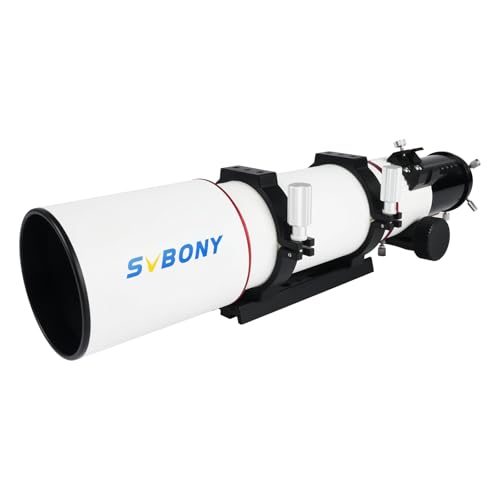
SVBONY SV550 AP0 Telescope, 80mm ED F6 Triplet Apochromatic Refractor OTA | "2.5"" Micro-Reduction Rap Focuser, 87mm Back Focus Distance, Telescope for Adults for Deep Sky Astrophotography & Visual "
Best for: Astrophotography
This is aimed at imagers who need controlled color and a long back focus for cameras and accessories. The triplet apochromatic design is built to limit false color on bright stars.
Pros
- Apochromatic triplet design reduces color fringing
- Focuser and back-focus distance suit camera setups
Cons
- Requires a sturdy mount and imaging accessories to get the most out of it
80mm 600mm Travel Refractor Backpack Kit

Telescopes for Adults Astronomy, 80mm Aperture 600mm Refractor Telescope for Kids & Beginners, Compact and Portable Travel Telescopio with Backpack
Best for: Portable use
This suits families or travelers who want a compact scope that fits in a bag and can be set up quickly away from home. Its 600mm focal length keeps the tube short.
Pros
- Compact tube and included backpack for transport
- Quick setup for impromptu viewing
Cons
- Lightweight tripods can wobble at higher magnification
Celestron StarSense Explorer LT 80AZ

Celestron StarSense Explorer LT 80AZ Smartphone Guided Refractor Telescope | Smartphone App Sky Navigation, Lightweight Manual Refractor Telescope, Perfect First Telescope, Great for Kids & Families
Best for: First-time users
This is for beginners who want help finding objects without learning star charts. The smartphone app guides you to targets, which many new owners find reduces frustration on the first few nights.
Pros
- Smartphone app helps locate objects in the sky
- Lightweight alt-azimuth mount is simple to use
Cons
- Phone must be charged and the app kept updated
Buying Guide
Optical quality
Look for a doublet or triplet lens design, since these reduce false color around bright objects. Apochromatic (APO) and ED glass typically cost more to make but give cleaner images at high power.
Mount type
An alt-azimuth mount is quick to set up and easy for beginners. An equatorial mount tracks objects more smoothly but takes practice to align.
Focal length and magnification
An 80mm aperture at 600mm focal length gives a wide, bright field for low-power viewing. Higher magnification needs better eyepieces and a steadier mount.
Portability
If you plan to observe away from home, weigh the tube and tripod together. A compact tube paired with a light tripod is easier to carry.
Good picks for this: Celestron PowerSeeker 80EQ and 80mm 600mm Travel Refractor
FAQ
Is an 80mm refractor good for beginners?
Yes. An 80mm aperture collects enough light to show the Moon, bright planets and many star clusters clearly, and it is compact enough to use often.
Can I photograph the night sky with an 80mm refractor?
You can, especially with an apochromatic model and a sturdy mount. Simple phone or camera adapters work for the Moon, while deep-sky imaging needs a tracking mount.
Do I need a solar filter with an 80mm refractor?
Yes, you must use a certified full-aperture solar filter to view the Sun. Never look at the Sun through a telescope without one, and consult the manufacturer’s safety instructions before observing.
Related reading
- Meade 80mm Refractor Telescope: 5 Best Picks Compared for 2026
- 4 Best Orion Short Tube Refractor Telescope 80mm Picks for Beginners (2026)
- 4 Best Orion Goscope 80mm Backpack Refractor Telescopes (2026): Our Picks
About Claire Whitaker
Claire Whitaker is part of our editorial team and reviews and edits our telescopes & stargazing guides, checking product details against manufacturer specifications and owner feedback.
About the author
Claire Whitaker writes reviews and buying guides for Astronomy Site.