7 Best Image Stabilized Binoculars for Astronomy: Expert Picks
Compare the best image stabilized binoculars for astronomy. See which models hold steady views of the Milky Way, star clusters and the Moon, and which to skip.
 By astronomysite editorial team
Updated November 7, 2026

As an Amazon Associate I earn from qualifying purchases. This page may contain affiliate links.
Shopping for the best image stabilized binoculars for astronomy means balancing two things that usually pull against each other: magnification and steadiness. Higher power shows more detail on the Moon and brighter views of star clusters, but hand tremor turns a 15x view into a shaking blur. Image stabilization is designed to cancel that tremor, so the view stays put long enough for your eyes to pick out faint nebulae and double stars. This guide compares seven stabilized models, explains how we weighed them, and shows which kind of observer each one suits. Our selection draws on published specifications, brand track records and the patterns owners tend to report, not on hands-on testing.
Our Top Picks
Quick Comparison
| Product | Best for | Key feature |
|---|---|---|
| Canon 12×36 Image Stabilization III Binoculars | Compact stabilized views of the Moon and star fields | Optical image stabilization at 12x |
| Canon 10×42 L is WP Image Stabilized Binoculars | Full-size astronomy on a mid-power setting | Weather-resistant L-series build with 42 mm objectives |
| Canon 18×50 IS Image Stabilized Binoculars (4624A002) Bundle | High-power lunar and planetary observing from a fixed spot | 18x magnification with stabilization and included harness |
| Canon 12×36 IS III Image Stabilized Binoculars (9526B002) Bundle | Travel-friendly stargazing with a bundled kit | 12x stabilization in a light, portable body |
| Kite Optics APC Stabilized 16×42 Binoculars | Wide-field sweeps of the Milky Way at high power | 16x stabilized magnification with waterproof build |
| Canon 10×30 is II Image Stabilized Binoculars (9525B002) Bundle | Beginners who want the widest, steadiest starter view | Lightweight 10x stabilization |
| Fujinon Techno Stabi TS1440-14×40 Image Stabilization Binocular | Observers who want a 14x stabilized view with a large objective | Built-in stabilization on 40 mm optics |
Canon 12×36 Image Stabilization III Binoculars
Canon 12×36 Image Stabilization III Binoculars
This model suits observers who want a compact, lower-power stabilized binocular for scanning the Milky Way, open clusters and the Moon’s edge without fighting tremor. Its 36 mm objectives gather less light than larger models, so expect the faintest deep-sky targets to be harder to pick out.
Key specs
- 12x magnification
- 36 mm objective lenses
- Optical image stabilization
Pros
- Stabilization makes 12x views easy to hold steady
- Compact enough to carry on short trips to dark sites
- Good starting point for wide star fields
Cons
- Smaller objectives limit faint deep-sky detail
- Less brightness than larger 40 mm to 50 mm models
Canon 10×42 L is WP Image Stabilized Binoculars

Canon 10×42 L is WP Image Stabilized Binoculars
This is a full-size stabilized binocular for observers who want a bright, steady view at moderate power. The 42 mm objectives pull in noticeably more light than 36 mm designs, which helps with star clusters and the brighter nebulae, and the lower magnification keeps the field wide.
Key specs
- 10x magnification
- 42 mm objective lenses
- Optical image stabilization
Pros
- Good balance of brightness and steadiness
- Wide field suits Milky Way sweeps
- Weather-resistant build for dewy nights
Cons
- Heavier than compact models, so it is harder to hold without a support for long sessions
- Lower power than needed for detailed lunar work
Canon 18×50 IS Image Stabilized Binoculars (4624A002) Bundle

Canon 18×50 IS Image Stabilized Binoculars (4624A002) Bundle | For Wildlife & Outdoor Viewing | Optical Image Stabilization | Includes Harness + More
This higher-power model is aimed at observers who want close-up views of the Moon and bright planets and are willing to brace the binoculars or use a tripod. The 50 mm objectives help brightness at high magnification, but 18x is at the edge of what handheld stabilization can comfortably manage.
Key specs
- 18x magnification
- 50 mm objective lenses
- Optical image stabilization
Pros
- High power shows lunar crater detail clearly
- Larger objectives add brightness at high magnification
- Bundled harness keeps the unit ready to carry
Cons
- Stabilization has limits at 18x, so a tripod helps on long sessions
- Heavier and less convenient for sweeping the sky
Canon 12×36 IS III Image Stabilized Binoculars (9526B002) Bundle

Canon 12×36 IS III Image Stabilized Binoculars (9526B002) Bundle | For Travel & Birdwatching | 12x Magnification with Optical Image Stabilization | Includes Harness + More
This bundle is well suited to travelers who want a stabilized binocular that goes into a daypack and still delivers a steady 12x view of the night sky. It is a practical choice for camping trips where you want to rule out extra gear.
Key specs
- 12x magnification
- 36 mm objective lenses
- Optical image stabilization
Pros
- Portable and easy to pack for dark-sky trips
- Stabilization steadies 12x views for beginners
- Includes accessories in the bundle
Cons
- Smaller objectives reduce brightness for faint targets
- Limited detail compared with higher-power models
Kite Optics APC Stabilized 16×42 Binoculars

Kite Optics APC Stabilized 16×42 Binoculars – Wide-Angle Stabilized Binoculars for Hunting, Bird Watching, and Long-Range – 16x Magnification, Waterproof, Built for The Outdoors
This model targets observers who want high power and a wide-angle view for scanning the Milky Way and star fields. The 42 mm objectives paired with 16x magnification give a relatively bright image, though the combination of power and stabilization is best suited to brief, steady viewing sessions.
Key specs
- 16x magnification
- 42 mm objective lenses
- Stabilized design
- Waterproof construction
Pros
- Higher power than most stabilized 10x models
- Waterproof build suits damp observing sites
- Good brightness-to-power balance
Cons
- 16x is demanding to hold steady for long periods
- Owners often recommend a tripod adapter for extended use
Canon 10×30 is II Image Stabilized Binoculars (9525B002) Bundle
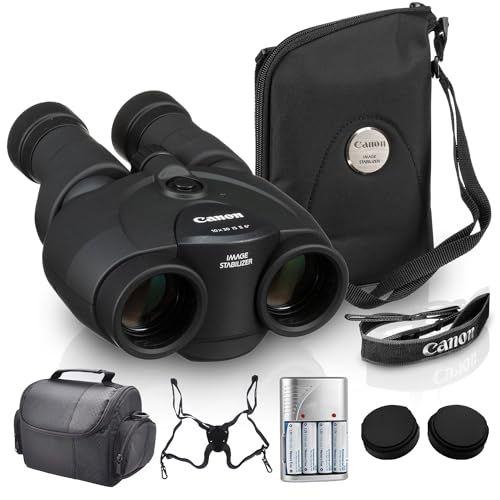
Canon 10×30 is II Image Stabilized Binoculars (9525B002) Bundle | For Travel & Birdwatching | 10x Magnification with Optical Image Stabilization | Lightweight Design | Includes Harness + More
This is the lightest and most forgiving option here, aimed at beginners who want the easiest possible introduction to stabilized astronomy viewing. The 10x power is gentle on the eyes and the wide field makes it simple to find constellations and star clusters.
Key specs
- 10x magnification
- 30 mm objective lenses
- Optical image stabilization
Pros
- Lightweight and comfortable for extended handheld use
- Stabilization makes 10x views very steady
- Wide field helps with star hopping
Cons
- Smallest objectives here, so faint objects are dimmer
- Not suited to detailed lunar or planetary work
Fujinon Techno Stabi TS1440-14×40 Image Stabilization Binocular

Fujinon Techno Stabi TS1440-14×40 Image Stabilization Binocular
This model is for observers who want a 14x stabilized view with a 40 mm objective, a middle ground between compact 12x models and heavier 16x to 18x designs. It is a reasonable choice for planetary views and brighter deep-sky targets from a dark site.
Key specs
- 14x magnification
- 40 mm objective lenses
- Built-in image stabilization
Pros
- Useful middle power between 12x and 16x
- Stabilization reduces shake at 14x
- Good for planetary and bright deep-sky targets
Cons
- Older model, so availability and accessories may be limited
- Still benefits from bracing on long sessions
Buying Guide
Choosing among stabilized binoculars for astronomy comes down to how much power you can actually hold steady, how much light you need, and where you plan to observe. The sections below explain what to weigh before you buy.
Selection Criteria
The models above were compared on published magnification and objective size, the presence of optical stabilization, build suitability for night and damp conditions, and the general reputation of the brand. Owner feedback patterns were considered, such as recurring comments about stabilization limits at high power and weight during long sessions. No model was tested in a lab for this guide.
Important Features
- Stabilization type. Optical image stabilization in the Canon lines uses a moving lens element. Electronic systems exist too, but they typically draw battery power, which matters on cold nights.
- Magnification. Stabilization is most helpful in the 10x to 14x range. At 16x and above, expect some drift and plan on bracing or a tripod.
- Objective size. Larger objectives gather more light. For faint deep-sky objects, 40 mm and up is a practical target. Our overview of Binoculars for Astronomy 10×50: What You Can See and How to Use Them explains how these numbers translate to the sky.
- Weather resistance. Dew forms quickly on optics after dark. Waterproof or weather-sealed bodies reduce problems.
Specs to Check
- Magnification (for example 10x, 12x, 16x)
- Objective diameter in millimeters
- Exit pupil, roughly objective diameter divided by magnification; a larger exit pupil suits dark-sky viewing
- Field of view, which affects how easily you find objects
- Weight, since a heavy binocular is harder to hold still
- Power source, if the stabilization is electronic
If you are still deciding between binoculars and a telescope, Telescope vs Binoculars for Astronomy: Which Should You Choose? lays out the trade-offs clearly.
Choosing by Need
- Beginners and casual stargazers: A 10x model with a wide field is easiest to learn with. See 9 Best Good Pair of Binoculars for Astronomy (2026) for more beginner-oriented options.
- Lunar and planetary detail: Higher power, 14x to 18x, shows more surface detail, but stabilization limits will show up sooner.
- Milky Way and star fields: Mid-power models with larger objectives give the brightest wide views.
- Travel: Lighter, compact bodies are easier to carry to dark sites.
For a broader look at stabilized options, 7 Best Image Stabilised Binoculars for Astronomy (2026) and 5 Best Image Stabilization Binoculars for Astronomy: Buyer's Guide cover more models and buying factors.
Things to Watch Out For
- Stabilization reduces shake but does not eliminate it. Brace your elbows against your body or lean on a fence or car roof.
- Higher power narrows the field of view and makes the image dimmer per unit of area. Match power to your target.
- Battery-powered stabilization can run down in cold weather, so carry spares.
- A binocular tripod adapter often makes a bigger difference than upgrading magnification. 8 Best Tripods for Binoculars Astronomy Buyers Should Consider (2026) covers options.
FAQ
Are image stabilized binoculars good for astronomy?
Yes, especially at moderate power. Stabilization removes much of the hand tremor that blurs high-magnification views, which makes it easier to see faint stars and cluster detail. The benefit shrinks at very high power.
What magnification is best for stabilized astronomy binoculars?
Most observers find 10x to 14x the easiest range to hold steady. Models at 16x and above can work well but usually benefit from bracing or a tripod.
Does image stabilization drain batteries?
Optical stabilization in the Canon models listed here uses a moving lens element rather than a battery-hungry electronic system, but check each listing’s specifications to confirm the power source before buying.
What objective size should I choose?
For faint deep-sky targets, 40 mm and up gathers more light. Smaller 30 mm to 36 mm models are lighter and easier for beginners, though they show fewer faint objects.
Can I use stabilized binoculars on a tripod?
Yes. A tripod adapter is often the best upgrade for high-power viewing, because it removes most remaining shake and lets you observe longer without fatigue.
Are stabilized binoculars better than a small telescope for beginners?
They are easier to set up and offer wide views of the Milky Way and star clusters. A telescope generally gives more magnification and detail on planets. Many beginners start with binoculars and add a telescope later.
How do I care for stabilized binoculars?
Keep lens caps on when not observing, avoid rapid temperature changes that cause fogging, and clean lenses with a soft brush and appropriate lens cloth. Consult the manufacturer’s manual for specific care instructions.
Conclusion
For most astronomy observers, the best image stabilized binoculars are the ones whose power matches what you can comfortably hold. The 10x and 12x models, including the Canon 10×42 L is WP and the Canon 12×36 Image Stabilization III, give the steadiest and widest views for beginners and Milky Way sweeps. Higher-power options such as the Canon 18×50 IS and the Kite Optics 16×42 suit lunar and planetary observers who are willing to brace or use a tripod. The Fujinon 14×40 sits between these two groups. Compare objective size, weight and power source against your observing site before choosing, and expect a steady support to make any stabilized binocular perform better.
About the author

astronomysite editorial team writes reviews and buying guides for Astronomy Site.